Cambodia Industrial Machinery Market Size, Share & Growth Rate
The Cambodia Industrial Machinery Market was estimated at USD 221 Million in 2025 and is projected to reach USD 242 Million by 2032, growing at a CAGR of 1.3% from 2026 to 2032. This growth trajectory is driven by the robust expansion of the manufacturing and construction sectors, as businesses increasingly invest in advanced machinery to enhance production efficiency and optimize quality control. Moreover, the rising adoption of automation technologies is reshaping the landscape, further propelling demand across various industries.
Cambodia Industrial Machinery Market Year-wise Growth Rate and Key Drivers
This graph highlights how the Cambodia Industrial Machinery Market has steadily grown over the years, supported by major growth factors.
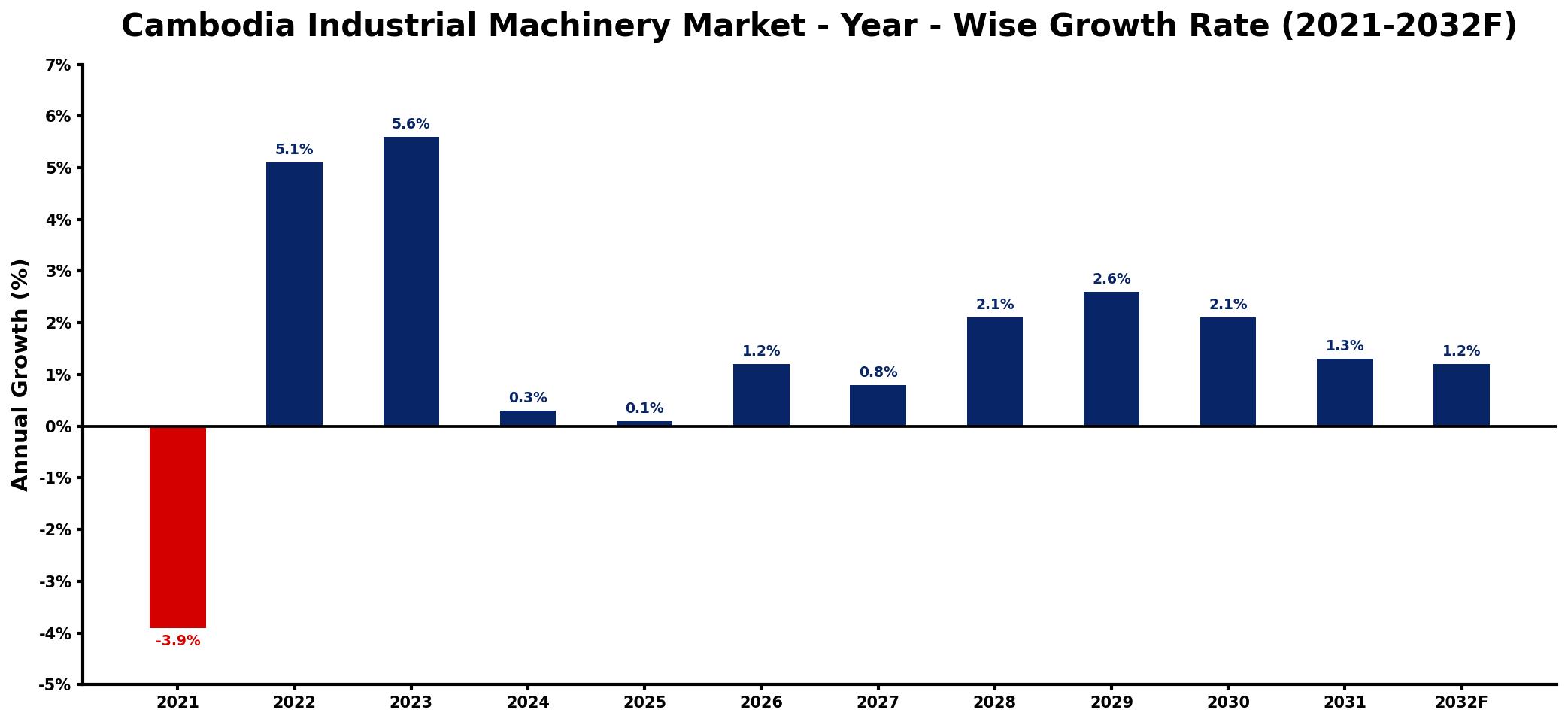
The table below presents the year‑wise growth rates along with the key drivers influencing the market
| Year | Growth Rate | Major Drivers |
| 2021 | -3.9% | decreased foreign investments in sector |
| 2022 | 5.1% | rise in construction project investments |
| 2023 | 5.6% | growth in manufacturing sector output |
| 2024 | 0.3% | increased demand for automation solutions |
| 2025 | 0.1% | expansion of renewable energy projects |
| 2026 | 1.2% | boost in agricultural technology adoption |
| 2027 | 0.8% | development of logistics infrastructure projects |
| 2028 | 2.1% | surge in export-oriented industries |
| 2029 | 2.6% | enhancement of local supply chains |
| 2030 | 2.1% | rising focus on sustainability practices |
| 2031 | 1.3% | improved processing technologies adoption |
| 2032 | 1.2% | increased domestic production output |
Note: Market size estimations and growth projections presented in this report are based on 6Wresearch's proprietary forecasting methodology, utilizing the latest available industry data, government publications, and primary research inputs.
Cambodia Industrial Machinery Market Synopsis
The Cambodia Industrial Machinery Market is currently experiencing significant momentum, influenced by a burgeoning manufacturing sector and a growing emphasis on infrastructure development. Organizations are increasingly recognizing the importance of integrating advanced machinery to meet rising production demands and improve operational efficiencies.
Notably, the trend towards automation is not only streamlining processes but is also enhancing the quality of output. As Cambodian industries strive to remain competitive on the global stage, the move towards adopting cutting-edge technologies has become a strategic priority for many enterprises.
Cambodia Industrial Machinery Market Key Takeaways
- The market is projected to reach USD 242 Million by 2032, underscoring its growth potential.
- Adoption of automation technologies is significantly influencing market dynamics.
- Government initiatives focused on innovation are creating a favorable environment for machinery investments.
- Manufacturing and construction sectors are the primary drivers of machinery demand.
- Ongoing technological advancements are enhancing machinery performance and reliability.
Evaluation of Restraints in Cambodia Industrial Machinery Market
Despite the promising growth, the Cambodia Industrial Machinery Market faces several challenges. Key among these is the need to ensure machinery reliability and optimize performance. Manufacturers often grapple with maintaining the efficiency of their equipment, which can result in increased operational costs and downtime. Furthermore, there is a pressing requirement to promote advanced manufacturing technologies, as the competition intensifies within the sector. This dual challenge of meeting maintenance needs while adapting to evolving market demands can create hurdles for sustained growth.
Cambodia Industrial Machinery Market Trends
A notable trend shaping the Cambodia Industrial Machinery Market is the integration of smart technologies in machinery. This includes IoT connectivity and data analytics, enabling real-time monitoring and predictive maintenance. Additionally, there is a growing focus on sustainability, with manufacturers seeking equipment that adheres to environmental regulations and promotes energy efficiency. These trends are not just enhancing operational efficiency but also aligning with global sustainability goals.
Cambodia Industrial Machinery Market Opportunities
The potential for growth within the Cambodia Industrial Machinery Market is substantial. Opportunities lie particularly in sectors such as textile manufacturing, food processing, and renewable energy. Investment in automation and advanced manufacturing processes is expected to yield considerable returns, especially as businesses seek to enhance productivity and reduce costs. Furthermore, as the Cambodian economy continues to evolve, the demand for innovative machinery solutions is likely to rise, paving the way for new entrants and technology providers.
Government Initiatives in the Cambodia Industrial Machinery Market
The Cambodian government is actively engaged in initiatives aimed at fostering technological innovation within the industrial machinery sector. Policies promoting productivity and competitiveness are being implemented, alongside regulations focused on machinery safety and performance standards. Moreover, the government is encouraging research and development in machinery technologies while offering incentives for businesses to adopt advanced solutions. These efforts are crucial in enhancing the industrial landscape and contributing to economic growth.
Future Insights of the Cambodia Industrial Machinery Market
Looking ahead to 2026-2032, the Cambodia Industrial Machinery Market is poised for steady growth. As industries increasingly embrace automation and advanced technologies, demand for high-quality machinery is expected to surge. The focus on innovation and productivity, paired with government support, will likely create a favorable environment for further investments. Consequently, the market is anticipated to evolve, offering diverse opportunities for stakeholders and paving the way for sustained economic development.
Cambodia Industrial Machinery Market Latest Developments (2025 - 2026)
Recent developments within the Cambodia Industrial Machinery Market have highlighted a shift towards integrating smart technologies in machinery solutions. Companies are increasingly focusing on machine interoperability and enhancing automation capabilities to improve productivity. Moreover, ongoing dialogues among industry stakeholders are promoting collaboration for innovation, leading to the introduction of advanced machinery tailored to local needs. This dynamic landscape indicates a robust commitment to evolving technological standards across the sector.
Cambodia Industrial Machinery Market - Key Attractiveness of the Report
- 10 Years of Market Numbers
- Historical Data Starting from 2022 to 2025
- Base Year: 2025
- Forecast Data until 2032
- Key Performance Indicators Impacting the Market
- Major Upcoming Developments and Projects
Key Highlights of the Report:
- Cambodia Industrial Machinery Market Outlook
- Market Size of Cambodia Industrial Machinery Market, 2025
- Forecast of Cambodia Industrial Machinery Market, 2032
- Historical Data and Forecast of Cambodia Industrial Machinery Revenues & Volume for the Period 2022-2032F
- Cambodia Industrial Machinery Market Trend Evolution
- Cambodia Industrial Machinery Market Drivers and Challenges
- Cambodia Industrial Machinery Price Trends
- Cambodia Industrial Machinery Porter's Five Forces
- Cambodia Industrial Machinery Industry Life Cycle
- Historical Data and Forecast of Cambodia Industrial Machinery Market Revenues & Volume By Application for the Period 2022-2032F
- Historical Data and Forecast of Cambodia Industrial Machinery Market Revenues & Volume By Agriculture for the Period 2022-2032F
- Historical Data and Forecast of Cambodia Industrial Machinery Market Revenues & Volume By Construction for the Period 2022-2032F
- Historical Data and Forecast of Cambodia Industrial Machinery Market Revenues & Volume By Packaging for the Period 2022-2032F
- Historical Data and Forecast of Cambodia Industrial Machinery Market Revenues & Volume By Food Processing for the Period 2022-2032F
- Historical Data and Forecast of Cambodia Industrial Machinery Market Revenues & Volume By Mining for the Period 2022-2032F
- Historical Data and Forecast of Cambodia Industrial Machinery Market Revenues & Volume By Semiconductor Manufacturing for the Period 2022-2032F
- Cambodia Industrial Machinery Import Export Trade Statistics
- Market Opportunity Assessment By Application
- Cambodia Industrial Machinery Top Companies Market Share
- Cambodia Industrial Machinery Competitive Benchmarking By Technical and Operational Parameters
- Cambodia Industrial Machinery Company Profiles
- Cambodia Industrial Machinery Key Strategic Recommendations






































