Cambodia Kosher Food Market Size, Share & Growth Rate
The Cambodia Kosher Food Market was estimated at USD 356 Million in 2025 and is projected to reach USD 468 Million by 2032, growing at a CAGR of 4.0% from 2026 to 2032. This growth trajectory is significantly influenced by the increasing cultural diversity within Cambodia, which has led to a burgeoning demand for kosher-certified products. Additionally, the rise in health-conscious consumers seeking high-quality, ethically sourced food is driving the expansion of kosher food options across the country.
Cambodia Kosher Food Market Year-wise Growth Rate and Key Drivers
This graph highlights how the Cambodia Kosher Food Market has steadily grown over the years, supported by major growth factors.
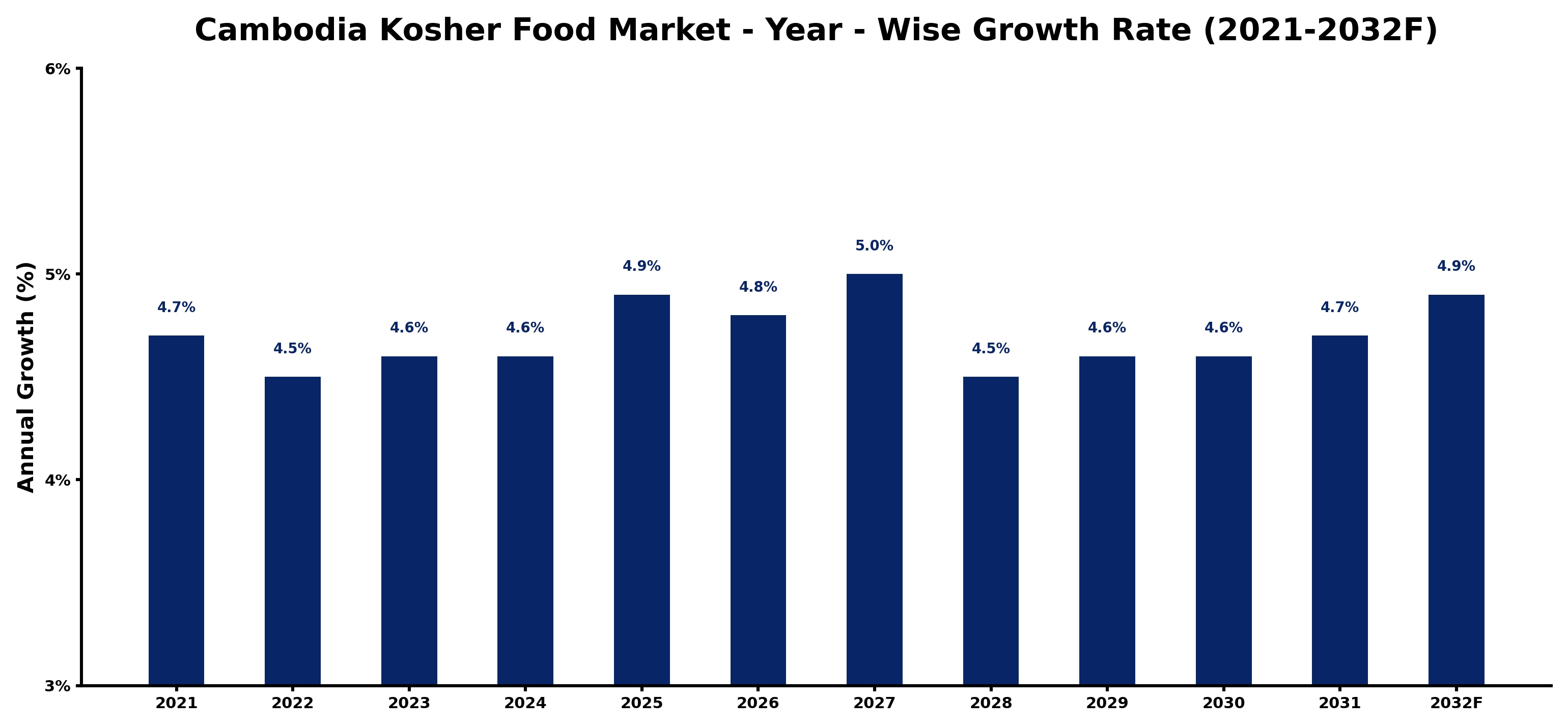
The table below presents the year‑wise growth rates along with the key drivers influencing the market
| Year | Growth Rate | Major Drivers |
| 2021 | 4.7% | Retail demand surge boosts local kosher food production capacity |
| 2022 | 4.5% | Kosher certification investments enhance local food manufacturing capacity |
| 2023 | 4.6% | Local kosher certification boosts demand for Cambodian food exports |
| 2024 | 4.6% | Export driven kosher certification advancements boosted local food processing capacity |
| 2025 | 4.9% | Upgraded food processing facilities enhanced kosher product output capacity |
| 2026 | 4.8% | Advanced packaging technology boosts kosher food shelf life and exports |
| 2027 | 5.0% | Kosher certification demand boosted local food processing plant upgrades |
| 2028 | 4.5% | New kosher certification facilities boost local food processing capabilities |
| 2029 | 4.6% | Investment in advanced processing technology boosts kosher food production capacity |
| 2030 | 4.6% | Manufacturing investments in cold chain logistics support kosher food production |
| 2031 | 4.7% | Commercial demand recovery boosted local kosher food production capacity |
| 2032 | 4.9% | Automation in kosher food processing enhances production efficiency levels |
Note - Market size estimations and growth projections presented in this report are based on 6Wresearch’s advanced forecasting approach, validated with industry datasets as of June 2026.
Cambodia Kosher Food Market Synopsis
The growing popularity of kosher-certified meat and dairy products among Cambodian consumers is reshaping the local food landscape. Increased awareness of dietary restrictions and a strong desire for quality have encouraged both importers and local producers to diversify their offerings, catering to this niche market.
Moreover, as more Cambodians explore various dietary practices, the demand for kosher packaged goods is expected to rise. This shift is not only reflective of changing consumer preferences but also of a broader acceptance and understanding of diverse culinary traditions within the Cambodian populace.
Cambodia Kosher Food Market Key Takeaways
- The market is witnessing significant growth driven by cultural diversity and dietary preferences.
- Certification standards and consumer trust are crucial factors influencing market dynamics.
- The demand for kosher food is expanding beyond religious observance to include health-conscious consumers.
- Awareness and education about kosher dietary laws are essential for market development.
- Government policies are supportive of food safety and cultural diversity, fostering market growth.
Evaluation of Restraints in Cambodia Kosher Food Market
Despite the promising growth trajectory, the Cambodia kosher food market faces significant restraints. One of the primary challenges is the ongoing need for education and awareness surrounding kosher dietary laws among consumers. There is also the concern of fluctuating market demand, which can complicate production planning and inventory management for suppliers. Compliance with certification standards is crucial, yet can be resource-intensive for producers, especially local businesses aiming to meet these requirements while maintaining product affordability and availability.
Cambodia Kosher Food Market Trends
The rise in online shopping is reshaping how consumers access kosher products, particularly among younger demographics who value convenience. Social media platforms are increasingly used to share information about kosher diets, further driving consumer interest. Additionally, there is a noticeable trend towards incorporating traditional Cambodian flavors into kosher offerings, appealing to a broader audience and creating unique culinary experiences.
Cambodia Kosher Food Market Opportunities
The market presents various growth and investment opportunities, particularly in the areas of product innovation and local sourcing. Companies can capitalize on the demand for new kosher food items by developing unique products that blend traditional Cambodian flavors with kosher standards. Furthermore, partnerships with local suppliers can enhance the supply chain and ensure product authenticity, attracting both local and international consumers.
Government Initiatives in the Cambodia Kosher Food Market
The Cambodian government is actively promoting food safety, cultural diversity, and religious freedom, which includes initiatives aimed at improving the certification process for kosher products. Support for businesses complying with kosher dietary laws and efforts to educate the public about kosher practices are fundamental components of these initiatives. Additionally, policies fostering interfaith dialogue are instrumental in enhancing understanding and acceptance of diverse dietary needs within the Cambodian community.
Future Insights of the Cambodia Kosher Food Market
Looking ahead to 2026-2032, the Cambodia kosher food market is expected to further evolve, characterized by increased product variety and wider distribution channels. As consumer awareness grows, the integration of kosher foods into mainstream grocery shopping will likely become more prevalent. The ongoing development of localized kosher production facilities may also contribute to market resilience, providing fresher options and supporting local economies.
Cambodia Kosher Food Market Latest Developments (May 2025 - June 2026)
Recent industry movements indicate a shift towards increased collaboration among importers and local producers to enhance the availability of kosher-certified products in Cambodia. Educational programs aimed at informing consumers about kosher dietary laws have gained traction, resulting in a more informed buyer base. Additionally, innovative marketing strategies utilizing digital platforms are being employed to engage a broader audience interested in kosher options.
Cambodia Kosher Food Market - Key Attractiveness of the Report
- 10 Years of Market Numbers
- Historical Data Starting from 2022 to 2025
- Base Year: 2025
- Forecast Data until 2032
- Key Performance Indicators Impacting the Market
- Major Upcoming Developments and Projects
Key Highlights of the Report:
- Cambodia Kosher Food Market Outlook
- Market Size of Cambodia Kosher Food Market, 2025
- Forecast of Cambodia Kosher Food Market, 2032
- Historical Data and Forecast of Cambodia Kosher Food Revenues & Volume for the Period 2022-2032F
- Cambodia Kosher Food Market Trend Evolution
- Cambodia Kosher Food Market Drivers and Challenges
- Cambodia Kosher Food Price Trends
- Cambodia Kosher Food Porter's Five Forces
- Cambodia Kosher Food Industry Life Cycle
- Historical Data and Forecast of Cambodia Kosher Food Market Revenues & Volume By Type for the Period 2022-2032F
- Historical Data and Forecast of Cambodia Kosher Food Market Revenues & Volume By Meat for the Period 2022-2032F
- Historical Data and Forecast of Cambodia Kosher Food Market Revenues & Volume By Dairy for the Period 2022-2032F
- Historical Data and Forecast of Cambodia Kosher Food Market Revenues & Volume By Pareve for the Period 2022-2032F
- Historical Data and Forecast of Cambodia Kosher Food Market Revenues & Volume By Application for the Period 2022-2032F
- Historical Data and Forecast of Cambodia Kosher Food Market Revenues & Volume By Seafood for the Period 2022-2032F
- Historical Data and Forecast of Cambodia Kosher Food Market Revenues & Volume By Processed Meat and Poultry for the Period 2022-2032F
- Historical Data and Forecast of Cambodia Kosher Food Market Revenues & Volume By Beverages for the Period 2022-2032F
- Historical Data and Forecast of Cambodia Kosher Food Market Revenues & Volume By Staples for the Period 2022-2032F
- Historical Data and Forecast of Cambodia Kosher Food Market Revenues & Volume By Snacks & Savoury for the Period 2022-2032F
- Historical Data and Forecast of Cambodia Kosher Food Market Revenues & Volume By Bakery and Confectionery for the Period 2022-2032F
- Historical Data and Forecast of Cambodia Kosher Food Market Revenues & Volume By Others for the Period 2022-2032F
- Historical Data and Forecast of Cambodia Kosher Food Market Revenues & Volume By Distribution Channel for the Period 2022-2032F
- Historical Data and Forecast of Cambodia Kosher Food Market Revenues & Volume By Supermarkets and Hypermarkets for the Period 2022-2032F
- Historical Data and Forecast of Cambodia Kosher Food Market Revenues & Volume By Grocery Stores for the Period 2022-2032F
- Historical Data and Forecast of Cambodia Kosher Food Market Revenues & Volume By Online Stores for the Period 2022-2032F
- Cambodia Kosher Food Import Export Trade Statistics
- Market Opportunity Assessment By Type
- Market Opportunity Assessment By Application
- Market Opportunity Assessment By Distribution Channel
- Cambodia Kosher Food Top Companies Market Share
- Cambodia Kosher Food Competitive Benchmarking By Technical and Operational Parameters
- Cambodia Kosher Food Company Profiles
- Cambodia Kosher Food Key Strategic Recommendations






































