Cambodia Perfumes & Deodorants Market Summary
The cambodia perfumes & deodorants market was estimated at USD 337 Million in 2025 and is projected to reach USD 463 Million by 2032, growing at a CAGR of 5.7% from 2026 to 2032.
Cambodia Perfumes & Deodorants Market Year-wise Growth Rate and Key Drivers
This graph highlights how the Cambodia Perfumes & Deodorants Market has steadily grown over the past five years, supported by major growth factors.
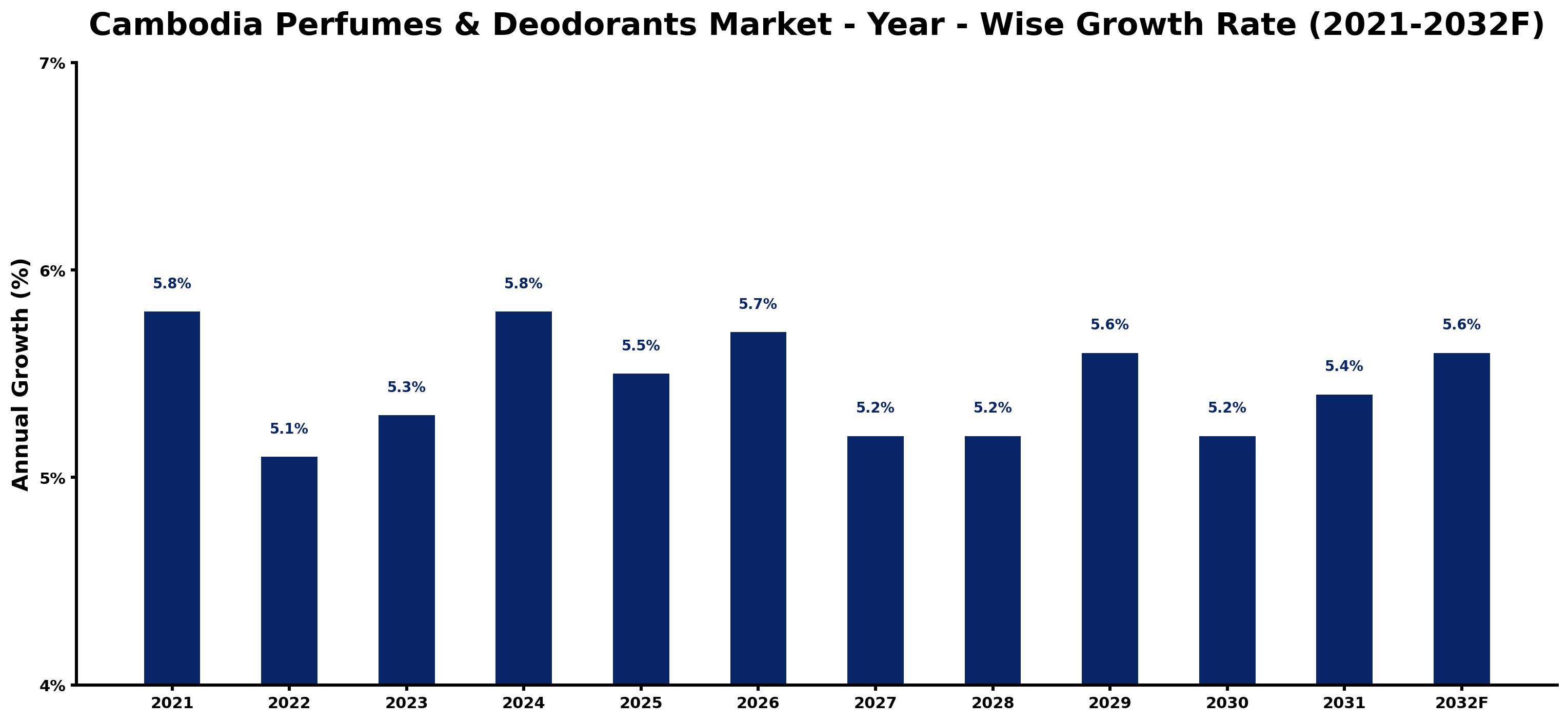
The table below presents the year wise growth rates along with the key drivers influencing the market
| Year | Growth Rate | Major Drivers |
| 2021 | 5.8% | Cambodia's urbanization trend leads consumers to explore personal grooming products. |
| 2022 | 5.1% | Local brands gain popularity, highlighting cultural preferences for floral and traditional scents. |
| 2023 | 5.3% | E-commerce growth enables broader access to international perfume brands and online shopping. |
| 2024 | 5.8% | Expansion of retail outlets in urban and semi-urban areas boosts product visibility. |
| 2025 | 5.5% | Social media marketing influences younger consumers, shaping fragrance preferences and trends. |
| 2026 | 5.7% | Increased tourism enhances demand for luxury and exotic fragrance segments in stores. |
| 2027 | 5.2% | Rising disposable income empowers consumers to invest in premium personal care products. |
| 2028 | 5.2% | Sustainability trends impact purchasing, with eco-friendly packaging appealing to conscious shoppers. |
| 2029 | 5.6% | Brand collaborations with local artisans create unique offerings that resonate with consumers. |
| 2030 | 5.2% | Health and wellness movements drive interest in deodorants with natural ingredients and fragrances. |
| 2031 | 5.4% | Distribution channels diversify, including convenience stores catering to on-the-go consumers. |
| 2032 | 5.6% | Investment in local manufacturing reduces import costs, facilitating competitive pricing strategies. |
Note - Market size estimations and growth projections presented in this report are based on 6Wresearch's advanced forecasting approach, validated with industry datasets as of June 2026.
Cambodia Perfumes & Deodorants Market Synopsis
The Cambodia Perfumes Deodorants Market is projected to reach 5.7% and witness significant growth during the forecast period (2026-2032). This growth is driven by a myriad of factors including increasing disposable income, evolving lifestyle habits, and a heightened awareness of personal hygiene among the Cambodian population. As the demand for premium and innovative products continues to rise, manufacturers are responding with new offerings that include unique fragrances and attractive packaging. This dynamic market environment is characterized by an influx of affordable brands that offer strong value for consumers, further propelling market expansion.
Cambodia Perfumes & Deodorants Market Growth Drivers
Several key drivers are influencing the growth of the Cambodia Perfumes & Deodorants Market:
- The rise in disposable income among Cambodian consumers allows for greater spending on personal care products, leading to an increased demand for perfumes and deodorants.
- Changing lifestyles, particularly among the younger demographics, are shifting the focus toward personal grooming and hygiene, making perfumes and deodorants a staple in everyday life.
- There is a growing awareness surrounding the importance of personal hygiene, driving consumers to seek out effective deodorants and appealing fragrances.
- Product innovation, including new fragrance blends and eco-friendly packaging, is attracting consumers looking for unique and premium experiences.
- The expansion of online retail channels provides consumers with greater access to a broader range of products at competitive prices, driving sales growth.
Cambodia Perfumes & Deodorants Market Trends and Opportunities
The Cambodia Perfumes & Deodorants Market is characterized by several notable trends and emerging opportunities:
- The introduction of e-commerce platforms offers a convenient shopping option, enabling consumers to explore a wide variety of brands and products without geographic limitations.
- Consumers are increasingly gravitating towards natural and organic ingredients in personal care products, leading to a demand for eco-friendly perfumes and deodorants.
- Social media marketing and influencer collaborations have become crucial for brands aiming to connect with younger audiences and build brand loyalty.
- Seasonal and limited-edition fragrance launches are appealing to consumers, creating a sense of exclusivity that enhances brand desirability.
- As urbanization progresses in Cambodia, the preference for premium products is expected to rise, presenting significant opportunities for high-end brands.
Cambodia Perfumes & Deodorants Market Challenges and Restraints
Despite the promising growth outlook, the Cambodia Perfumes & Deodorants Market faces certain challenges that could impede progress:
- The prevalence of counterfeit products in the market undermines brand integrity and negatively impacts consumer trust, as these look-alikes often sell at much lower price points.
- Lack of regulatory oversight regarding the sale of personal care products, especially counterfeit items, poses a significant risk to genuine manufacturers.
- Economic fluctuations may affect consumer spending habits, potentially leading to a shift towards lower-priced alternatives during tough economic times.
- Intense competition from both local and international brands can lead to price wars, diminishing profit margins for manufacturers.
- Consumer preferences may shift rapidly, necessitating constant innovation and adaptation from brands to remain relevant in the market.
Cambodia Perfumes & Deodorants Market Government Investment and Initiatives
The Cambodian government has recognized the importance of the personal care sector, including the perfumes and deodorants market, and is taking steps to foster growth and development. Key initiatives include:
- Investment in infrastructure improvements that facilitate distribution channels for personal care products, enhancing market accessibility.
- The implementation of policies aimed at regulating product quality and safety standards, which is crucial for building consumer trust and ensuring market integrity.
- Public awareness campaigns promoting personal hygiene and grooming, which indirectly encourage the consumption of perfumes and deodorants.
- Support for local manufacturers through incentives, aimed at boosting domestic production capacities and reducing reliance on imported goods.
- Encouragement of foreign investment within the cosmetics and personal care sectors, which can lead to technology transfers and knowledge sharing, enhancing competitiveness.
Cambodia Perfumes & Deodorants Market Latest Developments (May 2025 - June 2026)
Recent developments in the Cambodia Perfumes & Deodorants Market from May 2025 to June 2026 reflect a period of transformation and adaptation:
- Innovative marketing strategies have gained traction, with brands utilizing social media platforms to engage directly with consumers and showcase their products.
- New product launches featuring exotic and locally inspired fragrances have successfully captured consumer interest, leading to increased sales.
- Expansion of e-commerce platforms has revolutionized shopping experiences, with many consumers opting to purchase perfumes and deodorants online.
- The industry has seen a rise in collaborations between local artisans and global brands, fostering a unique blend of tradition and modernity in product offerings.
- Concerns regarding counterfeit products have prompted some stakeholders to advocate for stricter regulations and greater consumer education on product authenticity.
Cambodia Perfumes & Deodorants Market - Key Attractiveness of the Report
- 10 Years of Market Numbers
- Historical Data Starting from 2022 to 2025
- Base Year: 2025
- Forecast Data until 2032
- Key Performance Indicators Impacting the Market
- Major Upcoming Developments and Projects
Key Highlights of the Report:
- Cambodia Perfumes & Deodorants Market Outlook
- Market Size of Cambodia Perfumes & Deodorants Market, 2025
- Forecast of Cambodia Perfumes & Deodorants Market, 2032F
- Historical Data and Forecast of Cambodia Perfumes & Deodorants Revenues & Volume for the Period 2022-2032F
- Cambodia Perfumes & Deodorants Market Trend Evolution
- Cambodia Perfumes & Deodorants Market Drivers and Challenges
- Cambodia Perfumes & Deodorants Price Trends
- Cambodia Perfumes & Deodorants Porter's Five Forces
- Cambodia Perfumes & Deodorants Industry Life Cycle
- Historical Data and Forecast of Cambodia Perfumes & Deodorants Market Revenues & Volume By Product Types for the Period 2022-2032F
- Historical Data and Forecast of Cambodia Perfumes & Deodorants Market Revenues & Volume By Deodorants for the Period 2022-2032F
- Historical Data and Forecast of Cambodia Perfumes & Deodorants Market Revenues & Volume By Perfumes for the Period 2022-2032F
- Historical Data and Forecast of Cambodia Perfumes & Deodorants Market Revenues & Volume By Consumer Group for the Period 2022-2032F
- Historical Data and Forecast of Cambodia Perfumes & Deodorants Market Revenues & Volume By Men for the Period 2022-2032F
- Historical Data and Forecast of Cambodia Perfumes & Deodorants Market Revenues & Volume By Women for the Period 2022-2032F
- Historical Data and Forecast of Cambodia Perfumes & Deodorants Market Revenues & Volume By Unisex for the Period 2022-2032F
- Historical Data and Forecast of Cambodia Perfumes & Deodorants Market Revenues & Volume By Distribution Channel for the Period 2022-2032F
- Historical Data and Forecast of Cambodia Perfumes & Deodorants Market Revenues & Volume By Online for the Period 2022-2032F
- Historical Data and Forecast of Cambodia Perfumes & Deodorants Market Revenues & Volume By Offline for the Period 2022-2032F
- Historical Data and Forecast of Cambodia Perfumes & Deodorants Market Revenues & Volume By Price Segment for the Period 2022-2032F
- Historical Data and Forecast of Cambodia Perfumes & Deodorants Market Revenues & Volume By Premium for the Period 2022-2032F
- Historical Data and Forecast of Cambodia Perfumes & Deodorants Market Revenues & Volume By Mass for the Period 2022-2032F
- Cambodia Perfumes & Deodorants Import Export Trade Statistics
- Market Opportunity Assessment By Product Types
- Market Opportunity Assessment By Consumer Group
- Market Opportunity Assessment By Distribution Channel
- Market Opportunity Assessment By Price Segment
- Cambodia Perfumes & Deodorants Top Companies Market Share
- Cambodia Perfumes & Deodorants Competitive Benchmarking By Technical and Operational Parameters
- Cambodia Perfumes & Deodorants Company Profiles
- Cambodia Perfumes & Deodorants Key Strategic Recommendations






































