Canada Aggregates Market: Import Trend Analysis
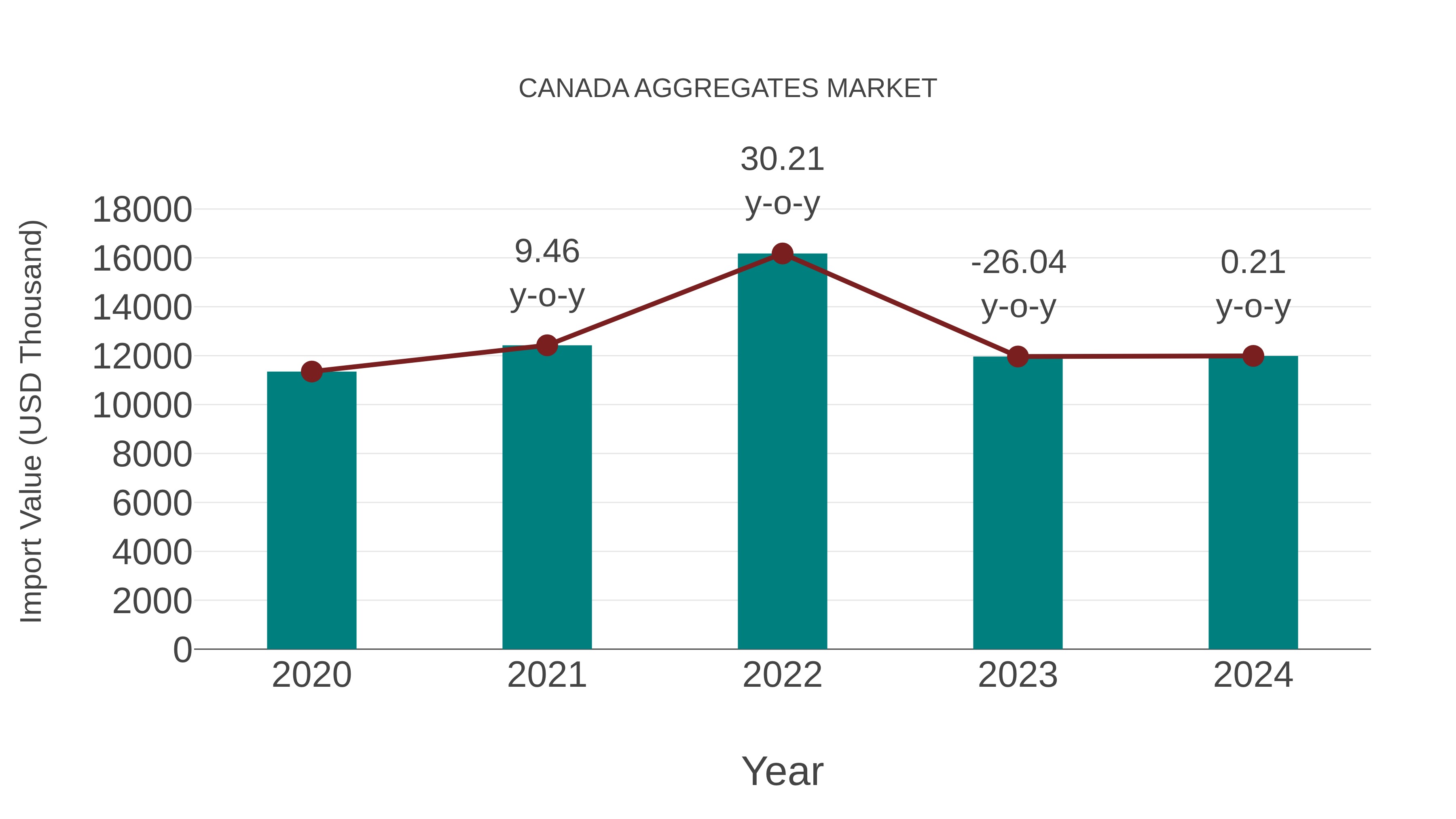
In the Canada aggregates market, the import trend showed a slight growth rate of 0.21% from 2023 to 2024. The compound annual growth rate (CAGR) for imports during the period 2020-2024 stood at 1.38%. This moderate increase in import momentum could be attributed to stable demand patterns and market stability within the industry.
Canada Aggregates Market Overview
The Canada aggregates market is a significant sector within the construction industry, encompassing the production and supply of materials such as sand, gravel, crushed stone, and other natural resources used in infrastructure projects, building construction, and road maintenance. The market is driven by factors including population growth, urbanization, and government investments in public infrastructure projects. Major players in the market include companies like LafargeHolcim, CRH plc, and Lehigh Hanson, who operate quarries and processing facilities across the country. Environmental regulations, sustainability concerns, and technological advancements in extraction and processing methods are influencing the market dynamics, leading to a shift towards more efficient and sustainable practices. Overall, the Canada aggregates market is expected to remain robust, supported by ongoing construction activities and infrastructure development projects nationwide.
Canada Aggregates Market Trends
The Canada aggregates market is experiencing a growing demand for sustainable and recycled materials, driven by environmental concerns and government regulations. There is a shift towards using recycled aggregates in construction projects to reduce the environmental impact of extracting natural resources. Additionally, the market is seeing a rise in technological advancements such as digital tools for efficient inventory management and automated processes for production and transportation. Infrastructure projects, particularly in urban areas, are driving the demand for aggregates, leading to a competitive market landscape with a focus on cost-efficiency and sustainable practices. Overall, the Canada aggregates market is evolving towards a more sustainable and technologically advanced industry to meet the growing construction needs while minimizing environmental impacts.
Canada Aggregates Market Challenges
In the Canada aggregates market, challenges include regulatory hurdles related to environmental concerns, such as obtaining permits for quarry operations and managing water usage. Infrastructure constraints, including limited transportation options for moving aggregates from production sites to construction projects, also pose challenges. Fluctuations in demand due to economic conditions can impact market stability, as well as competition from alternative materials like recycled aggregates. Additionally, the need for sustainable practices and the push towards carbon neutrality in the construction industry are pushing companies to invest in innovative technologies and processes to reduce the environmental impact of aggregate production. Overall, navigating these challenges requires companies in the Canada aggregates market to adapt to changing regulations, invest in sustainable practices, and efficiently manage their operations to stay competitive.
Canada Aggregates Market Investment Opportunities
The Canada aggregates market presents lucrative investment opportunities due to the country`s robust construction and infrastructure development projects. Investing in aggregate producers or suppliers can be profitable as demand for construction aggregates such as sand, gravel, and crushed stone is expected to increase with the growth of residential, commercial, and public infrastructure projects. Additionally, with the Canadian government`s focus on sustainable development and infrastructure renewal, there is a growing need for recycled aggregates and innovative solutions in the sector. Investors can also explore opportunities in the technology and equipment segment to improve operational efficiency and meet the increasing demand for high-quality aggregates. Overall, the Canada aggregates market offers diversified investment prospects with the potential for long-term growth and profitability.
Canada Aggregates Market Government Policy
In Canada, government policies related to the aggregates market focus on sustainable development, environmental protection, and resource management. The Canadian government has regulations in place to ensure that aggregates extraction and processing activities are conducted responsibly to minimize environmental impacts, such as water pollution and habitat destruction. Additionally, there are guidelines for land reclamation and rehabilitation to restore sites to their natural state after extraction activities are completed. The government also promotes the use of recycled aggregates to reduce the demand for virgin materials and minimize waste. Overall, the regulatory framework aims to balance the economic benefits of the aggregates industry with environmental considerations to support long-term sustainability.
Canada Aggregates Market Future Outlook
The Canada aggregates market is expected to witness steady growth in the coming years, driven by increasing infrastructure development projects, urbanization, and investments in the construction sector. The rising demand for aggregates, such as sand, gravel, and crushed stone, in various construction activities like road construction, building foundations, and landscaping is projected to fuel market expansion. Additionally, government initiatives aimed at improving transportation networks, energy infrastructure, and sustainable building practices are likely to further boost the demand for aggregates in Canada. However, challenges related to environmental regulations, transportation costs, and fluctuations in raw material prices could impact market growth. Overall, the Canada aggregates market is anticipated to demonstrate positive growth prospects in the foreseeable future, supported by ongoing construction activities and infrastructure development projects.
Key Highlights of the Report:
- Canada Aggregates Market Outlook
- Market Size of Canada Aggregates Market, 2025
- Forecast of Canada Aggregates Market, 2032
- Historical Data and Forecast of Canada Aggregates Revenues & Volume for the Period 2022-2032F
- Canada Aggregates Market Trend Evolution
- Canada Aggregates Market Drivers and Challenges
- Canada Aggregates Price Trends
- Canada Aggregates Porter's Five Forces
- Canada Aggregates Industry Life Cycle
- Historical Data and Forecast of Canada Aggregates Market Revenues & Volume By Product Type for the Period 2022-2032F
- Historical Data and Forecast of Canada Aggregates Market Revenues & Volume By Crushed Stone for the Period 2022-2032F
- Historical Data and Forecast of Canada Aggregates Market Revenues & Volume By Sand for the Period 2022-2032F
- Historical Data and Forecast of Canada Aggregates Market Revenues & Volume By Gravel for the Period 2022-2032F
- Historical Data and Forecast of Canada Aggregates Market Revenues & Volume By Recycled Aggregates for the Period 2022-2032F
- Historical Data and Forecast of Canada Aggregates Market Revenues & Volume By Application for the Period 2022-2032F
- Historical Data and Forecast of Canada Aggregates Market Revenues & Volume By Construction Materials for the Period 2022-2032F
- Historical Data and Forecast of Canada Aggregates Market Revenues & Volume By Road Construction for the Period 2022-2032F
- Historical Data and Forecast of Canada Aggregates Market Revenues & Volume By Concrete Production for the Period 2022-2032F
- Historical Data and Forecast of Canada Aggregates Market Revenues & Volume By Landscaping for the Period 2022-2032F
- Historical Data and Forecast of Canada Aggregates Market Revenues & Volume By End User for the Period 2022-2032F
- Historical Data and Forecast of Canada Aggregates Market Revenues & Volume By Construction Industry for the Period 2022-2032F
- Historical Data and Forecast of Canada Aggregates Market Revenues & Volume By Residential for the Period 2022-2032F
- Historical Data and Forecast of Canada Aggregates Market Revenues & Volume By Commercial for the Period 2022-2032F
- Canada Aggregates Import Export Trade Statistics
- Market Opportunity Assessment By Product Type
- Market Opportunity Assessment By Application
- Market Opportunity Assessment By End User
- Canada Aggregates Top Companies Market Share
- Canada Aggregates Competitive Benchmarking By Technical and Operational Parameters
- Canada Aggregates Company Profiles
- Canada Aggregates Key Strategic Recommendations






































