Canada Programmable Oscillator Market: Import Trend Analysis
During 2020-2024, the Canada programmable oscillator market witnessed a Compound Annual Growth Rate (CAGR) of 4.52%. In 2023-2024, the year-on-year growth rate was -0.54%. This resulted in an overall increase in imports of programmable oscillators during the specified period.
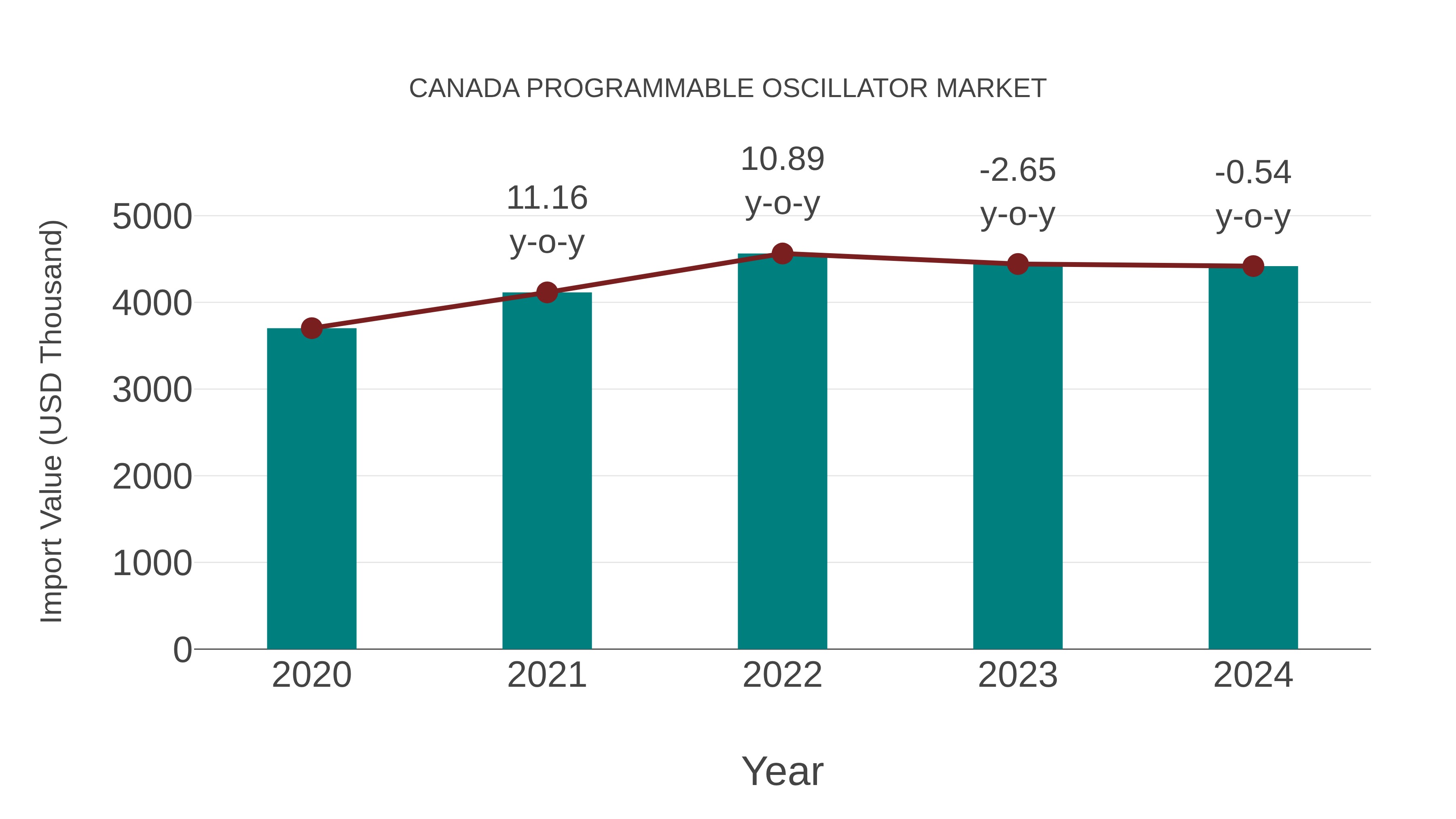
Canada Programmable Oscillator Market Overview
The Canada programmable oscillator market is witnessing steady growth driven by the increasing demand for precise timing solutions in various industries such as telecommunications, automotive, and consumer electronics. Programmable oscillators offer flexibility and customization options, allowing manufacturers to meet specific requirements for frequency, stability, and power consumption. Key players in the market are focusing on developing advanced programmable oscillators with features like wide frequency range, low jitter, and high reliability to cater to the evolving needs of the end-users. The adoption of programmable oscillators is expected to further rise in Canada as industries continue to emphasize the importance of accurate timing in their applications. Overall, the Canada programmable oscillator market is poised for expansion, offering opportunities for innovation and growth in the coming years.
Canada Programmable Oscillator Market Trends
The Canada programmable oscillator market is experiencing a growing demand for high-frequency and low-phase noise oscillators driven by the increasing adoption of advanced communication technologies such as 5G networks, IoT devices, and autonomous vehicles. Manufacturers are focusing on developing programmable oscillators with improved performance, smaller form factors, and lower power consumption to meet the evolving requirements of these applications. Additionally, the integration of advanced features like frequency synchronization, temperature compensation, and jitter attenuation is gaining traction in the market. With the automotive and industrial sectors also driving the demand for precise timing solutions, the Canada programmable oscillator market is expected to witness sustained growth in the coming years as companies continue to innovate and offer customized solutions to cater to diverse industry needs.
Canada Programmable Oscillator Market Challenges
In the Canada programmable oscillator market, some challenges include intense competition from both domestic and international players, rapid technological advancements leading to short product life cycles, and the need for continuous innovation to stay ahead in the market. Additionally, factors such as fluctuating raw material prices, economic uncertainties, and stringent regulations can also pose challenges for companies operating in this sector. Ensuring product differentiation, maintaining high quality standards, and effectively managing supply chain logistics are critical for companies to navigate these challenges and sustain growth in the Canada programmable oscillator market. Collaboration with key industry stakeholders, investing in research and development, and staying abreast of market trends are essential strategies for companies to overcome these challenges and maintain a competitive edge.
Canada Programmable Oscillator Market Investment Opportunities
The Canada programmable oscillator market offers promising investment opportunities due to the increasing demand for precision timing solutions across various industries such as telecommunications, automotive, aerospace, and consumer electronics. With the growing adoption of advanced technologies like 5G networks, IoT devices, and autonomous vehicles, the need for highly accurate and customizable oscillators is on the rise. Investing in companies that manufacture or provide innovative programmable oscillator solutions can be lucrative as they cater to the evolving requirements of the market. Additionally, the Canadian government`s focus on promoting technological advancements and fostering a supportive business environment further enhances the investment potential in the programmable oscillator sector within Canada. It is essential for investors to conduct thorough market research and assess the competitive landscape to capitalize on the opportunities presented by this dynamic market segment.
Canada Programmable Oscillator Market Government Policy
In Canada, the programmable oscillator market is regulated by various government policies that aim to promote innovation, competitiveness, and compliance with industry standards. The Canadian Radio-television and Telecommunications Commission (CRTC) oversees the telecommunications sector, which includes regulations on frequency allocation and spectrum management for programmable oscillators. Additionally, the Innovation, Science and Economic Development Canada (ISED) department sets standards for electronic devices, including programmable oscillators, to ensure they meet safety and performance requirements. The Canadian government also offers support programs and incentives for research and development in the electronics industry, which can benefit companies operating in the programmable oscillator market. Overall, the government policies in Canada create a regulatory framework that supports the growth and sustainability of the programmable oscillator market while ensuring consumer protection and industry competitiveness.
Canada Programmable Oscillator Market Future Outlook
The future outlook for the Canada programmable oscillator market appears positive, with a steady growth trajectory expected in the coming years. Factors such as the increasing demand for advanced electronic devices, rising adoption of IoT technologies, and the expanding automotive and telecommunications sectors are likely to drive the market`s growth. With the growing emphasis on precision timing in various applications, programmable oscillators are gaining popularity for their flexibility and customization options. Additionally, advancements in wireless communication technologies and the shift towards 5G networks are anticipated to further boost the demand for programmable oscillators in Canada. Overall, the market is poised for expansion, offering opportunities for manufacturers and suppliers to capitalize on the evolving technological landscape and meet the diverse needs of industries requiring precise timing solutions.
Key Highlights of the Report:
- Canada Programmable Oscillator Market Outlook
- Market Size of Canada Programmable Oscillator Market,2025
- Forecast of Canada Programmable Oscillator Market, 2032
- Historical Data and Forecast of Canada Programmable Oscillator Revenues & Volume for the Period 2022-2032F
- Canada Programmable Oscillator Market Trend Evolution
- Canada Programmable Oscillator Market Drivers and Challenges
- Canada Programmable Oscillator Price Trends
- Canada Programmable Oscillator Porter's Five Forces
- Canada Programmable Oscillator Industry Life Cycle
- Historical Data and Forecast of Canada Programmable Oscillator Market Revenues & Volume By Type for the Period 2022-2032F
- Historical Data and Forecast of Canada Programmable Oscillator Market Revenues & Volume By Voltage Controlled for the Period 2022-2032F
- Historical Data and Forecast of Canada Programmable Oscillator Market Revenues & Volume By Temperature Compensated for the Period 2022-2032F
- Historical Data and Forecast of Canada Programmable Oscillator Market Revenues & Volume By MEMS-based for the Period 2022-2032F
- Historical Data and Forecast of Canada Programmable Oscillator Market Revenues & Volume By Crystal Oscillator for the Period 2022-2032F
- Historical Data and Forecast of Canada Programmable Oscillator Market Revenues & Volume By Frequency Range for the Period 2022-2032F
- Historical Data and Forecast of Canada Programmable Oscillator Market Revenues & Volume By <10 MHz for the Period 2022-2032F
- Historical Data and Forecast of Canada Programmable Oscillator Market Revenues & Volume By 10-100 MHz for the Period 2022-2032F
- Historical Data and Forecast of Canada Programmable Oscillator Market Revenues & Volume By >100 MHz for the Period 2022-2032F
- Historical Data and Forecast of Canada Programmable Oscillator Market Revenues & Volume By Adjustable for the Period 2022-2032F
- Historical Data and Forecast of Canada Programmable Oscillator Market Revenues & Volume By Application for the Period 2022-2032F
- Historical Data and Forecast of Canada Programmable Oscillator Market Revenues & Volume By Communication for the Period 2022-2032F
- Historical Data and Forecast of Canada Programmable Oscillator Market Revenues & Volume By Signal Processing for the Period 2022-2032F
- Historical Data and Forecast of Canada Programmable Oscillator Market Revenues & Volume By Embedded Systems for the Period 2022-2032F
- Historical Data and Forecast of Canada Programmable Oscillator Market Revenues & Volume By IoT Devices for the Period 2022-2032F
- Historical Data and Forecast of Canada Programmable Oscillator Market Revenues & Volume By Features for the Period 2022-2032F
- Historical Data and Forecast of Canada Programmable Oscillator Market Revenues & Volume By Low Jitter for the Period 2022-2032F
- Historical Data and Forecast of Canada Programmable Oscillator Market Revenues & Volume By High Stability for the Period 2022-2032F
- Historical Data and Forecast of Canada Programmable Oscillator Market Revenues & Volume By Miniaturized for the Period 2022-2032F
- Historical Data and Forecast of Canada Programmable Oscillator Market Revenues & Volume By Low Power for the Period 2022-2032F
- Historical Data and Forecast of Canada Programmable Oscillator Market Revenues & Volume By End Use for the Period 2022-2032F
- Historical Data and Forecast of Canada Programmable Oscillator Market Revenues & Volume By Telecommunication for the Period 2022-2032F
- Historical Data and Forecast of Canada Programmable Oscillator Market Revenues & Volume By Aerospace for the Period 2022-2032F
- Historical Data and Forecast of Canada Programmable Oscillator Market Revenues & Volume By Consumer Electronics for the Period 2022-2032F
- Historical Data and Forecast of Canada Programmable Oscillator Market Revenues & Volume By Automotive for the Period 2022-2032F
- Canada Programmable Oscillator Import Export Trade Statistics
- Market Opportunity Assessment By Type
- Market Opportunity Assessment By Frequency Range
- Market Opportunity Assessment By Application
- Market Opportunity Assessment By Features
- Market Opportunity Assessment By End Use
- Canada Programmable Oscillator Top Companies Market Share
- Canada Programmable Oscillator Competitive Benchmarking By Technical and Operational Parameters
- Canada Programmable Oscillator Company Profiles
- Canada Programmable Oscillator Key Strategic Recommendations






































