Canada Semiconductor Equipment Market Growth Rate Analysis (2021 - 2031)
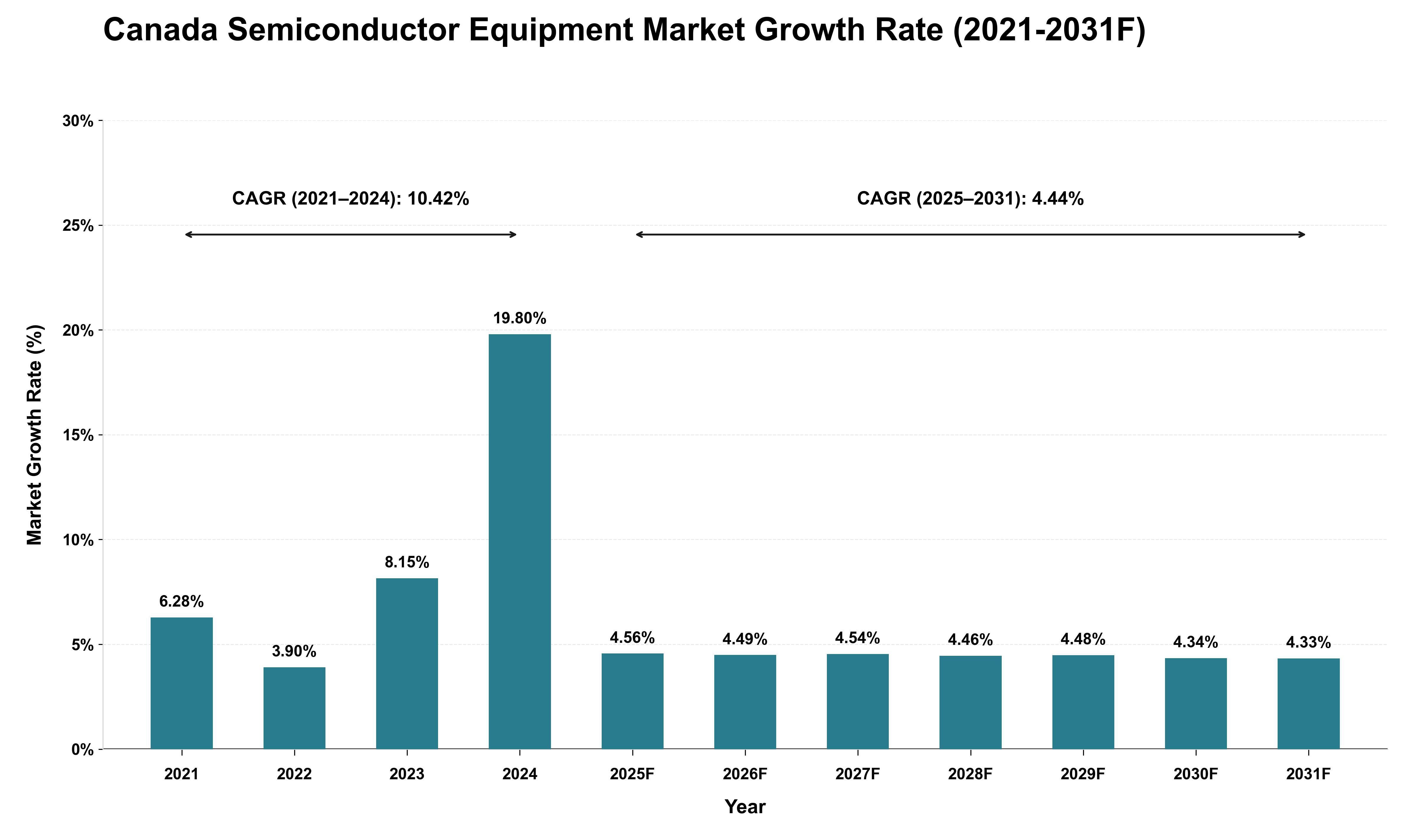
The Canadian semiconductor equipment market experienced a robust historical CAGR of 10.42% from 2021 to 2024, driven by heightened demand for advanced manufacturing capabilities amid global supply chain disruptions and the post-pandemic recovery in technology sectors. The annual growth rates fluctuated, peaking at 19.80% in 2024 as manufacturers ramped up production to address semiconductor shortages exacerbated by geopolitical tensions and increased reliance on imports. Moving into the forecast period (2025-2031), the market is expected to decelerate to a CAGR of 4.44%, reflecting a normalization phase as capacity expansions stabilize and competition intensifies among established players. This anticipated slowdown aligns with broader trends in global semiconductor investments, where firms are likely to focus on efficiency improvements rather than aggressive capacity increases, influenced by evolving trade policies and technological advancements that reshape the competitive landscape.
Key Highlights of the Report:
- Canada Semiconductor Equipment Market Outlook
- Market Size of Canada Semiconductor Equipment Market,2024
- Forecast of Canada Semiconductor Equipment Market, 2031
- Historical Data and Forecast of Canada Semiconductor Equipment Revenues & Volume for the Period 2021-2031
- Canada Semiconductor Equipment Market Trend Evolution
- Canada Semiconductor Equipment Market Drivers and Challenges
- Canada Semiconductor Equipment Price Trends
- Canada Semiconductor Equipment Porter's Five Forces
- Canada Semiconductor Equipment Industry Life Cycle
- Historical Data and Forecast of Canada Semiconductor Equipment Market Revenues & Volume By Type for the Period 2021-2031
- Historical Data and Forecast of Canada Semiconductor Equipment Market Revenues & Volume By Lithography Equipment for the Period 2021-2031
- Historical Data and Forecast of Canada Semiconductor Equipment Market Revenues & Volume By Etching Equipment for the Period 2021-2031
- Historical Data and Forecast of Canada Semiconductor Equipment Market Revenues & Volume By Deposition Equipment for the Period 2021-2031
- Historical Data and Forecast of Canada Semiconductor Equipment Market Revenues & Volume By Others for the Period 2021-2031
- Historical Data and Forecast of Canada Semiconductor Equipment Market Revenues & Volume By Process Step for the Period 2021-2031
- Historical Data and Forecast of Canada Semiconductor Equipment Market Revenues & Volume By Front-End for the Period 2021-2031
- Historical Data and Forecast of Canada Semiconductor Equipment Market Revenues & Volume By Back-End for the Period 2021-2031
- Historical Data and Forecast of Canada Semiconductor Equipment Market Revenues & Volume By Packaging for the Period 2021-2031
- Historical Data and Forecast of Canada Semiconductor Equipment Market Revenues & Volume By Others for the Period 2021-2031
- Historical Data and Forecast of Canada Semiconductor Equipment Market Revenues & Volume By End User for the Period 2021-2031
- Historical Data and Forecast of Canada Semiconductor Equipment Market Revenues & Volume By Foundries for the Period 2021-2031
- Historical Data and Forecast of Canada Semiconductor Equipment Market Revenues & Volume By Electronics Companies for the Period 2021-2031
- Historical Data and Forecast of Canada Semiconductor Equipment Market Revenues & Volume By Automotive for the Period 2021-2031
- Historical Data and Forecast of Canada Semiconductor Equipment Market Revenues & Volume By Others for the Period 2021-2031
- Historical Data and Forecast of Canada Semiconductor Equipment Market Revenues & Volume By Application for the Period 2021-2031
- Historical Data and Forecast of Canada Semiconductor Equipment Market Revenues & Volume By Wafer Manufacturing for the Period 2021-2031
- Historical Data and Forecast of Canada Semiconductor Equipment Market Revenues & Volume By Chip Production for the Period 2021-2031
- Historical Data and Forecast of Canada Semiconductor Equipment Market Revenues & Volume By Sensor Manufacturing for the Period 2021-2031
- Historical Data and Forecast of Canada Semiconductor Equipment Market Revenues & Volume By Others for the Period 2021-2031
- Canada Semiconductor Equipment Import Export Trade Statistics
- Market Opportunity Assessment By Type
- Market Opportunity Assessment By Process Step
- Market Opportunity Assessment By End User
- Market Opportunity Assessment By Application
- Canada Semiconductor Equipment Top Companies Market Share
- Canada Semiconductor Equipment Competitive Benchmarking By Technical and Operational Parameters
- Canada Semiconductor Equipment Company Profiles
- Canada Semiconductor Equipment Key Strategic Recommendations






































