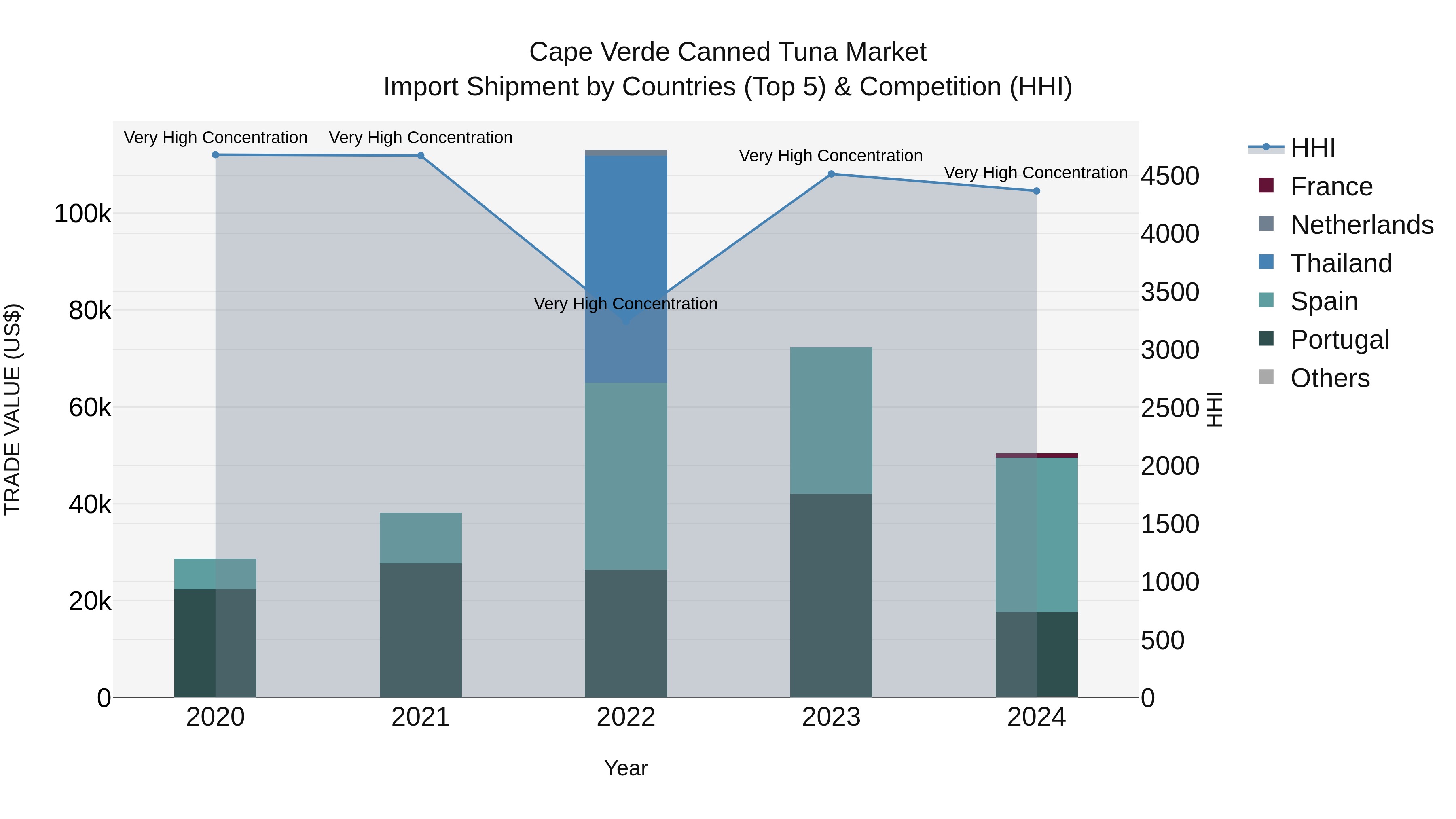
Cape Verde Canned Tuna Market: Top 5 Importing Countries and Market Competition (HHI) Analysis
In 2024, Cape Verde continued to heavily rely on canned tuna imports, with Spain, Portugal, France, USA, and the Netherlands being the top exporting countries. Despite a high concentration level indicated by the HHI, the market experienced a significant CAGR of 15.14% from 2020 to 2024. However, there was a notable decline in growth rate from 2023 to 2024 at -30.31%, suggesting potential challenges or shifts in the market dynamics. Monitoring these trends will be crucial for stakeholders in the canned tuna import industry in Cape Verde.
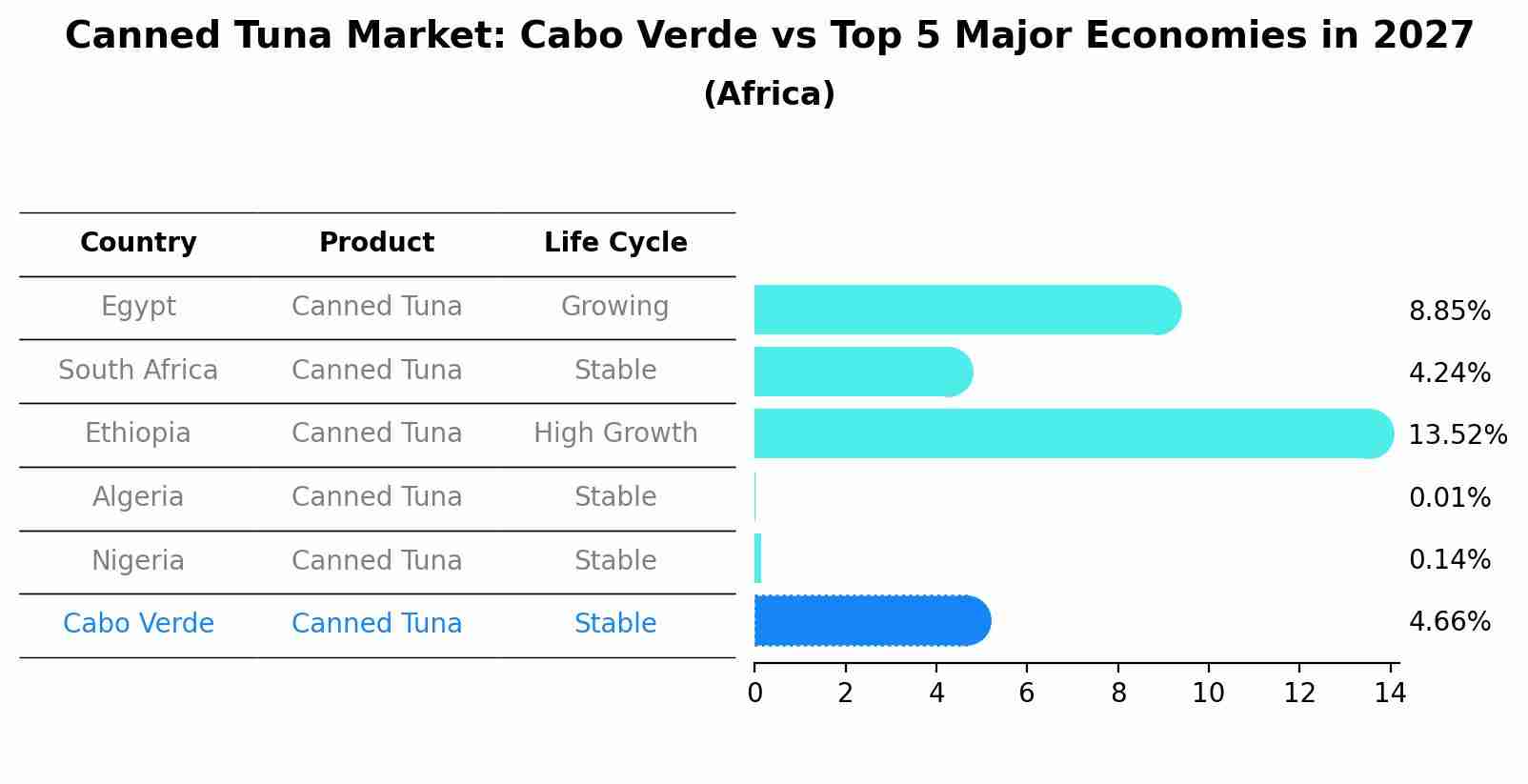
Canned Tuna Market: Cabo Verde vs Top 5 Major Economies in 2027 (Africa)
Cabo Verde's Canned Tuna market is anticipated to experience a stable growth rate of 4.66% by 2027, reflecting trends observed in the largest economy Egypt, followed by South Africa, Ethiopia, Algeria and Nigeria.
Cape Verde Canned Tuna Market Overview
The canned tuna market in Cape Verde is a significant segment of the canned seafood market, driven by the popularity of tuna as a protein source. Canned tuna is valued for its convenience and long shelf life. The local market relies on imports, as domestic production is minimal. The demand for canned tuna is influenced by consumer preferences, retail growth, and import costs. As the retail sector expands and consumer preferences evolve, there is potential for increased demand for canned tuna in Cape Verde.
Drivers of the market
The canned tuna market in Cape Verde experiences growth due to its popularity as a convenient and nutritious food option. The increasing demand for ready-to-eat seafood products and the rising awareness of the health benefits of tuna contribute to market expansion. Additionally, advancements in canning technology and the expansion of distribution channels support market growth.
Challenges of the market
The Cape Verde Canned Tuna market faces several challenges, including high import costs and limited local processing capabilities. The market`s reliance on imported tuna affects pricing and availability. Additionally, fluctuations in global tuna prices and competition from other canned seafood products impact market dynamics and profitability.
Government Policy of the market
The canned tuna market in Cape Verde is governed by regulations that focus on food safety and quality. The government sets standards for the processing, packaging, and labeling of canned tuna to ensure that it meets health and safety requirements. Regulations cover import requirements and quality control measures to prevent contamination. There are also incentives for local producers to invest in technology and practices that enhance the quality and safety of canned tuna products.
Key Highlights of the Report:
- Cape Verde Canned Tuna Market Outlook
- Market Size of Cape Verde Canned Tuna Market, 2024
- Forecast of Cape Verde Canned Tuna Market, 2031
- Historical Data and Forecast of Cape Verde Canned Tuna Revenues & Volume for the Period 2021-2031
- Cape Verde Canned Tuna Market Trend Evolution
- Cape Verde Canned Tuna Market Drivers and Challenges
- Cape Verde Canned Tuna Price Trends
- Cape Verde Canned Tuna Porter`s Five Forces
- Cape Verde Canned Tuna Industry Life Cycle
- Historical Data and Forecast of Cape Verde Canned Tuna Market Revenues & Volume By Product for the Period 2021-2031
- Historical Data and Forecast of Cape Verde Canned Tuna Market Revenues & Volume By Skipjack for the Period 2021-2031
- Historical Data and Forecast of Cape Verde Canned Tuna Market Revenues & Volume By Yellowfin for the Period 2021-2031
- Historical Data and Forecast of Cape Verde Canned Tuna Market Revenues & Volume By Others for the Period 2021-2031
- Historical Data and Forecast of Cape Verde Canned Tuna Market Revenues & Volume By Distribution Channel for the Period 2021-2031
- Historical Data and Forecast of Cape Verde Canned Tuna Market Revenues & Volume By Hypermarket & Supermarket for the Period 2021-2031
- Historical Data and Forecast of Cape Verde Canned Tuna Market Revenues & Volume By Specialty Stores for the Period 2021-2031
- Historical Data and Forecast of Cape Verde Canned Tuna Market Revenues & Volume By Online for the Period 2021-2031
- Cape Verde Canned Tuna Import Export Trade Statistics
- Market Opportunity Assessment By Product
- Market Opportunity Assessment By Distribution Channel
- Cape Verde Canned Tuna Top Companies Market Share
- Cape Verde Canned Tuna Competitive Benchmarking By Technical and Operational Parameters
- Cape Verde Canned Tuna Company Profiles
- Cape Verde Canned Tuna Key Strategic Recommendations






































