Chile Ammonia Market Top 5 Importing Countries and Market Competition (HHI) Analysis
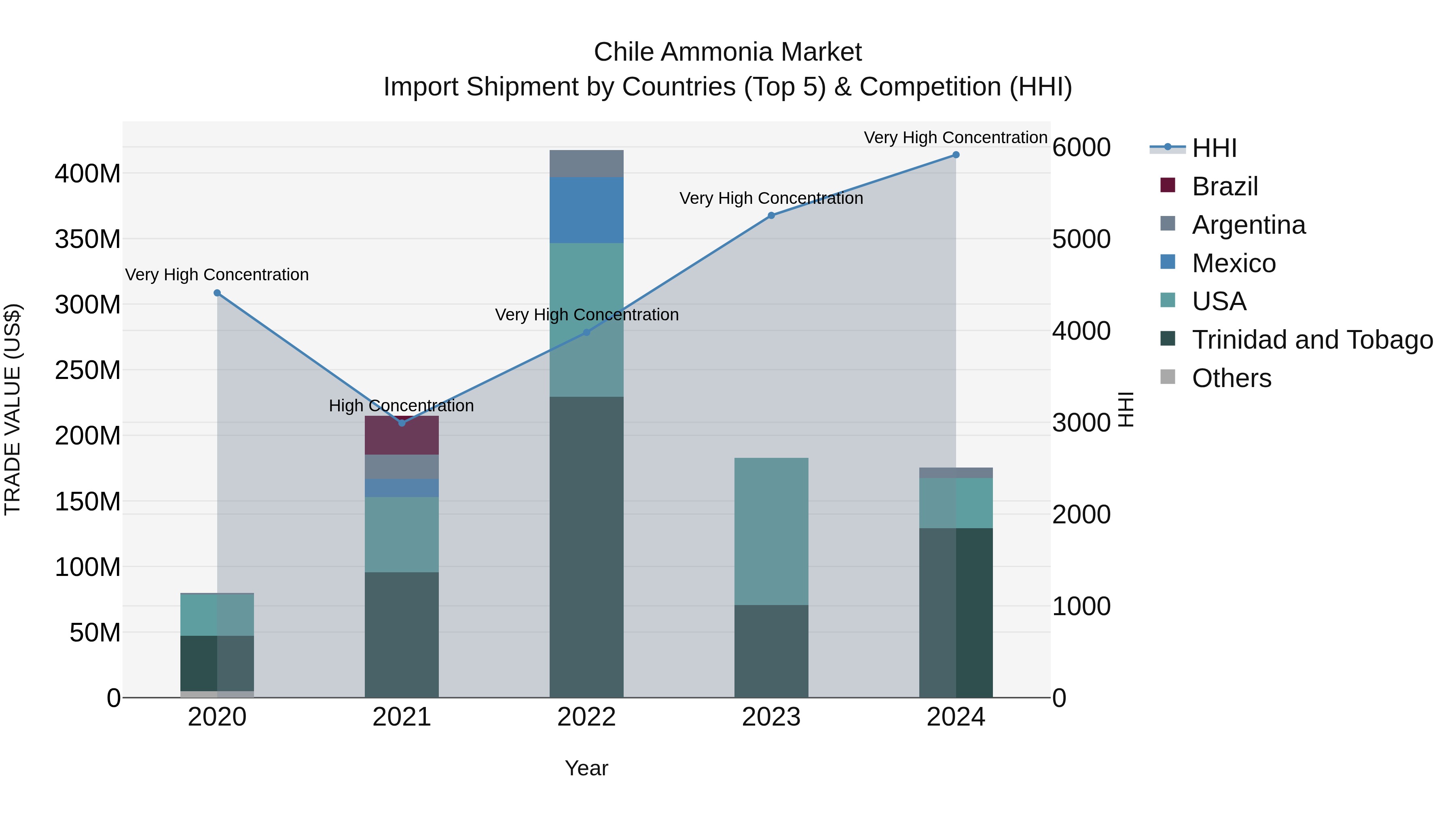
Chile continues to heavily rely on ammonia imports, with top countries including Trinidad and Tobago, USA, and Argentina. The high Herfindahl-Hirschman Index (HHI) indicates a concentrated market in 2024. Despite a strong compound annual growth rate (CAGR) of 21.81% from 2020-24, the slight decline in growth rate from 2023-24 at -4.06% suggests potential market challenges. Monitoring these trends will be crucial for stakeholders in the ammonia import industry in Chile.
Chile Ammonia Market Overview
The Chile ammonia market is experiencing steady growth due to the increasing demand from various sectors such as agriculture, mining, and manufacturing. Ammonia is a key component in fertilizer production, and with Chile being a major agricultural producer, the demand for ammonia remains robust. Additionally, the country`s mining industry relies on ammonia for various processes, further driving market growth. The ammonia market is also witnessing technological advancements to improve production efficiency and reduce environmental impact. With a strong emphasis on sustainable practices, there is a growing trend towards using green ammonia produced from renewable sources. Overall, the Chile ammonia market is poised for continued expansion driven by diverse end-user industries and efforts towards sustainability.
Chile Ammonia Market Trends
The Chile Ammonia Market is experiencing steady growth due to increasing demand from various end-use industries such as agriculture, mining, and chemical manufacturing. The agriculture sector remains a key driver of ammonia consumption in Chile, with farmers using it as a vital component in fertilizers to improve crop yields. Additionally, the mining industry`s continued expansion has led to a rise in demand for ammonia for use in explosives manufacturing. The market is also seeing a shift towards sustainable practices, with a growing interest in green ammonia production methods to reduce environmental impact. Overall, the Chile Ammonia Market is expected to continue its growth trajectory driven by diverse industry applications and a focus on sustainability.
Chile Ammonia Market Challenges
In the Chilean ammonia market, some of the challenges faced include fluctuating global prices of ammonia, which can impact the competitiveness of domestic producers. Additionally, the reliance on imported ammonia due to limited domestic production capacity poses a vulnerability to supply chain disruptions and price fluctuations. Regulatory hurdles and environmental concerns regarding ammonia production and transportation also present challenges for market growth. The need for significant investments in infrastructure and technology to enhance production efficiency and reduce environmental impact further complicates the market landscape. Overall, navigating these challenges requires a strategic approach from market players to ensure sustainable growth and competitiveness in the Chilean ammonia market.
Chile Ammonia Market Investment Opportunities
The Chile Ammonia Market presents promising investment opportunities due to the increasing demand for ammonia in industries such as agriculture, chemical manufacturing, and mining. With Chile being a major global exporter of agricultural products, the need for ammonia as a key fertilizer ingredient is expected to drive market growth. Additionally, the country`s growing industrial sector and mining activities further contribute to the demand for ammonia. Investing in Chile`s ammonia market could prove lucrative, especially considering the government`s support for the development of the mining and agricultural sectors. Potential investment avenues include ammonia production facilities, distribution networks, and partnerships with local companies to leverage the market`s growth potential. Conducting thorough market analysis and understanding regulatory frameworks will be crucial for successful investment in this sector.
Chile Ammonia Market Government Policy
The Chilean government has implemented various policies related to the ammonia market to promote sustainable production and usage. One key policy is the National Program for Sustainable Production and Use of Fertilizers, which aims to increase efficiency in fertilizer production and reduce environmental impact. Additionally, the government has set regulations on the import and use of ammonia to ensure quality standards and promote safety in handling and storage. In terms of taxation, ammonia is subject to value-added tax (VAT) and customs duties upon importation. The government also provides subsidies and incentives to encourage the adoption of ammonia-based fertilizers by farmers. Overall, these policies reflect a commitment to promoting responsible and efficient use of ammonia in Chile`s agricultural sector.
Chile Ammonia Market Future Outlook
The Chile ammonia market is expected to witness steady growth in the upcoming years, driven by increasing demand from various end-use industries such as agriculture, chemicals, and pharmaceuticals. The growing focus on sustainable agricultural practices and the need for efficient fertilizers are key factors contributing to the market`s growth. Additionally, the government`s initiatives to promote the use of ammonia as a clean energy source are expected to further boost market expansion. However, challenges such as fluctuating raw material prices and environmental regulations may pose some constraints. Overall, with the continuous development of infrastructure and technological advancements in ammonia production, the Chile ammonia market is anticipated to show positive growth prospects in the foreseeable future.
Key Highlights of the Report:
- Chile Ammonia Market Outlook
- Market Size of Chile Ammonia Market, 2021
- Forecast of Chile Ammonia Market, 2031
- Historical Data and Forecast of Chile Ammonia Revenues & Volume for the Period 2018 - 2031
- Chile Ammonia Market Trend Evolution
- Chile Ammonia Market Drivers and Challenges
- Chile Ammonia Price Trends
- Chile Ammonia Porter's Five Forces
- Chile Ammonia Industry Life Cycle
- Historical Data and Forecast of Chile Ammonia Market Revenues & Volume By Type for the Period 2018 - 2031
- Historical Data and Forecast of Chile Ammonia Market Revenues & Volume By Liquid for the Period 2018 - 2031
- Historical Data and Forecast of Chile Ammonia Market Revenues & Volume By Gas for the Period 2018 - 2031
- Historical Data and Forecast of Chile Ammonia Market Revenues & Volume By End-user Industry for the Period 2018 - 2031
- Historical Data and Forecast of Chile Ammonia Market Revenues & Volume By Agriculture for the Period 2018 - 2031
- Historical Data and Forecast of Chile Ammonia Market Revenues & Volume By Textiles for the Period 2018 - 2031
- Historical Data and Forecast of Chile Ammonia Market Revenues & Volume By Mining for the Period 2018 - 2031
- Historical Data and Forecast of Chile Ammonia Market Revenues & Volume By Pharmaceutical for the Period 2018 - 2031
- Historical Data and Forecast of Chile Ammonia Market Revenues & Volume By Refrigeration for the Period 2018 - 2031
- Historical Data and Forecast of Chile Ammonia Market Revenues & Volume By Others for the Period 2018 - 2031
- Chile Ammonia Import Export Trade Statistics
- Market Opportunity Assessment By Type
- Market Opportunity Assessment By End-user Industry
- Chile Ammonia Top Companies Market Share
- Chile Ammonia Competitive Benchmarking By Technical and Operational Parameters
- Chile Ammonia Company Profiles
- Chile Ammonia Key Strategic Recommendations






































