Chile Automotive Brake Pads Market Top 5 Importing Countries and Market Competition (HHI) Analysis
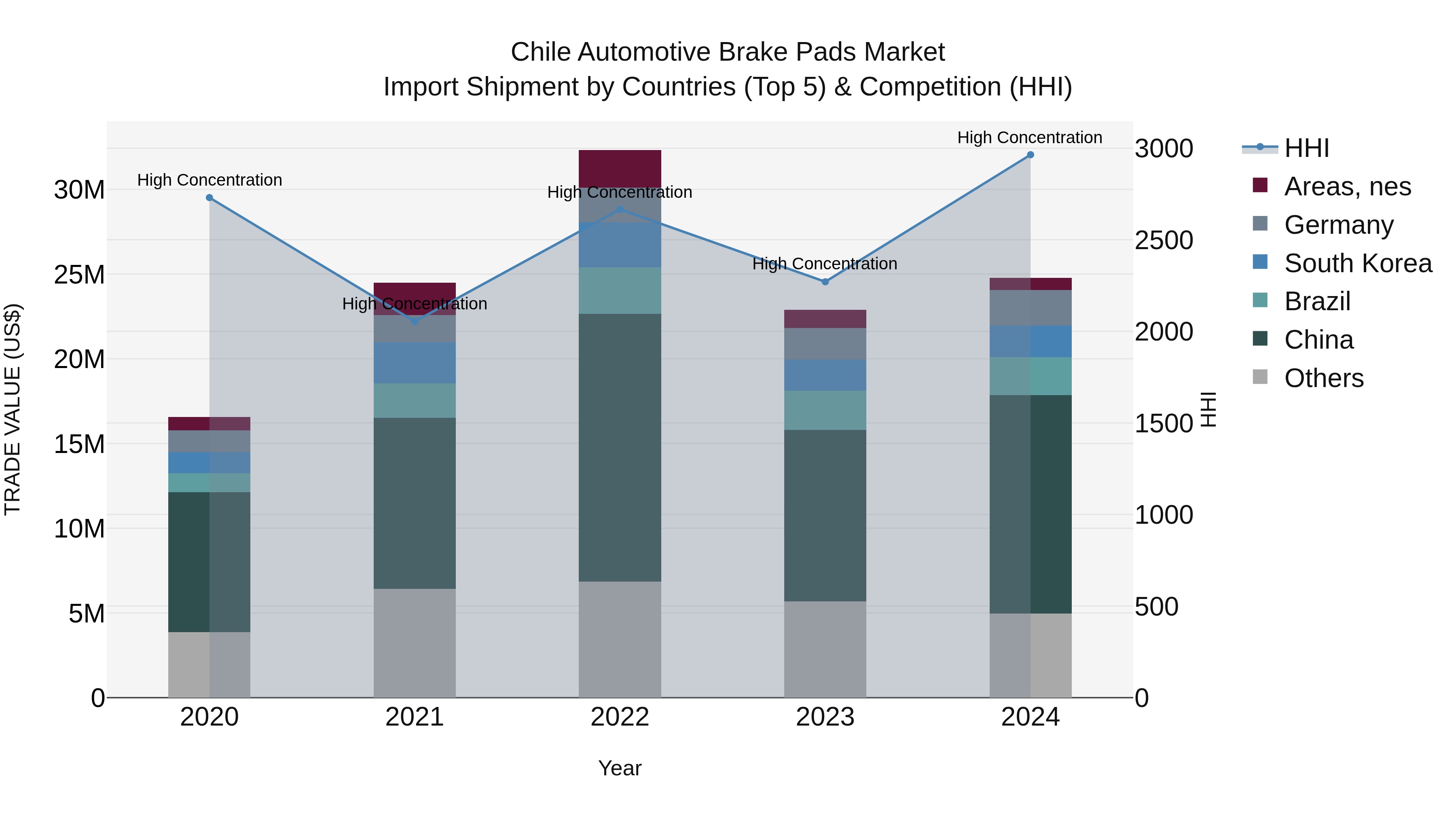
In 2024, Chile continued to rely on imports for automotive brake pads, with key suppliers being China, Brazil, Germany, South Korea, and Italy. The high Herfindahl-Hirschman Index (HHI) indicates a concentrated market. The compound annual growth rate (CAGR) from 2020 to 2024 stood at a healthy 10.59%, showcasing sustained demand. Moreover, the growth rate from 2023 to 2024 was a notable 8.24%, underscoring the momentum in the market. Chile`s automotive sector is poised for further expansion, with diverse sources contributing to the country`s brake pads supply chain.
Chile Automotive Brake Pads Market Overview
The Chile automotive brake pads market is experiencing steady growth driven by increasing vehicle sales and a growing emphasis on vehicle safety. Demand for high-quality brake pads is rising due to stricter safety regulations and a shift towards more advanced braking technologies. Key players in the market are focusing on innovation and product development to meet the evolving needs of consumers. The market is also witnessing a trend towards eco-friendly and noiseless brake pads, reflecting a growing awareness of environmental concerns and customer preferences. Overall, the Chile automotive brake pads market is expected to continue expanding, propelled by technological advancements, increasing vehicle fleet size, and a growing emphasis on road safety.
Chile Automotive Brake Pads Market Trends
Currently, the Chile Automotive Brake Pads Market is experiencing a shift towards eco-friendly and high-performance brake pad materials. There is a growing demand for brake pads made from ceramic and low-metallic compounds, as they offer improved durability, reduced noise, and lower dust emissions compared to traditional semi-metallic pads. Additionally, advancements in technology have led to the development of smart brake pads that can monitor wear levels and provide real-time data to drivers and mechanics. With a focus on safety and environmental concerns, manufacturers in Chile are also investing in research and development to create innovative brake pad solutions that meet stringent regulations and cater to the evolving needs of consumers in the automotive industry.
Chile Automotive Brake Pads Market Challenges
In the Chilean Automotive Brake Pads Market, some challenges faced include increasing competition from both domestic and international manufacturers, fluctuating raw material prices impacting production costs, and the need to comply with stringent government regulations related to environmental standards and safety requirements. Additionally, consumer preference for low-cost brake pads may pose a challenge for manufacturers focusing on producing high-quality, durable products. To stay competitive, companies in the Chilean market must invest in research and development to innovate new brake pad technologies, enhance product performance, and differentiate themselves from competitors. Furthermore, the market`s susceptibility to economic fluctuations and currency exchange rates can also impact the overall demand and pricing strategies within the industry.
Chile Automotive Brake Pads Market Investment Opportunities
The Chile Automotive Brake Pads Market presents promising investment opportunities driven by the growing automotive industry in the country. With increasing vehicle sales and a focus on road safety, there is a rising demand for high-quality brake pads. Investors can capitalize on this trend by investing in companies that manufacture or distribute brake pads within the Chilean market. Additionally, there is potential for innovation and technological advancements in brake pad materials and design to meet the evolving needs of consumers. Collaborating with local automotive manufacturers or suppliers to provide customized solutions can also be a strategic move in this market. Overall, investing in the Chile Automotive Brake Pads Market offers a chance to benefit from the sector`s growth and contribute to enhancing road safety in the country.
Chile Automotive Brake Pads Market Government Policy
The Chilean government has implemented various policies related to the Automotive Brake Pads Market to promote safety and environmental sustainability. One key regulation is the mandatory use of brake pads that meet specific quality and safety standards, aimed at reducing accidents and improving road safety. Additionally, there are regulations in place to limit the use of hazardous materials in brake pad manufacturing, such as asbestos, to minimize environmental impact. The government also encourages the adoption of eco-friendly brake pad alternatives, such as ceramic or organic brake pads, through incentives and awareness campaigns. Overall, these policies aim to ensure the quality and safety of brake pads in the Chilean market while promoting sustainable practices in the automotive industry.
Chile Automotive Brake Pads Market Future Outlook
The Chile Automotive Brake Pads Market is expected to witness moderate growth in the coming years, driven by factors such as increasing vehicle sales, rising awareness about road safety, and stringent regulations regarding vehicle maintenance. The market is likely to benefit from advancements in brake pad technology, leading to improved performance and durability. Additionally, the growing focus on eco-friendly and noiseless brake pads is anticipated to create new opportunities for market players. However, challenges such as fluctuating raw material prices and intense competition among key manufacturers may hinder the market growth to some extent. Overall, the Chile Automotive Brake Pads Market is poised for steady expansion, with a shift towards innovative and sustainable brake pad solutions shaping the industry landscape in the foreseeable future.
Key Highlights of the Report:
- Chile Automotive Brake Pads Market Outlook
- Market Size of Chile Automotive Brake Pads Market, 2021
- Forecast of Chile Automotive Brake Pads Market, 2031
- Historical Data and Forecast of Chile Automotive Brake Pads Revenues & Volume for the Period 2018 - 2031
- Chile Automotive Brake Pads Market Trend Evolution
- Chile Automotive Brake Pads Market Drivers and Challenges
- Chile Automotive Brake Pads Price Trends
- Chile Automotive Brake Pads Porter's Five Forces
- Chile Automotive Brake Pads Industry Life Cycle
- Historical Data and Forecast of Chile Automotive Brake Pads Market Revenues & Volume By Vehicle for the Period 2018 - 2031
- Historical Data and Forecast of Chile Automotive Brake Pads Market Revenues & Volume By Passenger Car for the Period 2018 - 2031
- Historical Data and Forecast of Chile Automotive Brake Pads Market Revenues & Volume By LCV for the Period 2018 - 2031
- Historical Data and Forecast of Chile Automotive Brake Pads Market Revenues & Volume By HCV for the Period 2018 - 2031
- Historical Data and Forecast of Chile Automotive Brake Pads Market Revenues & Volume By Two-wheelers for the Period 2018 - 2031
- Historical Data and Forecast of Chile Automotive Brake Pads Market Revenues & Volume By Material for the Period 2018 - 2031
- Historical Data and Forecast of Chile Automotive Brake Pads Market Revenues & Volume By Semi-metallic for the Period 2018 - 2031
- Historical Data and Forecast of Chile Automotive Brake Pads Market Revenues & Volume By Non-asbestos Organic (NAO) for the Period 2018 - 2031
- Historical Data and Forecast of Chile Automotive Brake Pads Market Revenues & Volume By Low-metallic NAO for the Period 2018 - 2031
- Historical Data and Forecast of Chile Automotive Brake Pads Market Revenues & Volume By Ceramic for the Period 2018 - 2031
- Historical Data and Forecast of Chile Automotive Brake Pads Market Revenues & Volume By Sales Outlet for the Period 2018 - 2031
- Historical Data and Forecast of Chile Automotive Brake Pads Market Revenues & Volume By OEM for the Period 2018 - 2031
- Historical Data and Forecast of Chile Automotive Brake Pads Market Revenues & Volume By Aftermarket for the Period 2018 - 2031
- Historical Data and Forecast of Chile Automotive Brake Pads Market Revenues & Volume By Position for the Period 2018 - 2031
- Historical Data and Forecast of Chile Automotive Brake Pads Market Revenues & Volume By Front for the Period 2018 - 2031
- Historical Data and Forecast of Chile Automotive Brake Pads Market Revenues & Volume By Front & Rear for the Period 2018 - 2031
- Chile Automotive Brake Pads Import Export Trade Statistics
- Market Opportunity Assessment By Vehicle
- Market Opportunity Assessment By Material
- Market Opportunity Assessment By Sales Outlet
- Market Opportunity Assessment By Position
- Chile Automotive Brake Pads Top Companies Market Share
- Chile Automotive Brake Pads Competitive Benchmarking By Technical and Operational Parameters
- Chile Automotive Brake Pads Company Profiles
- Chile Automotive Brake Pads Key Strategic Recommendations






































