Chile Ball Bearings Market Summary
The chile ball bearings market was estimated at USD 155 Million in 2025 and is projected to reach USD 215 Million by 2032, growing at a CAGR of 5.8% from 2026 to 2032.
Chile Ball Bearings Market Year-wise Growth Rate and Key Drivers
This graph highlights how the Chile Ball Bearings Market has steadily grown over the years, supported by major growth factors.
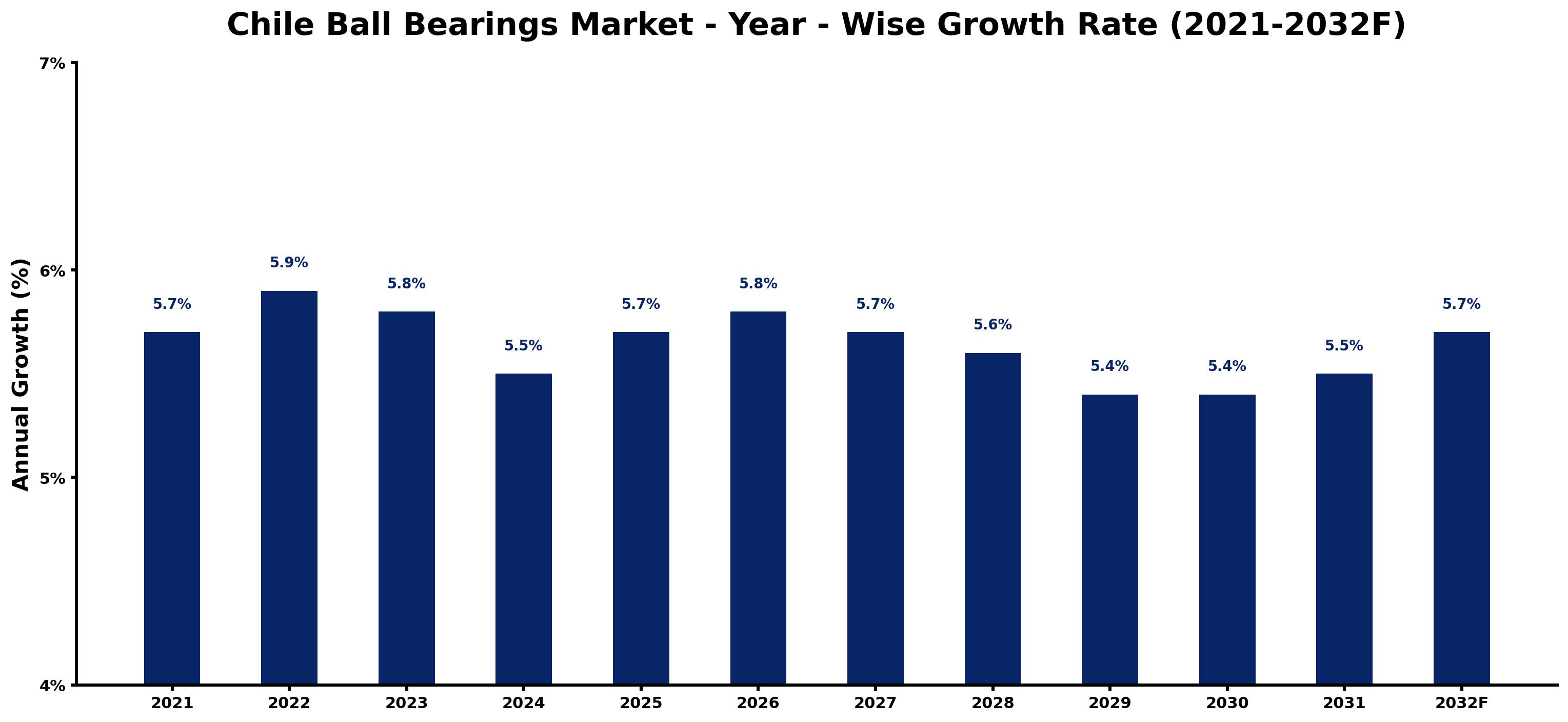
The table below presents the year wise growth rates along with the key drivers influencing the market
| Year | Growth Rate | Major Drivers |
| 2021 | 5.7% | Post-pandemic recovery in manufacturing sectors stimulated demand for efficient ball bearings. |
| 2022 | 5.9% | Increased investment in renewable energy projects created new applications for specialized bearings. |
| 2023 | 5.8% | Chilean mining sector modernization focused on enhanced equipment reliability and maintenance. |
| 2024 | 5.5% | Competitive pressures pushed local manufacturers to innovate with high-performance materials. |
| 2025 | 5.7% | Emerging automotive trends emphasized precision engineering, spurring bearing technology advancements. |
| 2026 | 5.8% | Infrastructure projects aimed at sustainability required innovative solutions in bearing applications. |
| 2027 | 5.7% | Technological upgrades in robotics and automation influenced ball bearing design requirements. |
| 2028 | 5.6% | Market consolidation among key players introduced new distribution channels and pricing strategies. |
| 2029 | 5.4% | Growing emphasis on operational efficiency led to increased demand for high-quality bearings. |
| 2030 | 5.4% | Adoption of Industry 4.0 principles reshaped manufacturing processes, enhancing product lifecycle management. |
| 2031 | 5.5% | Expanding e-commerce logistics networks required optimized performance in transport equipment bearings. |
| 2032 | 5.7% | Sustainability initiatives motivated manufacturers to develop eco-friendly bearing production methods. |
Note - Market size estimations and growth projections presented in this report are based on 6Wresearch's advanced forecasting approach, validated with industry datasets as of June 2026.
Chile Ball Bearings Market Synopsis
The Chile Ball Bearings Market is projected to reach 5.8% and witness significant growth during the forecast period (2026-2032). This growth is primarily fueled by the expanding industrial landscape in Chile, which encompasses key sectors such as automotive, mining, and manufacturing. With a rising demand for high-quality machinery and equipment, the necessity for precision components like ball bearings is increasingly critical for ensuring operational efficiency and reliability in various applications.
Chile Ball Bearings Market Growth Drivers
Several factors are driving the growth of the Chile Ball Bearings Market. The key aspects include:
- Increasing industrial activities in sectors such as automotive and mining are leading to higher demand for ball bearings, essential for machinery performance.
- Technological innovations in bearing materials and designs are yielding enhanced performance, boosting market appeal as industries seek durability and reliability.
- The growth of infrastructure projects supported by government initiatives is further augmenting the market as demand for construction machinery and related equipment rises.
- A shift towards energy-efficient and environmentally friendly products has prompted a growing interest in advanced bearing solutions, which are expected to drive demand.
- The need for custom solutions tailored to specific industrial requirements is fostering a trend towards specialized product offerings, thereby enhancing market dynamics.
Chile Ball Bearings Market Trends and Opportunities
The Chile Ball Bearings Market is witnessing several pivotal trends that are shaping its future. Key trends include:
- Adoption of precision bearings and ceramic bearings is on the rise, driven by their superior durability, reliability, and enhanced performance attributes.
- There is an increasing demand for customized ball bearing solutions that cater to the specific requirements of diverse industries, paving the way for niche market opportunities.
- Sustainability concerns are influencing manufacturers to pursue eco-friendly materials and greener production processes, aligning with global environmental standards.
- Investment in R&D for innovative bearing technologies is becoming crucial as companies aim to differentiate themselves and meet evolving customer expectations.
- The integration of IoT and automation in manufacturing processes is creating new avenues for ball bearings, as businesses seek to enhance operational efficiencies and minimize downtimes.
Chile Ball Bearings Market Challenges and Restraints
While the Chile Ball Bearings Market is poised for growth, several challenges must be addressed to ensure sustained progress. These include:
- Economic volatility in Chile presents a significant risk, affecting demand across key sectors like mining and automotive, which are vital for the ball bearings market.
- Fluctuations in the mining industry can lead to unpredictable demand patterns, complicating market stability for ball bearings.
- Intense competition from global manufacturers, often equipped with advanced technologies and established market presence, poses challenges for local firms seeking to maintain pricing strategies and product differentiation.
- The need for ongoing investment in technology and innovation can strain financial resources for smaller local manufacturers, who may struggle to keep pace with larger competitors.
- Navigating regulatory requirements and standards set by the government can also be challenging, impacting market entry and operational efficiency.
Chile Ball Bearings Market Investment Opportunities
The Chile Ball Bearings Market offers a wealth of investment opportunities, particularly in light of the country's robust industrial expansion. Potential avenues include:
- Manufacturing and supplying high-quality ball bearings to support the growing machinery needs in sectors such as mining, agriculture, and automotive.
- Exploring partnerships with local firms to facilitate market entry and enhance distribution networks across Chilean industries.
- Investing in innovative, environmentally sustainable ball bearing solutions that align with evolving market demands for green technologies.
- Focusing on the production of specialized bearings to meet the unique requirements of niche markets, thus tapping into less competitive segments.
- Considering opportunities in after-sales service and support, which are increasingly critical as industries seek to optimize equipment performance.
Chile Ball Bearings Market Government Investment and Initiatives
The Chilean government has been actively promoting the ball bearings market through various policies and initiatives aimed at fostering industrial competitiveness. Key aspects include:
- Regulations on import tariffs are in place to protect local manufacturers and encourage fair trade practices in the ball bearings sector.
- Specific standards and certifications are established to ensure high product quality and safety, safeguarding consumers and enhancing market credibility.
- Public spending on infrastructure projects is bolstering demand for ball bearings, as investment in industrial capacity ramps up across various sectors.
- Government incentives aimed at technological innovation and research in the manufacturing sector are encouraging companies to invest in advanced bearing technologies.
- Efforts to support sustainable growth through environmental regulations are promoting the development of eco-friendly manufacturing processes within the ball bearings industry.
Chile Ball Bearings Market Latest Developments (May 2025 - June 2026)
Recent developments in the Chile Ball Bearings Market from May 2025 to June 2026 indicate a vibrant industry landscape. Trends observed during this period include:
- Heightened interest in precision and ceramic bearing solutions, as manufacturers seek to enhance performance and durability in competitive applications.
- An increase in collaborative efforts between industry players and research institutions aimed at developing innovative ball bearing technologies.
- Growing emphasis on sustainability, with companies investing in eco-friendly materials and processes to align with global environmental standards.
- Expansion of distribution networks as firms aim to improve access to their products across various industrial sectors.
- A rise in customer-centric approaches, focusing on tailored solutions that address specific industrial requirements, reflecting changing market dynamics.
Chile Ball Bearings Market - Key Attractiveness of the Report
- 10 Years of Market Numbers
- Historical Data Starting from 2022 to 2025
- Base Year: 2025
- Forecast Data until 2032
- Key Performance Indicators Impacting the Market
- Major Upcoming Developments and Projects
Key Highlights of the Report:
- Chile Ball Bearings Market Outlook
- Market Size of Chile Ball Bearings Market, 2025
- Forecast of Chile Ball Bearings Market, 2032F
- Historical Data and Forecast of Chile Ball Bearings Revenues & Volume for the Period 2022-2032F
- Chile Ball Bearings Market Trend Evolution
- Chile Ball Bearings Market Drivers and Challenges
- Chile Ball Bearings Price Trends
- Chile Ball Bearings Porter's Five Forces
- Chile Ball Bearings Industry Life Cycle
- Historical Data and Forecast of Chile Ball Bearings Market Revenues & Volume By Product for the Period 2022-2032F
- Historical Data and Forecast of Chile Ball Bearings Market Revenues & Volume By Deep groove for the Period 2022-2032F
- Historical Data and Forecast of Chile Ball Bearings Market Revenues & Volume By Angular contact for the Period 2022-2032F
- Historical Data and Forecast of Chile Ball Bearings Market Revenues & Volume By Self-aligning for the Period 2022-2032F
- Historical Data and Forecast of Chile Ball Bearings Market Revenues & Volume By Others for the Period 2022-2032F
- Historical Data and Forecast of Chile Ball Bearings Market Revenues & Volume By End-user for the Period 2022-2032F
- Historical Data and Forecast of Chile Ball Bearings Market Revenues & Volume By Automotive industry for the Period 2022-2032F
- Historical Data and Forecast of Chile Ball Bearings Market Revenues & Volume By Heavy industry for the Period 2022-2032F
- Historical Data and Forecast of Chile Ball Bearings Market Revenues & Volume By Aerospace and railway industry for the Period 2022-2032F
- Historical Data and Forecast of Chile Ball Bearings Market Revenues & Volume By Others for the Period 2022-2032F
- Chile Ball Bearings Import Export Trade Statistics
- Market Opportunity Assessment By Product
- Market Opportunity Assessment By End-user
- Chile Ball Bearings Top Companies Market Share
- Chile Ball Bearings Competitive Benchmarking By Technical and Operational Parameters
- Chile Ball Bearings Company Profiles
- Chile Ball Bearings Key Strategic Recommendations






































