Chile Coconut Products Market Top 5 Importing Countries and Market Competition (HHI) Analysis
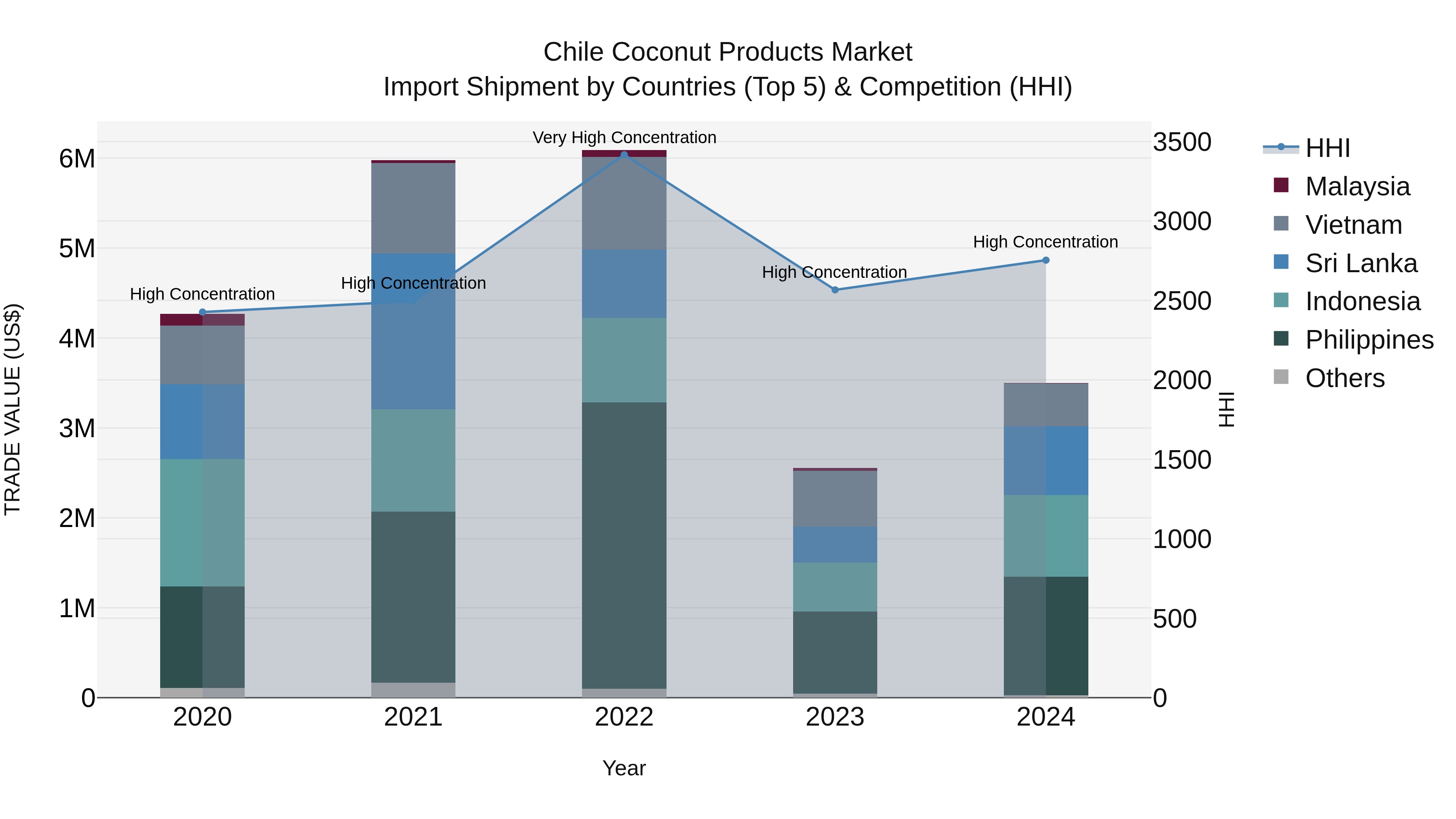
Chile continues to see a steady flow of chile coconut products imports, with top exporting countries being the Philippines, Indonesia, Sri Lanka, Vietnam, and the USA in 2024. Despite a negative compound annual growth rate (CAGR) from 2020 to 2024, there was a notable growth spurt from 2023 to 2024 at a rate of 36.93%. The high Herfindahl-Hirschman Index (HHI) indicates a concentrated market, suggesting that these top exporting countries hold significant market share in Chile`s coconut products import industry. This data signals both challenges and opportunities for market players in the coming years.
Chile Coconut Products Market Overview
The coconut products market in Chile is diverse, encompassing a wide range of items such as coconut water, coconut milk, coconut flour, and shredded coconut. The growing demand for natural and plant-based alternatives has fueled the popularity of coconut products among health-conscious consumers. Chile companies are increasingly innovating to offer coconut-based alternatives in various food and beverage categories.
Drivers of the market
The market for coconut products in Chile is driven by several factors influencing consumer preferences and industry dynamics. Firstly, the growing trend towards healthy and natural lifestyles has increased the demand for coconut-based products due to their nutritional benefits and versatility. Coconut products such as coconut water, milk, cream, and snacks are gaining popularity as alternatives to traditional dairy and snack options, driving market growth. Additionally, the availability of coconuts in Chile, either through domestic cultivation or imports, ensures a steady supply for manufacturing various coconut-based products. Furthermore, innovative product offerings and marketing strategies by industry players enhance consumer engagement and stimulate market expansion.
Challenges of the market
The Chile coconut products market faces challenges related to supply chain management, as well as ensuring product quality and consistency. Fluctuations in coconut prices and availability, coupled with increasing consumer demand for sustainable and organic products, add complexity to market dynamics. Additionally, competition from imported coconut products and alternative ingredients poses challenges for local manufacturers in Chile.
Government Policy of the market
Government policies in Chile regarding the coconut products market aim to foster value addition and export competitiveness. This includes incentives for investment in processing facilities to diversify product offerings beyond coconut oil, such as coconut milk, water, and desiccated coconut. Moreover, regulations prioritize quality control and food safety standards to meet international requirements and enhance market access for Chile coconut products.
Key Highlights of the Report:
- Chile Coconut Products Market Outlook
- Market Size of Chile Coconut Products Market, 2024
- Forecast of Chile Coconut Products Market, 2031
- Historical Data and Forecast of Chile Coconut Products Revenues & Volume for the Period 2021-2031
- Chile Coconut Products Market Trend Evolution
- Chile Coconut Products Market Drivers and Challenges
- Chile Coconut Products Price Trends
- Chile Coconut Products Porter's Five Forces
- Chile Coconut Products Industry Life Cycle
- Historical Data and Forecast of Chile Coconut Products Market Revenues & Volume By Type for the Period 2021-2031
- Historical Data and Forecast of Chile Coconut Products Market Revenues & Volume By Coconut Water for the Period 2021-2031
- Historical Data and Forecast of Chile Coconut Products Market Revenues & Volume By Coconut Oil for the Period 2021-2031
- Historical Data and Forecast of Chile Coconut Products Market Revenues & Volume By Coconut Milk for the Period 2021-2031
- Historical Data and Forecast of Chile Coconut Products Market Revenues & Volume By Dried Coconut Products for the Period 2021-2031
- Historical Data and Forecast of Chile Coconut Products Market Revenues & Volume By Others for the Period 2021-2031
- Historical Data and Forecast of Chile Coconut Products Market Revenues & Volume By Application for the Period 2021-2031
- Historical Data and Forecast of Chile Coconut Products Market Revenues & Volume By Food for the Period 2021-2031
- Historical Data and Forecast of Chile Coconut Products Market Revenues & Volume By Beverage for the Period 2021-2031
- Historical Data and Forecast of Chile Coconut Products Market Revenues & Volume By Cosmetics for the Period 2021-2031
- Historical Data and Forecast of Chile Coconut Products Market Revenues & Volume By Others for the Period 2021-2031
- Historical Data and Forecast of Chile Coconut Products Market Revenues & Volume By Form for the Period 2021-2031
- Historical Data and Forecast of Chile Coconut Products Market Revenues & Volume By Solid for the Period 2021-2031
- Historical Data and Forecast of Chile Coconut Products Market Revenues & Volume By Liquid for the Period 2021-2031
- Chile Coconut Products Import Export Trade Statistics
- Market Opportunity Assessment By Type
- Market Opportunity Assessment By Application
- Market Opportunity Assessment By Form
- Chile Coconut Products Top Companies Market Share
- Chile Coconut Products Competitive Benchmarking By Technical and Operational Parameters
- Chile Coconut Products Company Profiles
- Chile Coconut Products Key Strategic Recommendations






































