Chile Curtains and Window Blinds Market Size, Share & Growth Rate
The Chile Curtains and Window Blinds Market was estimated at USD 1475 Million in 2025 and is projected to reach USD 2641 Million by 2032, growing at a CAGR of 8.7% from 2026 to 2032. This robust growth trajectory is largely attributed to urbanization trends, where more consumers are investing in home aesthetics. Furthermore, the increasing disposable income levels in Chile are enabling homeowners to opt for premium window treatments that enhance both functionality and style.
Chile Curtains and Window Blinds Market Year-wise Growth Rate and Key Drivers
This graph highlights how the Chile Curtains and Window Blinds Market has steadily grown over the years, supported by major growth factors.
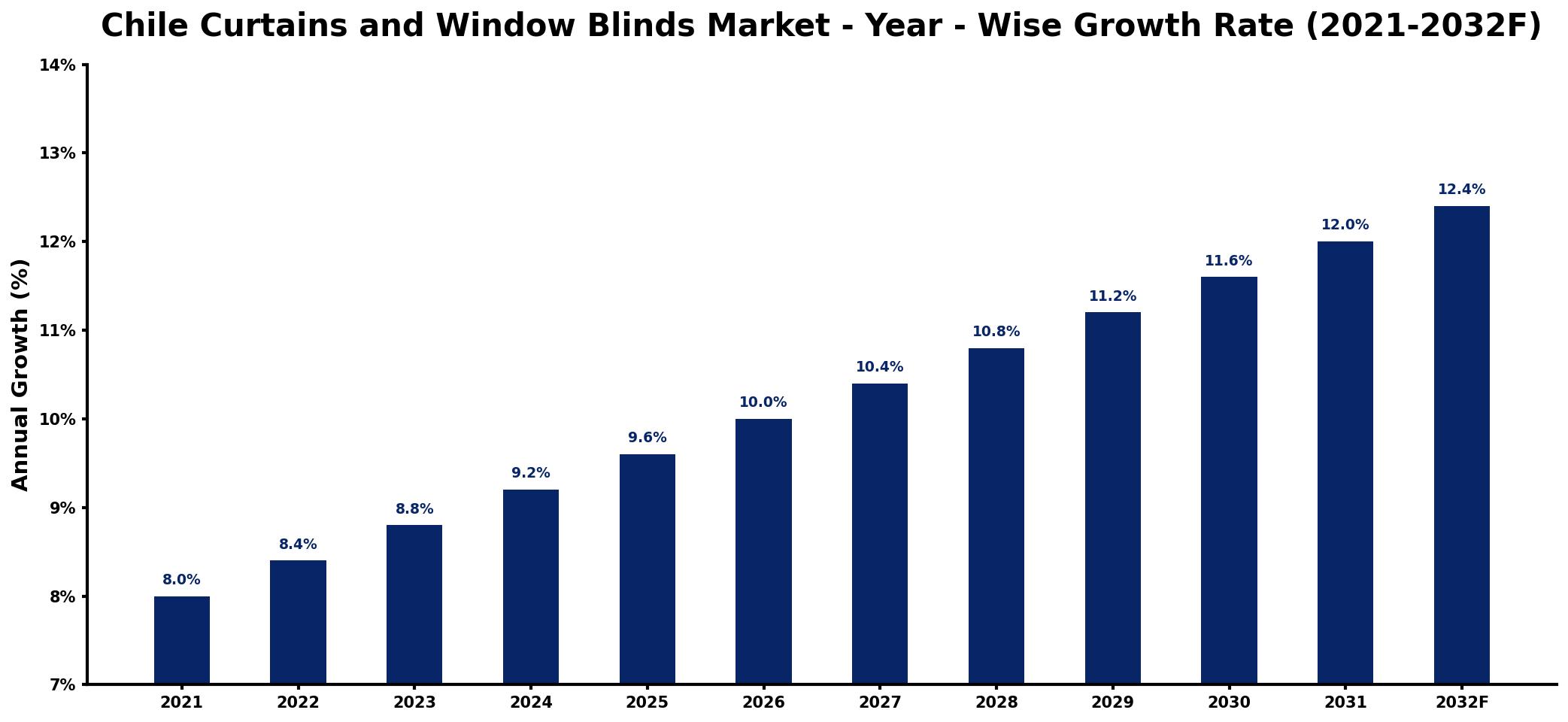
The table below presents the year‑wise growth rates along with the key drivers influencing the market
| Year | Growth Rate | Major Drivers |
| 2021 | 8.0% | Rising home renovation activities |
| 2022 | 8.4% | Increased disposable income levels |
| 2023 | 8.8% | Growing urbanization trends observed |
| 2024 | 9.2% | Surge in interior design projects |
| 2025 | 9.6% | Expansion of real estate developments |
| 2026 | 10.0% | Enhanced focus on energy efficiency |
| 2027 | 10.4% | Higher consumer awareness initiatives |
| 2028 | 10.8% | Investment in smart home technologies |
| 2029 | 11.2% | Flourishing tourism boosting hospitality |
| 2030 | 11.6% | Sustainable materials gaining popularity |
| 2031 | 12.0% | Innovations in automated solutions |
| 2032 | 12.4% | E-commerce growth transforming retail |
Note: Market size estimations and growth projections presented in this report are based on 6Wresearch's proprietary forecasting methodology, utilizing the latest available industry data, government publications, and primary research inputs.
Chile Curtains and Window Blinds Market Synopsis
The Chile Curtains and Window Blinds Market is witnessing a diverse range of products, including various styles and materials tailored to meet the unique demands of the local consumer base. From elegant drapes to modern roller blinds, there is something for everyone, allowing homeowners to personalize their living spaces effectively.
This burgeoning market is increasingly focusing on sustainability and technological advancements. With consumers seeking more eco-friendly options and smart home solutions, manufacturers are innovating to provide products that not only meet aesthetic requirements but also contribute to energy efficiency and environmental sustainability.
Chile Curtains and Window Blinds Market Key Takeaways
- The market is projected to grow significantly, driven by urbanization and increased disposable income.
- There is a notable shift towards eco-friendly materials and smart window treatments.
- Customization and personalization are key trends in consumer preferences.
- Online retail channels are becoming increasingly important for market growth.
- Investment opportunities are abundant for companies focusing on sustainability and technology integration.
Evaluation of Restraints in Chile Curtains and Window Blinds Market
Despite the promising growth landscape, the Chile Curtains and Window Blinds Market faces several constraints. Heightened competition among domestic and international players often results in aggressive pricing strategies, which can compromise profit margins. Additionally, rapid shifts in consumer preferences towards more modern and energy-efficient designs put pressure on companies to innovate continually. Supply chain issues and fluctuations in raw material prices further complicate operational stability, necessitating strategic agility from businesses within the market.
Chile Curtains and Window Blinds Market Trends
The market is currently experiencing a strong inclination towards sustainability, with consumers increasingly gravitating towards products made from organic or recycled materials. Furthermore, smart window treatments are capturing consumer interest, enabling automated control features that align with modern living standards. There is also a notable trend towards minimalist design aesthetics, where simple lines and neutral tones are favored, reflecting changing tastes in home décor.
Chile Curtains and Window Blinds Market Opportunities
For investors and manufacturers, the Chile Curtains and Window Blinds Market offers several lucrative opportunities. The increasing demand for stylish and functional window coverings in both residential and commercial settings creates a fertile ground for high-quality, customizable offerings. With a rising interest in smart blinds, technologies that integrate with home automation systems present a significant avenue for innovation. Collaborating with local distributors and establishing a robust online sales presence can further unlock market potential.
Government Initiatives in the Chile Curtains and Window Blinds Market
The Chilean government has instituted various regulations to bolster consumer safety and promote sustainability within the curtains and window blinds sector. These regulations include fire safety standards and labeling requirements, ensuring that consumers are informed about the materials and safety features of products. Initiatives to encourage the use of eco-friendly materials also play a crucial role in shaping industry practices, aiming to reduce the environmental footprint associated with window treatment products.
Future Insights of the Chile Curtains and Window Blinds Market
Looking ahead to the period between 2026 and 2032, the Chile Curtains and Window Blinds Market is anticipated to evolve significantly. Driven by ongoing urbanization and an increasing emphasis on home aesthetics, the demand for innovative and sustainable window treatment solutions will likely intensify. The growing e-commerce landscape will further facilitate consumer access to a wider array of products, enhancing convenience and choice. However, players in the market will need to remain vigilant of external challenges, such as fluctuating costs and competitive pressures, to fully capitalize on growth opportunities.
Chile Curtains and Window Blinds Market Latest Developments (2025 - 2026)
In recent months, the Chile Curtains and Window Blinds Market has observed a marked increase in innovative product launches that prioritize sustainability and smart technology integration. Companies are leveraging advancements in automation to introduce smart blinds that can be controlled via mobile applications, catering to the modern consumers desire for convenience. Additionally, partnerships between manufacturers and e-commerce platforms have expanded product reach, allowing for more robust market penetration.
Chile Curtains and Window Blinds Market - Key Attractiveness of the Report
- 10 Years of Market Numbers
- Historical Data Starting from 2022 to 2025
- Base Year: 2025
- Forecast Data until 2032
- Key Performance Indicators Impacting the Market
- Major Upcoming Developments and Projects
Key Highlights of the Report:
- Chile Curtains and Window Blinds Market Outlook
- Market Size of Chile Curtains and Window Blinds Market, 2025
- Forecast of Chile Curtains and Window Blinds Market, 2032
- Historical Data and Forecast of Chile Curtains and Window Blinds Revenues & Volume for the Period 2022-2032F
- Chile Curtains and Window Blinds Market Trend Evolution
- Chile Curtains and Window Blinds Market Drivers and Challenges
- Chile Curtains and Window Blinds Price Trends
- Chile Curtains and Window Blinds Porter's Five Forces
- Chile Curtains and Window Blinds Industry Life Cycle
- Historical Data and Forecast of Chile Curtains and Window Blinds Market Revenues & Volume By Materials for the Period 2022-2032F
- Historical Data and Forecast of Chile Curtains and Window Blinds Market Revenues & Volume By Curtains (Cotton, Linen, Polyester) for the Period 2022-2032F
- Historical Data and Forecast of Chile Curtains and Window Blinds Market Revenues & Volume By Window Blinds (Cotton, Linen, Wood, PVC, Metal) for the Period 2022-2032F
- Historical Data and Forecast of Chile Curtains and Window Blinds Market Revenues & Volume By Product for the Period 2022-2032F
- Historical Data and Forecast of Chile Curtains and Window Blinds Market Revenues & Volume By Curtains (Box pleat curtains, Pinch pleat curtains & drapery, Goblet pleat curtains & drapery, Eyelet curtains & drapery) for the Period 2022-2032F
- Historical Data and Forecast of Chile Curtains and Window Blinds Market Revenues & Volume By Window Blinds (Window Shades,, Window Screens, Connected) for the Period 2022-2032F
- Historical Data and Forecast of Chile Curtains and Window Blinds Market Revenues & Volume By Distribution Channel for the Period 2022-2032F
- Historical Data and Forecast of Chile Curtains and Window Blinds Market Revenues & Volume By B2B for the Period 2022-2032F
- Historical Data and Forecast of Chile Curtains and Window Blinds Market Revenues & Volume By B2C for the Period 2022-2032F
- Historical Data and Forecast of Chile Curtains and Window Blinds Market Revenues & Volume By E-commerce for the Period 2022-2032F
- Historical Data and Forecast of Chile Curtains and Window Blinds Market Revenues & Volume By Price Range for the Period 2022-2032F
- Historical Data and Forecast of Chile Curtains and Window Blinds Market Revenues & Volume By High for the Period 2022-2032F
- Historical Data and Forecast of Chile Curtains and Window Blinds Market Revenues & Volume By Medium for the Period 2022-2032F
- Historical Data and Forecast of Chile Curtains and Window Blinds Market Revenues & Volume By Low for the Period 2022-2032F
- Chile Curtains and Window Blinds Import Export Trade Statistics
- Market Opportunity Assessment By Materials
- Market Opportunity Assessment By Product
- Market Opportunity Assessment By Distribution Channel
- Market Opportunity Assessment By Price Range
- Chile Curtains and Window Blinds Top Companies Market Share
- Chile Curtains and Window Blinds Competitive Benchmarking By Technical and Operational Parameters
- Chile Curtains and Window Blinds Company Profiles
- Chile Curtains and Window Blinds Key Strategic Recommendations






































