Chile Edge Data Center Market Size & Growth Rate (2026-2032)
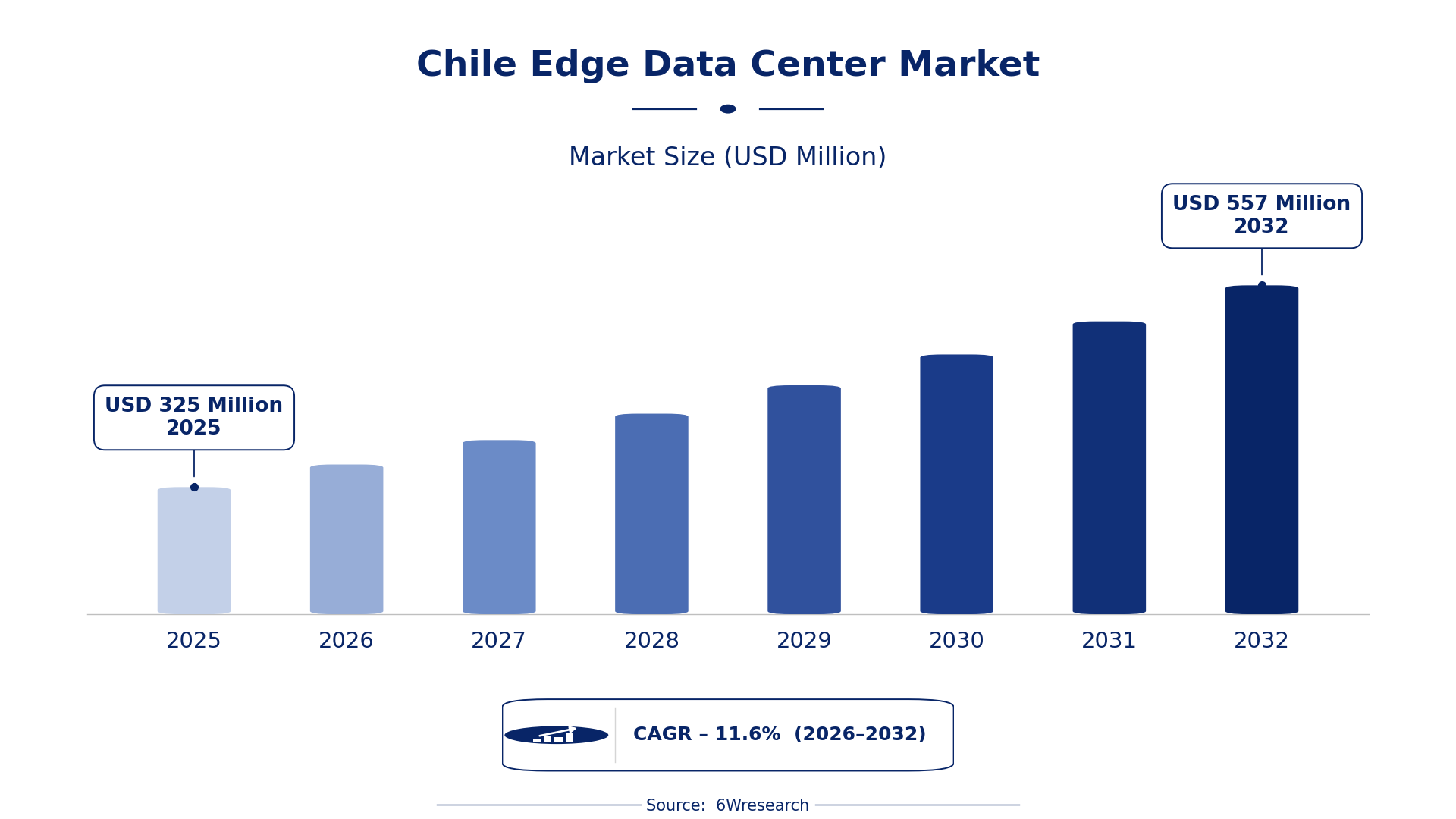
The Chile Edge Data Center Market was estimated at USD 325 Million in 2025 and is projected to reach USD 557 Million by 2032, growing at a CAGR of 11.6% from 2026 to 2032.
Chile Edge Data Center Market Synopsis
The Chile Edge Data Center Market is experiencing a surge in demand, primarily driven by the increasing need for low-latency solutions and high-bandwidth connectivity. This growing requirement is closely linked to the rapid expansion of IoT, AI, and cloud technologies, all of which rely heavily on efficient data processing at the edge.
Additionally, Chile's strategic geographic location and stable political climate enhance its appeal as a data center hub in Latin America. The country's favorable regulatory environment is fostering significant investments from both local and international players, further solidifying its position in the edge data center space.
Chile Edge Data Center Market Year-wise Growth Rate and Key Drivers
This graph illustrates the annual growth rates of the Chile Edge Data Center Market from 2021 to 2032, highlighting a steady upward trajectory and projected expansion over the forecast period.
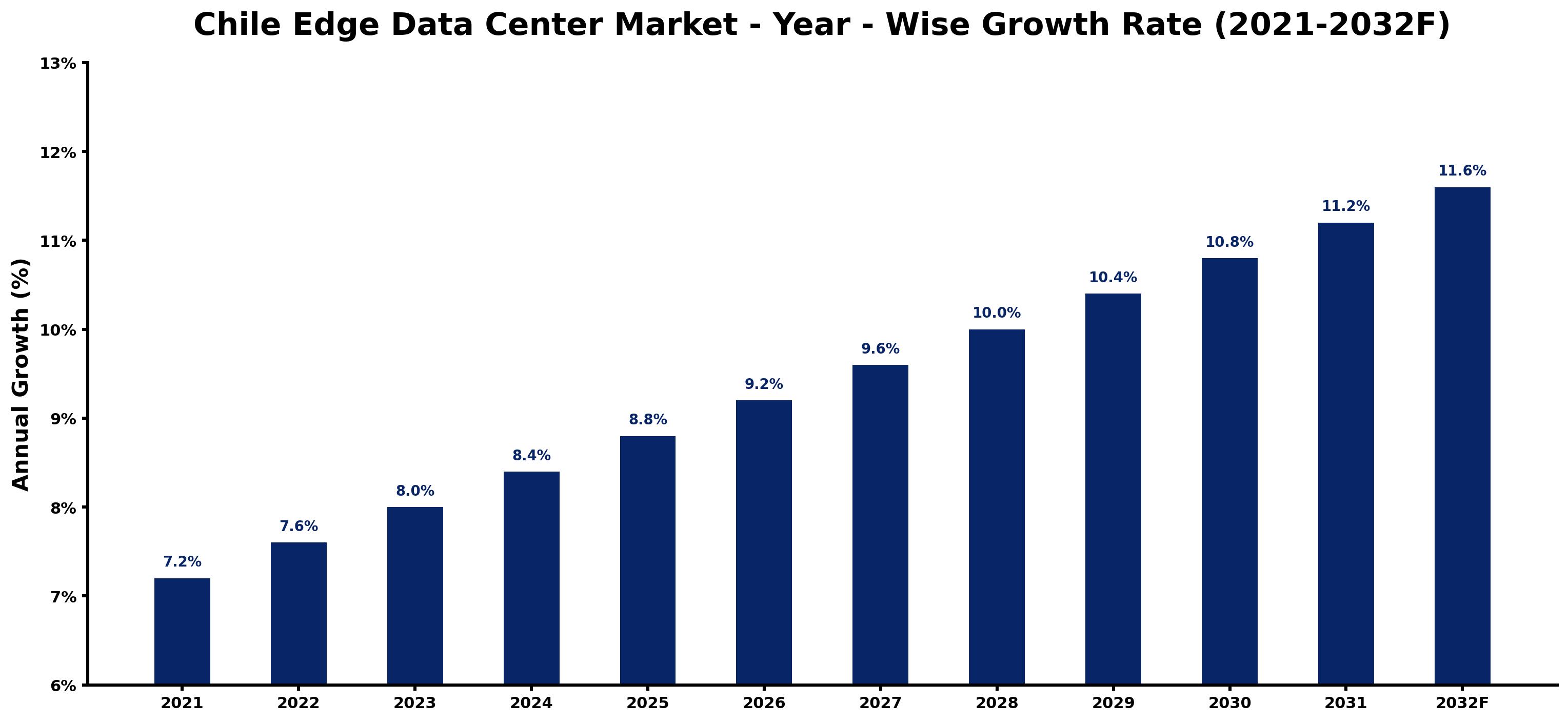
The table below presents the year‑wise growth rates along with the key drivers influencing the market
| Year | Growth Rate | Major Drivers |
| 2021 | 7.2% | ANID promotes advanced technology and digital resources development. |
| 2022 | 7.6% | Increased e-commerce surge boosts local data processing demands. |
| 2023 | 8.0% | Chilean telecom operators enhancing 5G networks for edge solutions. |
| 2024 | 8.4% | Growing adoption of smart devices spurs edge data needs. |
| 2025 | 8.8% | Local businesses digitizing operations require more data proximity. |
| 2026 | 9.2% | Regulatory support for data sovereignty fuels edge expansion. |
| 2027 | 9.6% | Rise in remote work increases demand for local data access. |
| 2028 | 10.0% | Chilean universities accelerating research in edge computing technologies. |
| 2029 | 10.4% | Government's investment in tech parks attracts edge data centers. |
| 2030 | 10.8% | Emerging fintech companies drive increased data processing requirements. |
| 2031 | 11.2% | Urbanization increase necessitates localized data center solutions. |
| 2032 | 11.6% | Sustainability policies boost demand for energy-efficient data centers. |
Note: Market size estimations and growth projections presented in this report are based on 6Wresearch's proprietary forecasting methodology, utilizing the latest available industry data, government publications, and primary research inputs.
Chile Edge Data Center Market Key Takeaways
Below are some of the specific key takeaways from the market, including:
- Chile is becoming a key player in the Latin American edge data center market due to its strategic location and infrastructure.
- Government initiatives are actively promoting investments and improving digital infrastructure in the country.
- The increasing adoption of IoT, AI, and cloud services is driving the demand for edge computing solutions.
- There are opportunities for data center operators to expand their services closer to end-users to meet growing demand.
- Challenges related to skilled workforce availability and infrastructure constraints need to be addressed for sustainable growth.
Evaluation of Restraints in Chile Edge Data Center Market
Despite the promising outlook, several real restraints are affecting the Chile Edge Data Center Market. A significant concern is the limited availability of skilled professionals who can effectively design, deploy, and manage edge computing technologies. As demand escalates for advanced applications requiring low latency, the workforce gap becomes increasingly critical.
on top of that, infrastructure challenges, particularly in remote areas, hinder the establishment of edge locations. Issues such as inconsistent power supply and connectivity can create operational delays. Regulatory hurdles also contribute to the complexity, making it essential for stakeholders to navigate these challenges carefully.
Chile Edge Data Center Market Trends
Several trends are currently shaping the Chile Edge Data Center Market. The rise of 5G technology is significantly influencing the need for edge data centers, as it demands faster processing and lower latency. on top of that, the increasing focus on energy efficiency is prompting operators to adopt more sustainable practices in their data center operations.
Another emerging trend is the growing importance of data localization due to compliance with data sovereignty laws, pushing businesses to establish local data storage solutions. This shift is creating additional demand for edge facilities that can provide localized services while adhering to regulatory requirements.
Chile Edge Data Center Market Opportunities
The Chile Edge Data Center Market is ripe with opportunities for investors and service providers. The increasing proliferation of IoT devices opens doors for localized data processing and analytics, making edge solutions more attractive to businesses across various sectors. Additionally, the government's focus on enhancing digital infrastructure presents a favorable environment for investments.
As businesses undergo digital transformation, the need for agile, efficient data handling at the edge will continue to rise. This trend represents a substantial opportunity for data center operators to innovate and expand their service offerings, ultimately catering to the evolving demands of the market.
Government Initiatives in the Chile Edge Data Center Market
The Chilean government is playing an active role in shaping the Edge Data Center Market through targeted policies and initiatives aimed at enhancing digital infrastructure. By creating a conducive regulatory environment, the government is attracting both local and international investments, which is critical for the market's growth and sustainability.
- The Special Regime for Data Center Investments (REID), recently implemented, provides tax incentives and streamlined permitting processes for data center operators.
- The Fiber Optic Nationalization Plan is currently underway, aimed at improving connectivity across the country.
- A Digital Transformation Strategy has been initiated to bolster the digital infrastructure, emphasizing the need for advanced data handling capabilities.
- A planned public-private partnership expected to launch by mid-2026 aims to enhance telecommunications access in remote regions.
- Ongoing discussions around regulatory frameworks are focused on establishing standards for data center operations and sustainability practices.
Future Insights of the Chile Edge Data Center Market
Looking ahead to 2026-2032, the Chile Edge Data Center Market is expected to witness robust growth driven by the continuous demand for low-latency applications and the proliferation of connected devices. The commitment of the Chilean government to improve digital infrastructure and connectivity will further bolster the development of edge facilities.
As sectors like e-commerce, fintech, and telecommunications expand, they will increasingly rely on efficient data processing at the edge. This evolution signifies a promising horizon for data center operators and investors, who must remain adaptable to the dynamic market conditions.
Chile Edge Data Center Market Latest Developments
In the past year, the Chile Edge Data Center Market has seen a flurry of activities, underscoring its burgeoning potential. Stakeholders are actively investing in infrastructure projects and innovative solutions tailored to meet the growing demand for edge computing capabilities.
- A leading regional operator launched a new edge data center facility in early 2025, significantly enhancing local data processing capabilities.
- Currently, an initiative aimed at improving energy efficiency in data center operations is underway, with several pilot projects in different regions.
- By late 2025, a major technology vendor is expected to introduce new edge computing solutions that cater specifically to the needs of the local market.
- A collaboration between public and private sectors is currently in progress to enhance broadband connectivity in underserved areas, targeting completion by mid-2026.
- A new regulatory framework focusing on data center compliance and sustainability is planned to be introduced in 2026, aiming to standardize operational practices.
Chile Edge Data Center Market - Key Attractiveness of the Report
- 10 Years of Market Numbers
- Historical Data Starting from 2022 to 2025
- Base Year: 2025
- Forecast Data until 2032
- Key Performance Indicators Impacting the Market
- Major Upcoming Developments and Projects
Key Highlights of the Report:
- Chile Edge Data Center Market Outlook
- Market Size of Chile Edge Data Center Market, 2025
- Forecast of Chile Edge Data Center Market, 2032
- Historical Data and Forecast of Chile Edge Data Center Revenues & Volume for the Period 2022-2032F
- Chile Edge Data Center Market Trend Evolution
- Chile Edge Data Center Market Drivers and Challenges
- Chile Edge Data Center Price Trends
- Chile Edge Data Center Porter's Five Forces
- Chile Edge Data Center Industry Life Cycle
- Historical Data and Forecast of Chile Edge Data Center Market Revenues & Volume By Component for the Period 2022-2032F
- Historical Data and Forecast of Chile Edge Data Center Market Revenues & Volume By Solutions for the Period 2022-2032F
- Historical Data and Forecast of Chile Edge Data Center Market Revenues & Volume By Services for the Period 2022-2032F
- Historical Data and Forecast of Chile Edge Data Center Market Revenues & Volume By for the Period 2022-2032F
- Historical Data and Forecast of Chile Edge Data Center Market Revenues & Volume By APAC for the Period 2022-2032F
- Historical Data and Forecast of Chile Edge Data Center Market Revenues & Volume By Facility Size for the Period 2022-2032F
- Historical Data and Forecast of Chile Edge Data Center Market Revenues & Volume By Small for the Period 2022-2032F
- Historical Data and Forecast of Chile Edge Data Center Market Revenues & Volume By Medium Facilities for the Period 2022-2032F
- Historical Data and Forecast of Chile Edge Data Center Market Revenues & Volume By Large Facility for the Period 2022-2032F
- Historical Data and Forecast of Chile Edge Data Center Market Revenues & Volume By Vertical for the Period 2022-2032F
- Historical Data and Forecast of Chile Edge Data Center Market Revenues & Volume By IT and Telecom for the Period 2022-2032F
- Historical Data and Forecast of Chile Edge Data Center Market Revenues & Volume By BFSI for the Period 2022-2032F
- Historical Data and Forecast of Chile Edge Data Center Market Revenues & Volume By Healthcare and Lifesciences for the Period 2022-2032F
- Historical Data and Forecast of Chile Edge Data Center Market Revenues & Volume By Manufacturing for the Period 2022-2032F
- Historical Data and Forecast of Chile Edge Data Center Market Revenues & Volume By Government for the Period 2022-2032F
- Historical Data and Forecast of Chile Edge Data Center Market Revenues & Volume By Automotive for the Period 2022-2032F
- Historical Data and Forecast of Chile Edge Data Center Market Revenues & Volume By Gaming and Entertainment for the Period 2022-2032F
- Historical Data and Forecast of Chile Edge Data Center Market Revenues & Volume By Retail and E-commerce for the Period 2022-2032F
- Chile Edge Data Center Import Export Trade Statistics
- Market Opportunity Assessment By Component
- Market Opportunity Assessment By
- Market Opportunity Assessment By Facility Size
- Market Opportunity Assessment By Vertical
- Chile Edge Data Center Top Companies Market Share
- Chile Edge Data Center Competitive Benchmarking By Technical and Operational Parameters
- Chile Edge Data Center Company Profiles
- Chile Edge Data Center Key Strategic Recommendations






































