Chile Food & Grocery Retail Market Size, Share & Growth Rate
The Chile Food & Grocery Retail Market was estimated at USD 460 Million in 2025 and is projected to reach USD 784 Million by 2032, growing at a CAGR of 7.9% from 2026 to 2032. This growth trajectory is being fueled by a confluence of factors, including rising disposable incomes, an increasingly health-conscious population, and a shift towards online shopping. As consumers demand a broader array of quality products and services, retailers are adapting their strategies to meet these evolving preferences.
Chile Food & Grocery Retail Market Year-wise Growth Rate and Key Drivers
This graph highlights how the Chile Food & Grocery Retail Market has steadily grown over the years, supported by major growth factors.
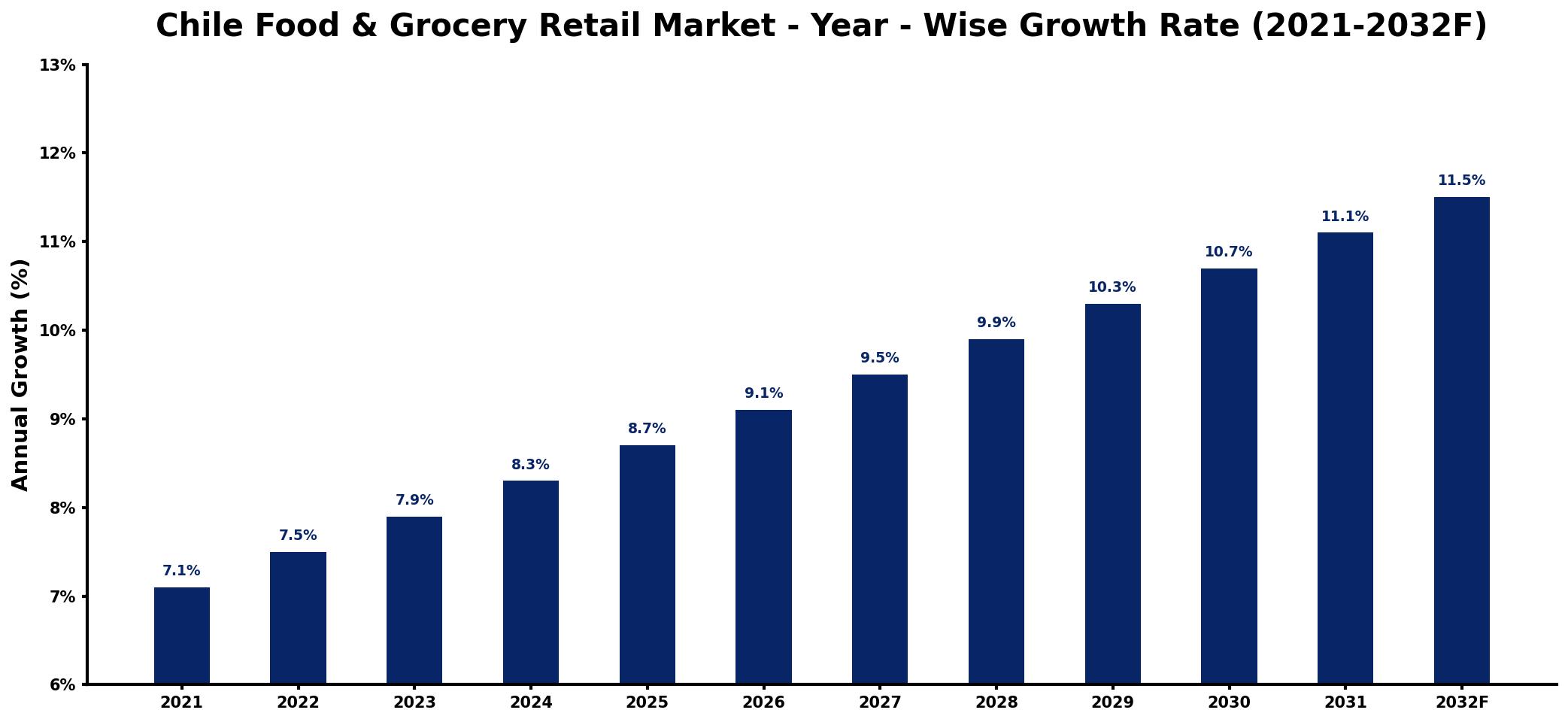
The table below presents the year‑wise growth rates along with the key drivers influencing the market
| Year | Growth Rate | Major Drivers |
| 2021 | 7.1% | rising consumer purchasing power |
| 2022 | 7.5% | expansion of e-commerce platforms |
| 2023 | 7.9% | expanding healthcare application demand |
| 2024 | 8.3% | growth in local sourcing initiatives |
| 2025 | 8.7% | emergence of new market entrants |
| 2026 | 9.1% | enhanced delivery service options |
| 2027 | 9.5% | investments in supply chain technology |
| 2028 | 9.9% | increased demand for convenience products |
| 2029 | 10.3% | enhanced product quality standards |
| 2030 | 10.7% | wider adoption of loyalty programs |
| 2031 | 11.1% | improved raw material availability |
| 2032 | 11.5% | rising interest in sustainable practices |
Note: Market size estimations and growth projections presented in this report are based on 6Wresearch's proprietary forecasting methodology, utilizing the latest available industry data, government publications, and primary research inputs.
Chile Food & Grocery Retail Market Synopsis
Currently, the Chile Food & Grocery Retail Market is witnessing a robust transformation characterized by the integration of e-commerce and a heightened focus on health and sustainability. These shifts have reshaped consumer expectations, prompting retailers to enhance their offerings and embrace technological advancements.
Moreover, the market's competitive landscape is becoming more intense as traditional stores evolve to include modern grocery formats, and new players enter the space. The push for transparency in sourcing and the demand for premium products further reflect a dynamic sector responsive to consumer trends.
- The market is projected to grow significantly, indicating a flourishing retail environment.
- Health-conscious consumers are driving demand for organic and premium food products.
- E-commerce is rapidly transforming how consumers shop for groceries in Chile.
- Retailers are investing in sustainability and ethical sourcing to meet new consumer expectations.
- Government initiatives support healthy eating, creating a conducive environment for market growth.
Despite the promising outlook, the Chile Food & Grocery Retail Market faces several hurdles. The intense competition among both domestic and international retailers exerts pressure on pricing and margins, often leading to price wars. Furthermore, the need to adapt to shifting consumer preferences towards healthier and sustainable options necessitates ongoing innovation, which can be resource-intensive. Regulatory hurdles, including stringent food safety standards and complex labeling requirements, add another layer of complexity that retailers must navigate effectively. The geographic diversity of Chile presents logistical challenges that can complicate distribution and transportation strategies.
Several key trends are currently shaping the Chile Food & Grocery Retail Market. A significant movement towards healthy and organic products is evident, driven by an increasing consumer awareness of health and wellness. The rise of e-commerce continues to gain traction, as online grocery shopping becomes a preferred method for many consumers, highlighting the need for retailers to enhance their digital presence.
Sustainability and ethical sourcing are also emerging as pivotal concerns among consumers, prompting retailers to adopt environmentally-friendly practices. Lastly, there is a growing appetite for premium and gourmet food products, which reflects a shift in consumer behavior towards unique, high-quality offerings.
The Chile Food & Grocery Retail Market presents numerous opportunities for investment and growth. The expanding middle-class demographic is increasingly seeking premium and specialty food items, creating a fertile ground for retailers to introduce innovative products. Additionally, the boom in e-commerce offers a lucrative avenue for investments in digital infrastructure and logistics, further enhancing consumer reach and operational efficiency.
Furthermore, embracing sustainable practices and forming strategic partnerships with local producers can position retailers advantageously within the marketplace. With the right strategies, businesses can capitalize on the evolving preferences of Chilean consumers and the associated market potential.
The Chilean government has taken several steps to regulate and support the Food & Grocery Retail Market. Policies focusing on consumer protection have been implemented to ensure fair pricing and maintain quality standards. Regulations around food labeling and advertising aim to foster transparency and health awareness among consumers. Additionally, the government has developed initiatives targeting small and medium-sized enterprises, providing access to financing and training programs to bolster their competitiveness. Efforts to promote healthy eating habits and reduce food waste further underline the government's commitment to nurturing a sustainable food retail landscape.
Looking ahead to 2026-2032, the Chile Food & Grocery Retail Market is anticipated to continue its upward trajectory. Factors such as rising disposable incomes and increasing consumer preference for healthier and organic products will likely drive market expansion. The trend of convenience and ready-to-eat meals will also play a significant role, along with the anticipated expansion of international food chains within the country.
While challenges such as price competition and regulatory shifts may pose risks, the overall economic climate remains favorable. The evolving demands of consumers, coupled with strategic adaptations by retailers, suggest that innovation and growth will remain at the forefront of the market's development.
In recent months, the Chile Food & Grocery Retail Market has seen notable developments as retailers adapt to changing consumer behaviors. Initiatives aimed at enhancing online shopping experiences are being rolled out, with several companies investing heavily in logistics and technology to streamline order fulfillment. There is also a marked increase in the introduction of health-oriented product lines, aligning with consumer demand for nutritious options. Moreover, collaborative efforts between retailers and local producers are fostering sustainability practices and enhancing the transparency of supply chains.
- 10 Years of Market Numbers
- Historical Data Starting from 2022 to 2025
- Base Year: 2025
- Forecast Data until 2032
- Key Performance Indicators Impacting the Market
- Major Upcoming Developments and Projects
Key Highlights of the Report:
- Chile Food & Grocery Retail Market Outlook
- Market Size of Chile Food & Grocery Retail Market, 2025
- Forecast of Chile Food & Grocery Retail Market, 2032
- Historical Data and Forecast of Chile Food & Grocery Retail Revenues & Volume for the Period 2022-2032F
- Chile Food & Grocery Retail Market Trend Evolution
- Chile Food & Grocery Retail Market Drivers and Challenges
- Chile Food & Grocery Retail Price Trends
- Chile Food & Grocery Retail Porter's Five Forces
- Chile Food & Grocery Retail Industry Life Cycle
- Historical Data and Forecast of Chile Food & Grocery Retail Market Revenues & Volume By Product for the Period 2022-2032F
- Historical Data and Forecast of Chile Food & Grocery Retail Market Revenues & Volume By Fresh Food for the Period 2022-2032F
- Historical Data and Forecast of Chile Food & Grocery Retail Market Revenues & Volume By Frozen Food for the Period 2022-2032F
- Historical Data and Forecast of Chile Food & Grocery Retail Market Revenues & Volume By Food Cupboard for the Period 2022-2032F
- Historical Data and Forecast of Chile Food & Grocery Retail Market Revenues & Volume By Beverages for the Period 2022-2032F
- Historical Data and Forecast of Chile Food & Grocery Retail Market Revenues & Volume By Cleaning & Household for the Period 2022-2032F
- Historical Data and Forecast of Chile Food & Grocery Retail Market Revenues & Volume By Others for the Period 2022-2032F
- Historical Data and Forecast of Chile Food & Grocery Retail Market Revenues & Volume By Distribution Channel for the Period 2022-2032F
- Historical Data and Forecast of Chile Food & Grocery Retail Market Revenues & Volume By Supermarkets & Hypermarkets for the Period 2022-2032F
- Historical Data and Forecast of Chile Food & Grocery Retail Market Revenues & Volume By Convenience Stores for the Period 2022-2032F
- Historical Data and Forecast of Chile Food & Grocery Retail Market Revenues & Volume By Departmental Stores & Clubs for the Period 2022-2032F
- Historical Data and Forecast of Chile Food & Grocery Retail Market Revenues & Volume By Online for the Period 2022-2032F
- Chile Food & Grocery Retail Import Export Trade Statistics
- Market Opportunity Assessment By Product
- Market Opportunity Assessment By Distribution Channel
- Chile Food & Grocery Retail Top Companies Market Share
- Chile Food & Grocery Retail Competitive Benchmarking By Technical and Operational Parameters
- Chile Food & Grocery Retail Company Profiles
- Chile Food & Grocery Retail Key Strategic Recommendations






































