Chile Gas Sensors Market Size, Share & Growth Rate
The Chile Gas Sensors Market was estimated at USD 491 Million in 2025 and is projected to reach USD 668 Million by 2032, growing at a CAGR of 4.5% from 2026 to 2032. This growth trajectory is primarily driven by a mounting focus on environmental monitoring and enhanced safety regulations across critical industries like oil & gas, mining, and manufacturing. As businesses increasingly prioritize compliance with stringent safety standards, the demand for reliable gas detection solutions is set to intensify.
Chile Gas Sensors Market Year-wise Growth Rate and Key Drivers
This graph highlights how the Chile Gas Sensors Market has steadily grown over the years, supported by major growth factors.
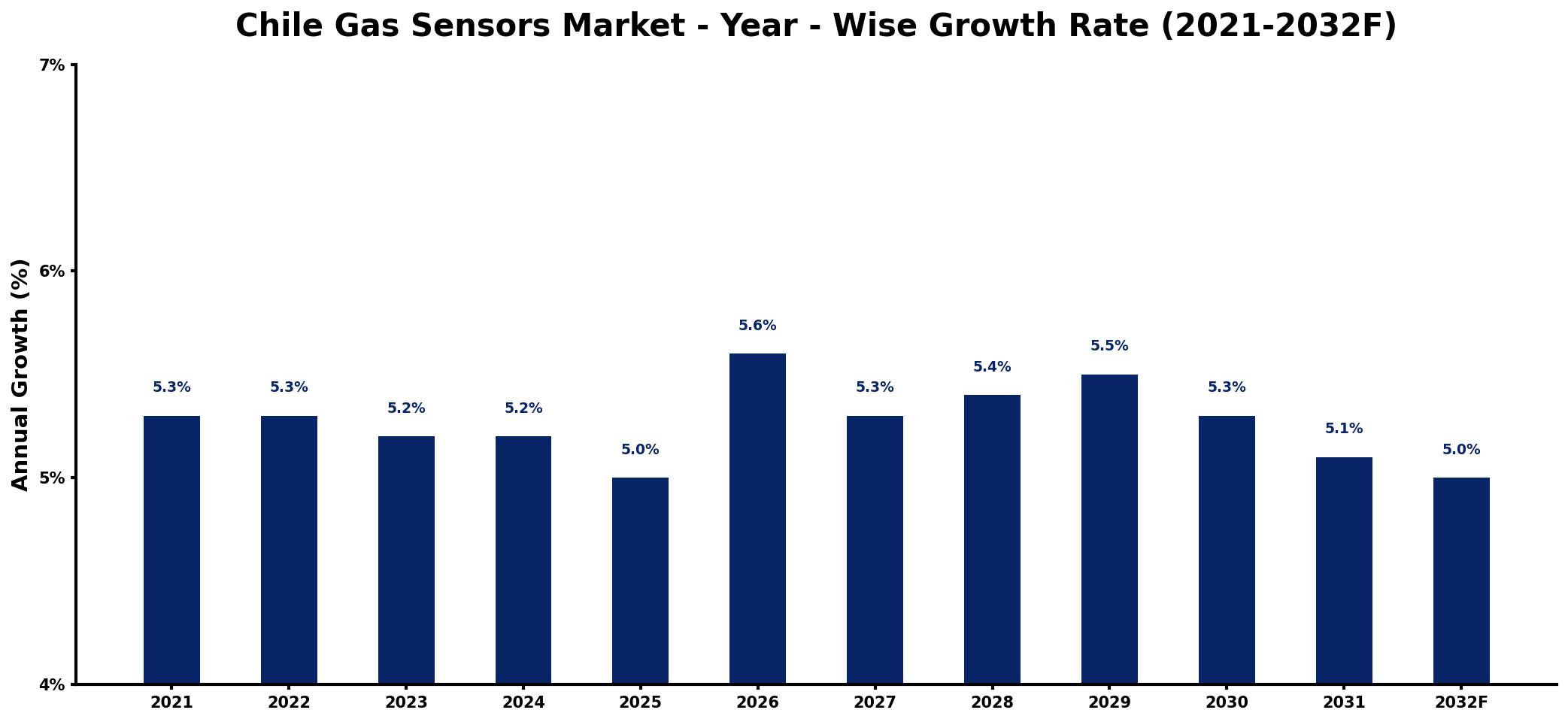
The table below presents the year‑wise growth rates along with the key drivers influencing the market
| Year | Growth Rate | Major Drivers |
| 2021 | 5.3% | Rising industrial safety regulations |
| 2022 | 5.3% | Increased environmental monitoring initiatives |
| 2023 | 5.2% | Growing urbanization and infrastructure projects |
| 2024 | 5.2% | Expansion of renewable energy sectors |
| 2025 | 5.0% | Technological advancements in monitoring |
| 2026 | 5.6% | Enhanced public health awareness campaigns |
| 2027 | 5.3% | Investment in smart city developments |
| 2028 | 5.4% | Growth in manufacturing sector demands |
| 2029 | 5.5% | Emerging applications in agriculture |
| 2030 | 5.3% | Strengthening compliance with international standards |
| 2031 | 5.1% | Focus on pollution control measures |
| 2032 | 5.0% | Adoption of IoT in industries |
Note: Market size estimations and growth projections presented in this report are based on 6Wresearch's proprietary forecasting methodology, utilizing the latest available industry data, government publications, and primary research inputs.
Chile Gas Sensors Market Synopsis
The need for advanced gas sensors in Chile is particularly pronounced in the mining and oil & gas sectors, where detecting hazardous gases such as methane and hydrogen sulfide is crucial for safety and operational efficiency. This rising awareness of workplace safety has prompted companies to adopt innovative sensing technologies that not only improve safety standards but also comply with environmental regulations.
A diverse landscape of local and international manufacturers in the Chile gas sensors market provides a wide array of sensor technologies, including electrochemical, semiconductor, and infrared options. The integration of IoT and AI is further transforming the market, enabling real-time data access and enhancing monitoring capabilities, thus fostering a culture of proactive safety management in various industries.
Chile Gas Sensors Market Key Takeaways
- Demand for gas sensors is driven by regulatory compliance and an emphasis on workplace safety across multiple sectors.
- The integration of IoT and AI technologies is enhancing real-time monitoring capabilities in the market.
- Emerging trends include miniaturization and wireless connectivity, making gas sensors more accessible and user-friendly.
- Investment opportunities abound as Chile focuses on sustainable practices and stringent environmental regulations.
- Government policies are actively promoting the adoption of gas sensors for improved air quality and public safety.
Evaluation of Restraints in Chile Gas Sensors Market
Despite the positive growth outlook, the Chile gas sensors market faces significant challenges. Increasing competition among manufacturers is driving price wars, which can squeeze profit margins. Additionally, the necessity for continuous innovation in sensor technology is critical, as customers demand increasingly precise and reliable solutions. Compliance with evolving environmental and safety standards can also pose hurdles, as companies navigate the complexities of regulation. Fluctuating raw material costs present another concern that can affect manufacturing and pricing strategies, while limited awareness in specific industries may slow market penetration efforts.
Chile Gas Sensors Market Trends
Current trends in the Chile gas sensors market indicate a growing inclination towards sophisticated gas detection technologies. Industries such as oil and gas, automotive, and chemicals are investing in advanced sensing solutions to meet stringent safety regulations. The rise of IoT technology is enabling real-time data monitoring, allowing for enhanced operational efficiency and immediate response capabilities. Furthermore, a shift towards the development of compact, portable sensors reflects a demand for devices that can be easily integrated into various applications, particularly in personal safety and health monitoring.
Chile Gas Sensors Market Opportunities
Investors should view the Chile gas sensors market as a fertile ground for opportunities, driven by rapid industrialization and heightened urbanization. The emphasis on sustainable practices, coupled with a government push for clean energy solutions, indicates a robust potential for innovative gas sensor technologies. Those focused on low-power consumption, real-time monitoring, and remote access capabilities are particularly well-positioned for significant returns. Staying abreast of regulatory changes and technological advancements will be essential for capitalizing on these emerging opportunities.
Government Initiatives in the Chile Gas Sensors Market
The Chilean government is actively promoting the use of gas sensors through various policies aimed at enhancing environmental monitoring. Key initiatives include the National Air Quality Plan, which mandates the installation of gas sensors to monitor urban air quality. Additionally, the Ministry of Energy offers incentives for energy efficiency programs that encourage industrial sectors to adopt gas sensors for reducing emissions. These governmental efforts are designed not only to improve public health but also to foster a culture of compliance and sustainability across industries.
Future Insights of the Chile Gas Sensors Market
Looking ahead, the Chile gas sensors market is expected to maintain a steady growth trajectory through 2026-2032. As environmental concerns intensify, coupled with rising industrial safety standards, the demand for sophisticated gas sensing solutions will likely increase across various sectors. Continued advancements in sensor technology, including improved miniaturization and connectivity, will further enhance market dynamics. The increasing integration of smart city initiatives will also act as a catalyst for demand, positioning the market for sustained growth as technology and regulatory landscapes evolve.
Chile Gas Sensors Market Latest Developments (2025 - 2026)
In recent months, the Chile gas sensors market has seen a wave of innovations focused on enhancing functionality and ease of use. Companies are increasingly adopting miniaturized designs and wireless technology, making installations simpler and more cost-effective. Collaborative projects between technology firms and industrial sectors are emerging, with a focus on developing IoT-enabled sensors that support real-time monitoring and data analytics. Additionally, several government initiatives aimed at promoting air quality management have spurred greater adoption of gas sensing solutions across urban areas.
Chile Gas Sensors Market - Key Attractiveness of the Report
- 10 Years of Market Numbers
- Historical Data Starting from 2022 to 2025
- Base Year: 2025
- Forecast Data until 2032
- Key Performance Indicators Impacting the Market
- Major Upcoming Developments and Projects
Key Highlights of the Report:
- Chile Gas Sensors Market Outlook
- Market Size of Chile Gas Sensors Market, 2025
- Forecast of Chile Gas Sensors Market, 2032
- Historical Data and Forecast of Chile Gas Sensors Revenues & Volume for the Period 2022-2032F
- Chile Gas Sensors Market Trend Evolution
- Chile Gas Sensors Market Drivers and Challenges
- Chile Gas Sensors Price Trends
- Chile Gas Sensors Porter's Five Forces
- Chile Gas Sensors Industry Life Cycle
- Historical Data and Forecast of Chile Gas Sensors Market Revenues & Volume By Product for the Period 2022-2032F
- Historical Data and Forecast of Chile Gas Sensors Market Revenues & Volume By Hydrogen for the Period 2022-2032F
- Historical Data and Forecast of Chile Gas Sensors Market Revenues & Volume By Ammonia for the Period 2022-2032F
- Historical Data and Forecast of Chile Gas Sensors Market Revenues & Volume By Hydrogen Sulfide for the Period 2022-2032F
- Historical Data and Forecast of Chile Gas Sensors Market Revenues & Volume By Methyl Mercaptan Sensor for the Period 2022-2032F
- Historical Data and Forecast of Chile Gas Sensors Market Revenues & Volume By NOx Sensor for the Period 2022-2032F
- Historical Data and Forecast of Chile Gas Sensors Market Revenues & Volume By Carbon Monoxide Sensor for the Period 2022-2032F
- Historical Data and Forecast of Chile Gas Sensors Market Revenues & Volume By Carbon Dioxide Sensor for the Period 2022-2032F
- Historical Data and Forecast of Chile Hydrogen Gas Sensors Market Revenues & Volume By Oxygen/Lambda Sensor for the Period 2022-2032F
- Historical Data and Forecast of Chile Gas Sensors Market Revenues & Volume By Technology for the Period 2022-2032F
- Historical Data and Forecast of Chile Gas Sensors Market Revenues & Volume By Infrared for the Period 2022-2032F
- Historical Data and Forecast of Chile Gas Sensors Market Revenues & Volume By Catalytic for the Period 2022-2032F
- Historical Data and Forecast of Chile Gas Sensors Market Revenues & Volume By Photo-Ionization Detector for the Period 2022-2032F
- Historical Data and Forecast of Chile Gas Sensors Market Revenues & Volume By Solid State/MOS for the Period 2022-2032F
- Historical Data and Forecast of Chile Gas Sensors Market Revenues & Volume By Semiconductor for the Period 2022-2032F
- Historical Data and Forecast of Chile Gas Sensors Market Revenues & Volume By Electrochemical for the Period 2022-2032F
- Chile Gas Sensors Import Export Trade Statistics
- Market Opportunity Assessment By Product
- Market Opportunity Assessment By Technology
- Chile Gas Sensors Top Companies Market Share
- Chile Gas Sensors Competitive Benchmarking By Technical and Operational Parameters
- Chile Gas Sensors Company Profiles
- Chile Gas Sensors Key Strategic Recommendations






































