Chile Greenhouse Horticulture Market Size, Share & Growth Rate
The Chile Greenhouse Horticulture Market was estimated at USD 192 Million in 2025 and is projected to reach USD 209 Million by 2032, growing at a CAGR of 1.2% from 2026 to 2032. This steady growth trajectory is primarily fueled by the rising demand for fresh produce both locally and in export markets, coupled with technological advancements that enhance agricultural practices. Furthermore, supportive government policies aimed at promoting sustainable greenhouse farming play a pivotal role in sustaining market momentum.
Chile Greenhouse Horticulture Market Year-wise Growth Rate and Key Drivers
This graph highlights how the Chile Greenhouse Horticulture Market has steadily grown over the years, supported by major growth factors.
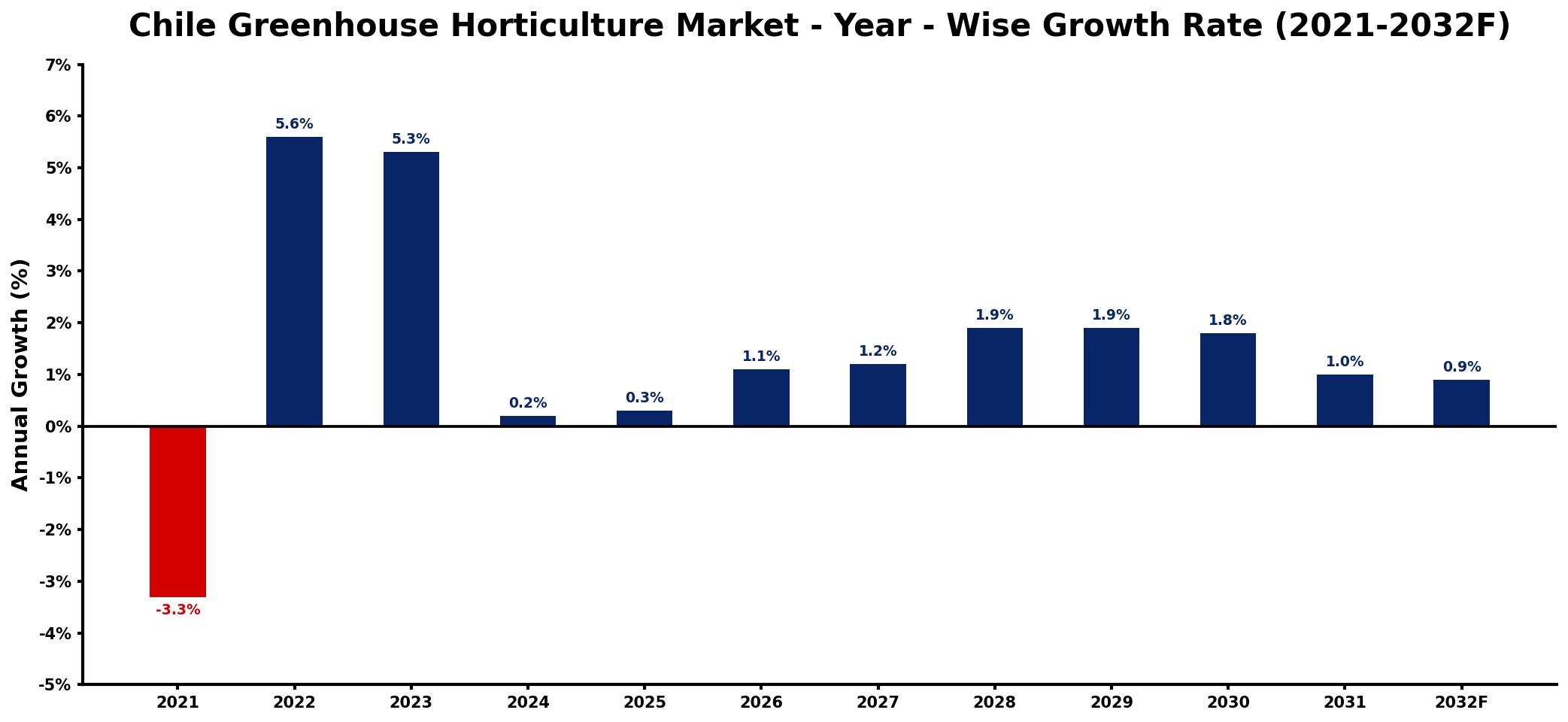
The table below presents the year‑wise growth rates along with the key drivers influencing the market
| Year | Growth Rate | Major Drivers |
| 2021 | -3.3% | Decreased consumer spending on fresh |
| 2022 | 5.6% | Rising demand for organic produce |
| 2023 | 5.3% | Increased investment in technology |
| 2024 | 0.2% | Expansion of local food markets |
| 2025 | 0.3% | Growth in export opportunities |
| 2026 | 1.1% | Rising interest in sustainable practices |
| 2027 | 1.2% | Increased availability of financing options |
| 2028 | 1.9% | rising procurement volume requirements |
| 2029 | 1.9% | rising end-use demand growth |
| 2030 | 1.8% | Emergence of new distribution channels |
| 2031 | 1.0% | Increased collaboration with researchers |
| 2032 | 0.9% | growing regional consumption patterns |
Note: Market size estimations and growth projections presented in this report are based on 6Wresearch's proprietary forecasting methodology, utilizing the latest available industry data, government publications, and primary research inputs.
Chile Greenhouse Horticulture Market Synopsis
The most significant force currently shaping the Chile Greenhouse Horticulture Market is the increasing consumer preference for fresh, locally sourced produce. As consumers become more health-conscious, the demand for high-quality horticultural products like tomatoes, cucumbers, and peppers continues to rise, necessitating innovative approaches in cultivation.
In addition to consumer demand, technological integration within greenhouse operations is driving efficiency and productivity. Growers are increasingly adopting advanced solutions such as climate control systems, hydroponics, and vertical farming practices that not only optimize resource utilization but also bolster crop yields and quality. This transformative shift toward controlled-environment agriculture is positioning Chile as a leader in sustainable horticultural practices.
Chile Greenhouse Horticulture Market Key Takeaways
- The market is experiencing robust growth due to rising fresh produce demand and advanced technologies.
- Technological adoption in greenhouse farming is leading to higher productivity and sustainability.
- Chile's climate and skilled labor force provide a competitive advantage for horticulture producers.
- Government support through incentives and subsidies is fostering growth and innovation in the sector.
- The trend towards organic and specialty crops aligns with shifting consumer preferences for healthier options.
Evaluation of Restraints in Chile Greenhouse Horticulture Market
Despite the optimistic growth outlook, the Chile Greenhouse Horticulture Market faces some noteworthy constraints. Water scarcity is a pressing issue, as the horticulture sector demands substantial water resources, leading to potential conflicts with other industries and communities in this water-stressed region. Moreover, as the industry matures, increased competition among growers could result in price pressures, challenging their ability to maintain profit margins while innovating. Fluctuating export demands and the impact of climate change on agricultural output further complicate the landscape, necessitating strategic adaptation and meticulous planning for sustained success.
Chile Greenhouse Horticulture Market Trends
A surge in controlled-environment agriculture practices is emerging as a key trend within the Chile Greenhouse Horticulture Market. Hydroponics and vertical farming are gaining traction, allowing producers to maximize space and minimize water usage while optimizing crop yields. Furthermore, the consumer shift towards organic and specialty crops reflects a growing demand for healthier and more diverse food options, which is driving growers to diversify their offerings. Automation and smart technology solutions are increasingly being integrated into greenhouse operations, enhancing productivity and operational efficiency, setting the stage for future advancements in the market.
Chile Greenhouse Horticulture Market Opportunities
The investment landscape in the Chile Greenhouse Horticulture Market is ripe with opportunities. With Chile's favorable climate, coupled with a strong focus on technology adoption, investors can explore avenues in greenhouse construction, technology provision, and horticultural product production for export. The countrys reputation for premium agricultural products presents significant returns for ventures in sectors such as berries, avocados, and grapes. Additionally, its strategic geographic location serves as a gateway to major export markets, including the United States and Europe, further enhancing the attractiveness of investments in this dynamic sector.
Government Initiatives in the Chile Greenhouse Horticulture Market
The Chilean government has been proactive in implementing policies that bolster the greenhouse horticulture sector. Financial incentives, including subsidies and tax breaks for greenhouse operators, have been established to encourage industry growth. Moreover, the government invests in research and development initiatives aimed at improving agricultural technology and productivity. Regulations and standards ensuring quality and safety for greenhouse-grown products are also enforced, promoting sustainable practices across the industry. These initiatives not only stimulate innovation but also contribute to the overarching goals of environmental sustainability and food security in the region.
Future Insights of the Chile Greenhouse Horticulture Market
Looking ahead to the years 2026-2032, the future of the Chile Greenhouse Horticulture Market appears optimistic. The persistent consumer demand for fresh, high-quality produce is expected to sustain growth, while advancements in greenhouse technologies will further enhance productivity and sustainability. With the government's continued support for greenhouse initiatives and the growing trend for organic, locally grown products, the market is poised for steady growth. As societal priorities shift toward healthy eating habits and environmentally friendly agricultural practices, the Chile Greenhouse Horticulture Market is well positioned to meet these evolving demands.
Chile Greenhouse Horticulture Market Latest Developments (2025 - 2026)
Recent developments in the Chile Greenhouse Horticulture Market indicate a strong movement toward innovation. A growing number of greenhouse operations are integrating smart technologies to enhance their capabilities, focusing on automation and precision agriculture. Additionally, a wave of interest in organic produce has prompted many growers to shift their cultivation practices, aligning with consumer trends towards healthier food options. The government's ongoing commitment to supporting the sector through financial and infrastructural initiatives is anticipated to yield positive outcomes in the upcoming years.
Chile Greenhouse Horticulture Market - Key Attractiveness of the Report
- 10 Years of Market Numbers
- Historical Data Starting from 2022 to 2025
- Base Year: 2025
- Forecast Data until 2032
- Key Performance Indicators Impacting the Market
- Major Upcoming Developments and Projects
Key Highlights of the Report:
- Chile Greenhouse Horticulture Market Outlook
- Market Size of Chile Greenhouse Horticulture Market, 2025
- Forecast of Chile Greenhouse Horticulture Market, 2032
- Historical Data and Forecast of Chile Greenhouse Horticulture Revenues & Volume for the Period 2022-2032F
- Chile Greenhouse Horticulture Market Trend Evolution
- Chile Greenhouse Horticulture Market Drivers and Challenges
- Chile Greenhouse Horticulture Price Trends
- Chile Greenhouse Horticulture Porter's Five Forces
- Chile Greenhouse Horticulture Industry Life Cycle
- Historical Data and Forecast of Chile Greenhouse Horticulture Market Revenues & Volume By Material Type for the Period 2022-2032F
- Historical Data and Forecast of Chile Greenhouse Horticulture Market Revenues & Volume By Glass for the Period 2022-2032F
- Historical Data and Forecast of Chile Greenhouse Horticulture Market Revenues & Volume By Plastic for the Period 2022-2032F
- Historical Data and Forecast of Chile Greenhouse Horticulture Market Revenues & Volume By Crop Type for the Period 2022-2032F
- Historical Data and Forecast of Chile Greenhouse Horticulture Market Revenues & Volume By Fruits and Vegetables for the Period 2022-2032F
- Historical Data and Forecast of Chile Greenhouse Horticulture Market Revenues & Volume By Flowers and Ornamentals for the Period 2022-2032F
- Historical Data and Forecast of Chile Greenhouse Horticulture Market Revenues & Volume By Nursery Crops for the Period 2022-2032F
- Historical Data and Forecast of Chile Greenhouse Horticulture Market Revenues & Volume By Others for the Period 2022-2032F
- Historical Data and Forecast of Chile Greenhouse Horticulture Market Revenues & Volume By Technology for the Period 2022-2032F
- Historical Data and Forecast of Chile Greenhouse Horticulture Market Revenues & Volume By Heating System for the Period 2022-2032F
- Historical Data and Forecast of Chile Greenhouse Horticulture Market Revenues & Volume By Cooling System for the Period 2022-2032F
- Chile Greenhouse Horticulture Import Export Trade Statistics
- Market Opportunity Assessment By Material Type
- Market Opportunity Assessment By Crop Type
- Market Opportunity Assessment By Technology
- Chile Greenhouse Horticulture Top Companies Market Share
- Chile Greenhouse Horticulture Competitive Benchmarking By Technical and Operational Parameters
- Chile Greenhouse Horticulture Company Profiles
- Chile Greenhouse Horticulture Key Strategic Recommendations






































