Chile Licensed Merchandise Market Size, Share & Growth Rate
The Chile Licensed Merchandise Market was estimated at USD 386 Million in 2025 and is projected to reach USD 562 Million by 2032, growing at a CAGR of 5.5% from 2026 to 2032. This growth trajectory is largely fueled by a robust economy and increasing consumer appetite for high-quality, branded products across entertainment, sports, and fashion sectors. Moreover, the rising influence of e-commerce is expanding accessibility to a diverse range of licensed goods, further stimulating market expansion.
Chile Licensed Merchandise Market Year-wise Growth Rate and Key Drivers
This graph highlights how the Chile Licensed Merchandise Market has steadily grown over the years, supported by major growth factors.
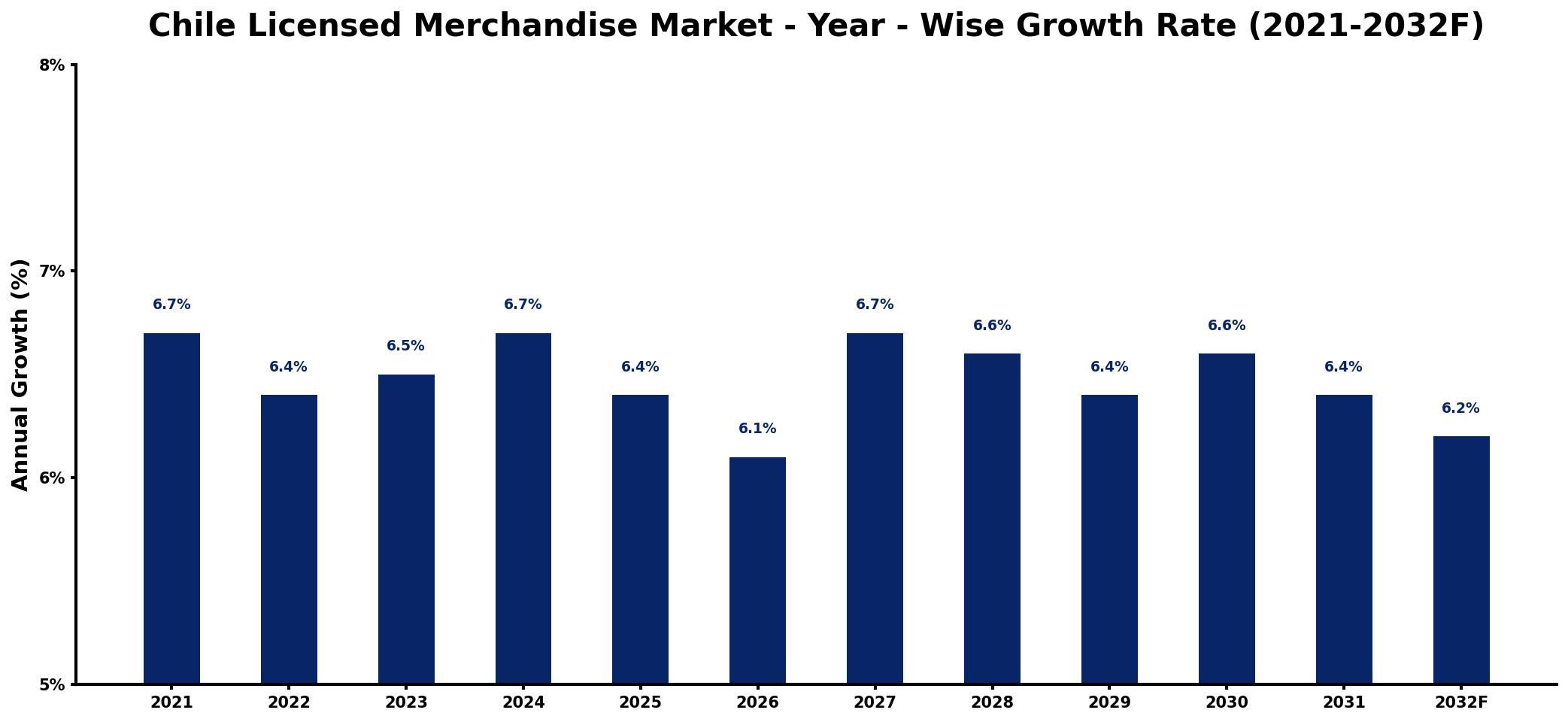
The table below presents the year‑wise growth rates along with the key drivers influencing the market
| Year | Growth Rate | Major Drivers |
| 2021 | 6.7% | Increased consumer spending on experiences |
| 2022 | 6.4% | Rise in digital marketing strategies |
| 2023 | 6.5% | Growth in e-commerce platforms usage |
| 2024 | 6.7% | Expansion of international brand partnerships |
| 2025 | 6.4% | Increased focus on youth culture |
| 2026 | 6.1% | Emergence of new retail formats |
| 2027 | 6.7% | Surge in social media influence |
| 2028 | 6.6% | Growth of experiential retail spaces |
| 2029 | 6.4% | Investment in sustainability initiatives |
| 2030 | 6.6% | stronger distribution network expansion |
| 2031 | 6.4% | Increased demand for personalization |
| 2032 | 6.2% | improved raw material availability |
Note: Market size estimations and growth projections presented in this report are based on 6Wresearch's proprietary forecasting methodology, utilizing the latest available industry data, government publications, and primary research inputs.
Chile Licensed Merchandise Market Synopsis
In Chile, the demand for licensed merchandise is increasingly shaped by the popularity of global franchises, especially among younger consumers. Products ranging from apparel to toys and home decor are aligning closely with beloved characters and brands, which in turn drives engagement and sales.
Moreover, local brands are steadily gaining traction, with consumers seeking authenticity and cultural relevance in their purchases. This trend presents a unique opportunity for both local and international licensors aiming to tap into the Chilean market's evolving preferences.
Chile Licensed Merchandise Market Key Takeaways
- The market is witnessing consistent growth due to rising consumer demand across various sectors.
- E-commerce is a key facilitator, broadening the reach and convenience for consumers purchasing licensed products.
- Sustainability and local authenticity are becoming major purchase drivers among Chilean consumers.
- Investment opportunities exist in licensing agreements with both international and local brands.
- Government policies aim to protect intellectual property and promote fair competition within the market.
Evaluation of Restraints in Chile Licensed Merchandise Market
The Chile Licensed Merchandise Market faces several restraints that could limit its growth potential. The relatively small consumer base compared to larger markets poses a challenge, as does the limited understanding of licensing among some consumers. Additionally, the high costs involved in obtaining licenses can deter new entrants, while the presence of counterfeit merchandise undermines the integrity of authentic products. Companies must navigate these challenges while also differentiating themselves in a competitive landscape that includes both local and global players.
Chile Licensed Merchandise Market Trends
A significant trend within the Chile Licensed Merchandise Market is the growing consumer preference for sustainable and eco-friendly products. As awareness of environmental issues rises, brands that demonstrate social responsibility are increasingly favored. Alongside this, there's a burgeoning interest in locally-inspired merchandise that reflects Chile's unique culture and artistry, drawing consumers who value authenticity in their purchases. Furthermore, digital marketing strategies are evolving, leveraging social media platforms to engage consumers more effectively.
Chile Licensed Merchandise Market Opportunities
Investment opportunities in the Chile Licensed Merchandise Market are ripe, particularly in partnerships with well-known international brands, which can leverage existing consumer loyalty. Local collaborations with artists and designers can also create unique offerings that resonate with Chilean consumers. Additionally, the ongoing expansion of e-commerce platforms provides a crucial avenue for brands to reach wider audiences and enhance their market presence.
Government Initiatives in the Chile Licensed Merchandise Market
The Chilean government has enacted various policies aimed at fostering a robust licensing environment. Intellectual property laws protect the rights of both licensors and licensees, ensuring quality and authenticity of licensed products. Strict import regulations are enforced to curb the influx of counterfeit goods, further supporting the integrity of the market. Additionally, trade agreements with other nations facilitate licensing arrangements and promote equitable competition among market players.
Future Insights of the Chile Licensed Merchandise Market
The outlook for the Chile Licensed Merchandise Market from 2026 to 2032 is positive, with anticipated growth driven by an expanding middle class and increasing disposable income. Consumer interest in branded products, particularly in entertainment and sports, is set to rise. With digital channels becoming more entrenched in shopping behavior, companies that adapt to these trends while focusing on sustainability and local engagement will likely thrive in this evolving landscape.
Chile Licensed Merchandise Market Latest Developments (2025 - 2026)
Recent developments within the Chile Licensed Merchandise Market indicate a shift toward more innovative and eco-friendly product offerings. Companies are increasingly adopting practices that emphasize sustainability, and collaborations with local designers are on the rise. This trend highlights the growing consumer demand for products that reflect both international branding and local cultural elements, creating a unique niche in the marketplace.
Chile Licensed Merchandise Market - Key Attractiveness of the Report
- 10 Years of Market Numbers
- Historical Data Starting from 2022 to 2025
- Base Year: 2025
- Forecast Data until 2032
- Key Performance Indicators Impacting the Market
- Major Upcoming Developments and Projects
Key Highlights of the Report:
- Chile Licensed Merchandise Market Outlook
- Market Size of Chile Licensed Merchandise Market, 2025
- Forecast of Chile Licensed Merchandise Market, 2032
- Historical Data and Forecast of Chile Licensed Merchandise Revenues & Volume for the Period 2022-2032F
- Chile Licensed Merchandise Market Trend Evolution
- Chile Licensed Merchandise Market Drivers and Challenges
- Chile Licensed Merchandise Price Trends
- Chile Licensed Merchandise Porter's Five Forces
- Chile Licensed Merchandise Industry Life Cycle
- Historical Data and Forecast of Chile Licensed Merchandise Market Revenues & Volume By Product Type for the Period 2022-2032F
- Historical Data and Forecast of Chile Licensed Merchandise Market Revenues & Volume By Apparel and Footwear for the Period 2022-2032F
- Historical Data and Forecast of Chile Licensed Merchandise Market Revenues & Volume By Accessories and Gifts for the Period 2022-2032F
- Historical Data and Forecast of Chile Licensed Merchandise Market Revenues & Volume By Toys and Games for the Period 2022-2032F
- Historical Data and Forecast of Chile Licensed Merchandise Market Revenues & Volume By Others for the Period 2022-2032F
- Historical Data and Forecast of Chile Licensed Merchandise Market Revenues & Volume By for the Period 2022-2032F
- Historical Data and Forecast of Chile Licensed Merchandise Market Revenues & Volume By Distribution Channel for the Period 2022-2032F
- Historical Data and Forecast of Chile Licensed Merchandise Market Revenues & Volume By Online Stores for the Period 2022-2032F
- Historical Data and Forecast of Chile Licensed Merchandise Market Revenues & Volume By Supermarkets and Hypermarkets for the Period 2022-2032F
- Historical Data and Forecast of Chile Licensed Merchandise Market Revenues & Volume By Departmental Stores for the Period 2022-2032F
- Historical Data and Forecast of Chile Licensed Merchandise Market Revenues & Volume By Specialty Stores for the Period 2022-2032F
- Historical Data and Forecast of Chile Licensed Merchandise Market Revenues & Volume By Others for the Period 2022-2032F
- Historical Data and Forecast of Chile Licensed Merchandise Market Revenues & Volume By for the Period 2022-2032F
- Historical Data and Forecast of Chile Licensed Merchandise Market Revenues & Volume By Price Range for the Period 2022-2032F
- Historical Data and Forecast of Chile Licensed Merchandise Market Revenues & Volume By Premium for the Period 2022-2032F
- Historical Data and Forecast of Chile Licensed Merchandise Market Revenues & Volume By Economic for the Period 2022-2032F
- Historical Data and Forecast of Chile Licensed Merchandise Market Revenues & Volume By for the Period 2022-2032F
- Historical Data and Forecast of Chile Licensed Merchandise Market Revenues & Volume By End-User for the Period 2022-2032F
- Historical Data and Forecast of Chile Licensed Merchandise Market Revenues & Volume By Men for the Period 2022-2032F
- Historical Data and Forecast of Chile Licensed Merchandise Market Revenues & Volume By Women for the Period 2022-2032F
- Historical Data and Forecast of Chile Licensed Merchandise Market Revenues & Volume By Children for the Period 2022-2032F
- Chile Licensed Merchandise Import Export Trade Statistics
- Market Opportunity Assessment By Product Type
- Market Opportunity Assessment By Distribution Channel
- Market Opportunity Assessment By Price Range
- Market Opportunity Assessment By End-User
- Chile Licensed Merchandise Top Companies Market Share
- Chile Licensed Merchandise Competitive Benchmarking By Technical and Operational Parameters
- Chile Licensed Merchandise Company Profiles
- Chile Licensed Merchandise Key Strategic Recommendations






































