Chile Middleware Market Size & Growth Rate (2026-2032)
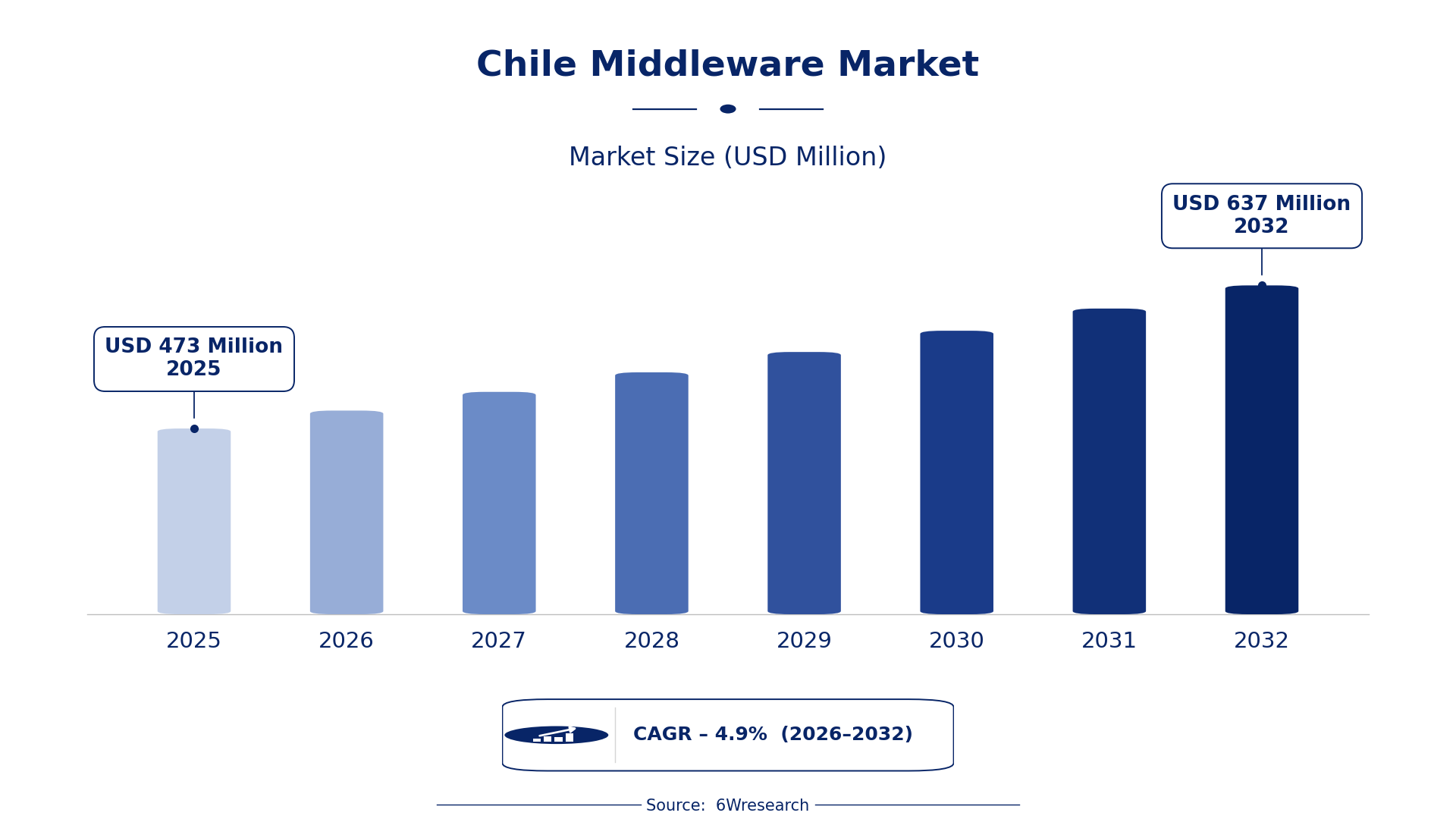
The Chile Middleware Market was estimated at USD 473 Million in 2025 and is projected to reach USD 637 Million by 2032, growing at a CAGR of 4.9% from 2026 to 2032.
Chile Middleware Market Synopsis
The middleware market in Chile is experiencing robust demand driven by the increasing need for integration across various IT systems. As businesses pivot towards digital transformation, middleware solutions have emerged as essential tools for facilitating communication between disparate applications, thereby enhancing operational efficiency.
Industries like finance, healthcare, and manufacturing are at the forefront of this trend, leveraging middleware to streamline processes and improve data exchange. The ongoing digital shift is not merely a passing trend; it reflects a fundamental change in how organizations operate in a connected world.
Chile Middleware Market Year-wise Growth Rate and Key Drivers
This graph illustrates the annual growth rates of the Chile Middleware Market from 2021 to 2032, highlighting a steady upward trajectory and projected expansion over the forecast period.
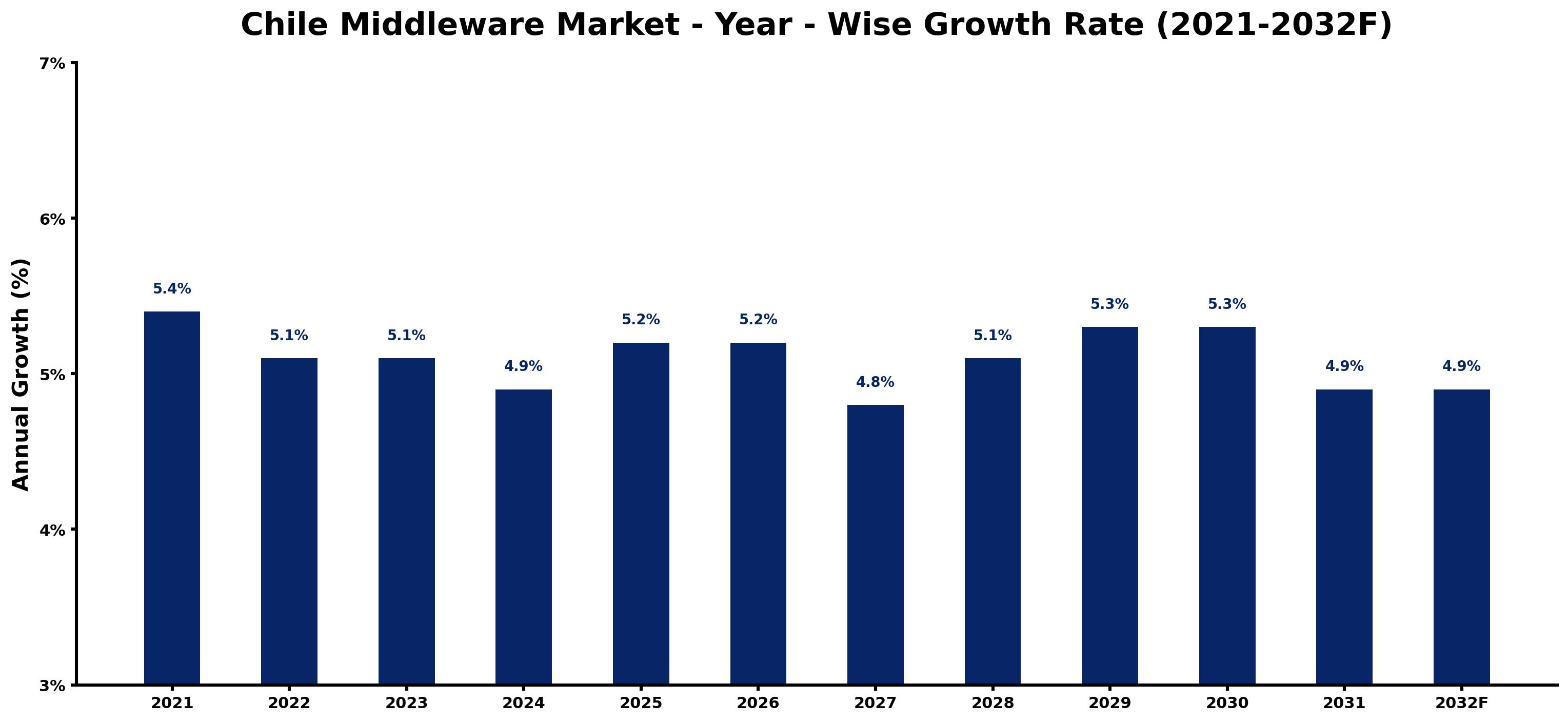
The table below presents the year‑wise growth rates along with the key drivers influencing the market
| Year | Growth Rate | Major Drivers |
| 2021 | 5.4% | Boost in local fintech startups driving middleware needs. |
| 2022 | 5.1% | Chile’s regulatory support for open banking initiatives. |
| 2023 | 5.1% | Growing e-commerce sector requiring enhanced data integration. |
| 2024 | 4.9% | Increased mobile app development boosting middleware solutions. |
| 2025 | 5.2% | Government funding for smart city digital infrastructure projects. |
| 2026 | 5.2% | Surge in IoT deployments increasing middleware demand. |
| 2027 | 4.8% | Local universities enhancing IT curriculum for middleware skills. |
| 2028 | 5.1% | High demand for digital payment solutions in retail. |
| 2029 | 5.3% | Rising cybersecurity regulations pushing for middleware security features. |
| 2030 | 5.3% | Emergence of AI technologies demanding advanced middleware support. |
| 2031 | 4.9% | Regional growth in tech hubs increasing software partnerships. |
| 2032 | 4.9% | Local manufacturers investing in automated software systems. |
Note: Market size estimations and growth projections presented in this report are based on 6Wresearch's proprietary forecasting methodology, utilizing the latest available industry data, government publications, and primary research inputs.
Chile Middleware Market Key Takeaways
Below are some of the specific key takeaways from the market, including:
- The middleware market is crucial for enabling interoperability among diverse IT systems.
- Cloud computing and IoT are primary drivers of middleware adoption in Chile.
- Integration complexities and skilled workforce shortages present real challenges.
- Government policies are shaping the regulatory framework around data protection and cybersecurity.
- Digital transformation initiatives across key sectors are fueling demand for middleware solutions.
Evaluation of Restraints in Chile Middleware Market
Despite its growth potential, the middleware market in Chile faces several restraints. Interoperability issues among varied IT systems can hinder effective integration, leading to operational inefficiencies. Organizations often grapple with the complexities of integrating new solutions with legacy systems, which can stall digital transformation efforts. on top of that, a shortage of skilled IT professionals capable of implementing and managing middleware solutions exacerbates these challenges, limiting market expansion.
Chile Middleware Market Trends
Current trends indicate an accelerating adoption of cloud-based middleware solutions, driven by the need for scalability and flexibility. The Internet of Things (IoT) is also gaining traction, prompting businesses to seek middleware that can handle real-time data processing and integration. Additionally, there is a growing emphasis on security features in middleware solutions, as organizations prioritize safeguarding sensitive data against breaches.
Chile Middleware Market Opportunities
A wealth of opportunities exists within the Chile Middleware Market, particularly for vendors that can offer innovative integration solutions tailored to specific industries. The push for digital transformation across sectors presents a fertile ground for middleware providers to introduce their offerings. on top of that, the integration of artificial intelligence and machine learning into middleware solutions can enhance operational capabilities, presenting new avenues for growth.
Government Initiatives in the Chile Middleware Market
Government initiatives are increasingly influential in shaping the middleware market in Chile, particularly in the context of information and communication technology (ICT) infrastructure. Regulatory frameworks focused on data privacy and cybersecurity are pivotal in guiding middleware adoption across various sectors, ensuring that organizations meet compliance standards while enhancing operational efficiency.
- A national digital infrastructure upgrade programme now in its rollout phase aims to enhance connectivity and accessibility across urban and rural areas.
- A regulatory framework introduced in 2025 mandates stricter data protection measures for organizations, impacting middleware solutions' design and implementation.
- The government is currently promoting an initiative to improve interoperability standards among public sector IT systems, enhancing data sharing capabilities.
- A planned public-private initiative is expected to expand training programs for IT professionals, addressing the skills gap in middleware technologies by 2028.
Future Insights of the Chile Middleware Market
Looking ahead, the Chile Middleware Market is set to experience sustained growth driven by the ongoing digital transformation across industries. As organizations increasingly recognize the importance of integration in achieving operational agility, the demand for sophisticated middleware solutions will intensify. By 2032, we anticipate a more mature market landscape, characterized by advanced technologies that facilitate seamless communication and data exchange.
Chile Middleware Market Latest Developments
Recent developments in the Chile Middleware Market highlight a dynamic shift towards innovative solutions designed to meet the evolving needs of businesses. Over the past year, several significant initiatives have emerged, reflecting the market's response to increasing integration demands.
- A new middleware platform was launched in early 2025, providing enhanced capabilities for IoT integration, which has gained traction among manufacturing firms.
- An initiative that began in mid-2025 and remains underway focuses on upgrading existing middleware solutions to incorporate advanced security features, addressing growing data protection concerns.
- A partnership between technology vendors and educational institutions is currently facilitating training programs aimed at upskilling IT professionals in middleware technologies.
- A rollout expected to begin in the second half of 2026 will introduce a cloud-based middleware solution specifically tailored for the financial services sector.
Chile Middleware Market - Key Attractiveness of the Report
- 10 Years of Market Numbers
- Historical Data Starting from 2022 to 2025
- Base Year: 2025
- Forecast Data until 2032
- Key Performance Indicators Impacting the Market
- Major Upcoming Developments and Projects
Key Highlights of the Report:
- Chile Middleware Market Outlook
- Market Size of Chile Middleware Market, 2025
- Forecast of Chile Middleware Market, 2032
- Historical Data and Forecast of Chile Middleware Revenues & Volume for the Period 2022-2032F
- Chile Middleware Market Trend Evolution
- Chile Middleware Market Drivers and Challenges
- Chile Middleware Price Trends
- Chile Middleware Porter's Five Forces
- Chile Middleware Industry Life Cycle
- Historical Data and Forecast of Chile Middleware Market Revenues & Volume By Product Type for the Period 2022-2032F
- Historical Data and Forecast of Chile Middleware Market Revenues & Volume By Communication Middleware for the Period 2022-2032F
- Historical Data and Forecast of Chile Middleware Market Revenues & Volume By Platform Middleware for the Period 2022-2032F
- Historical Data and Forecast of Chile Middleware Market Revenues & Volume By Integration Middleware for the Period 2022-2032F
- Historical Data and Forecast of Chile Middleware Market Revenues & Volume By Others for the Period 2022-2032F
- Historical Data and Forecast of Chile Middleware Market Revenues & Volume By Deployment Types for the Period 2022-2032F
- Historical Data and Forecast of Chile Middleware Market Revenues & Volume By On-Premise for the Period 2022-2032F
- Historical Data and Forecast of Chile Middleware Market Revenues & Volume By Hosted for the Period 2022-2032F
- Historical Data and Forecast of Chile Middleware Market Revenues & Volume By Hybrid for the Period 2022-2032F
- Historical Data and Forecast of Chile Middleware Market Revenues & Volume By Organization Size for the Period 2022-2032F
- Historical Data and Forecast of Chile Middleware Market Revenues & Volume By Small businesses for the Period 2022-2032F
- Historical Data and Forecast of Chile Middleware Market Revenues & Volume By Medium businesses for the Period 2022-2032F
- Historical Data and Forecast of Chile Middleware Market Revenues & Volume By Enterprises for the Period 2022-2032F
- Historical Data and Forecast of Chile Middleware Market Revenues & Volume By Large enterprises for the Period 2022-2032F
- Historical Data and Forecast of Chile Middleware Market Revenues & Volume By Verticals for the Period 2022-2032F
- Historical Data and Forecast of Chile Middleware Market Revenues & Volume By Banking, financial services and insurance (BFSI) for the Period 2022-2032F
- Historical Data and Forecast of Chile Middleware Market Revenues & Volume By Consumer Goods and Retail for the Period 2022-2032F
- Historical Data and Forecast of Chile Middleware Market Revenues & Volume By IT and telecom for the Period 2022-2032F
- Historical Data and Forecast of Chile Middleware Market Revenues & Volume By Manufacturing for the Period 2022-2032F
- Historical Data and Forecast of Chile Middleware Market Revenues & Volume By Oil and Gas for the Period 2022-2032F
- Historical Data and Forecast of Chile Middleware Market Revenues & Volume By Healthcare for the Period 2022-2032F
- Historical Data and Forecast of Chile Middleware Market Revenues & Volume By Government for the Period 2022-2032F
- Chile Middleware Import Export Trade Statistics
- Market Opportunity Assessment By Product Type
- Market Opportunity Assessment By Deployment Types
- Market Opportunity Assessment By Organization Size
- Market Opportunity Assessment By Verticals
- Chile Middleware Top Companies Market Share
- Chile Middleware Competitive Benchmarking By Technical and Operational Parameters
- Chile Middleware Company Profiles
- Chile Middleware Key Strategic Recommendations






































