Chile Military Laser Rangefinder Market Size, Share & Growth Rate
The Chile Military Laser Rangefinder Market was estimated at USD 380 Million in 2025 and is projected to reach USD 512 Million by 2032, growing at a CAGR of 4.4% from 2026 to 2032. This growth trajectory reflects a rising demand for precision in military operations, particularly as the Chilean Armed Forces pursue advanced technology to enhance their capabilities. The integration of laser rangefinding technology within existing military systems, combined with a focus on improving operational efficiency and accuracy in targeting, is further fueling this upward trend.
Chile Military Laser Rangefinder Market Year-wise Growth Rate and Key Drivers
This graph highlights how the Chile Military Laser Rangefinder Market has steadily grown over the years, supported by major growth factors.
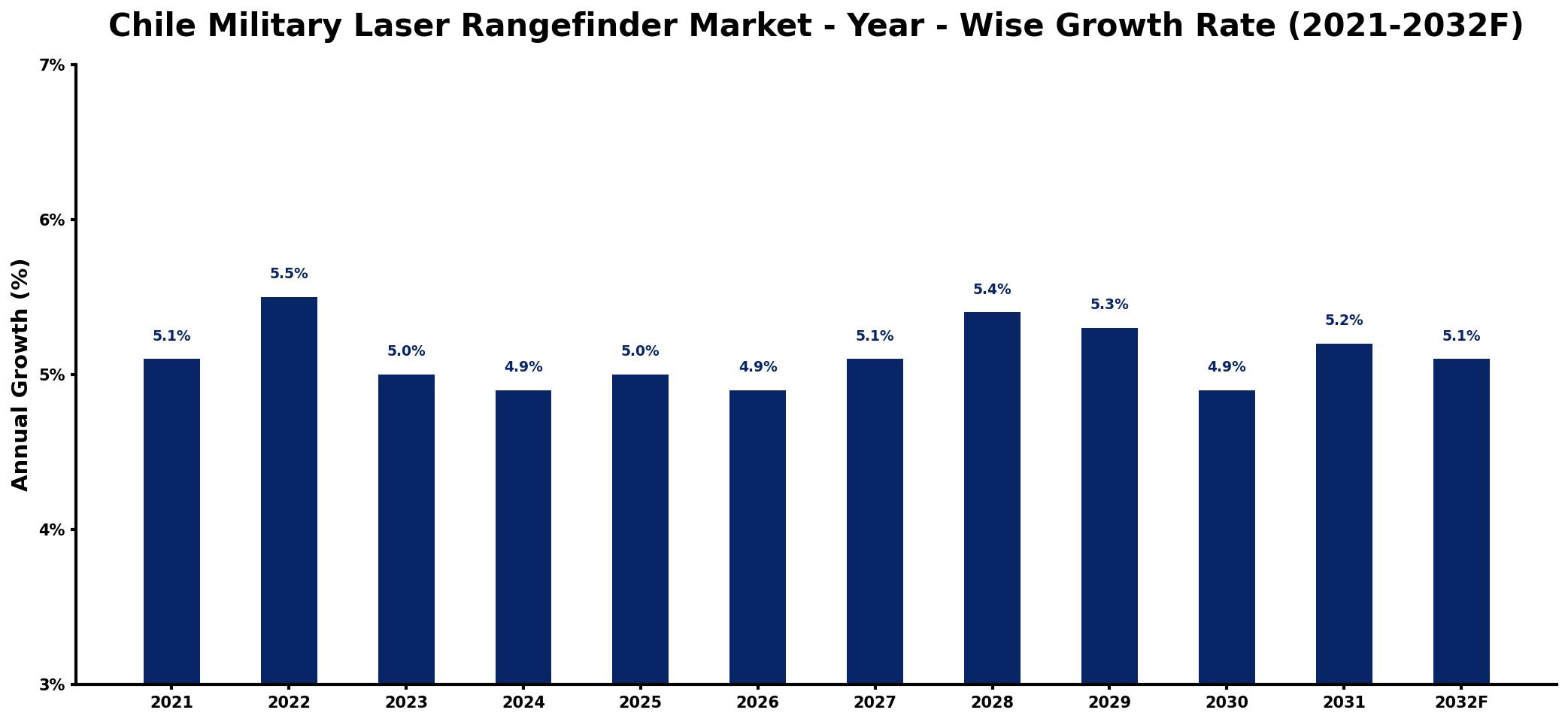
The table below presents the year‑wise growth rates along with the key drivers influencing the market
| Year | Growth Rate | Major Drivers |
| 2021 | 5.1% | increased pharmaceutical industry usage |
| 2022 | 5.5% | Increased technological advancements adoption |
| 2023 | 5.0% | Growing interest in precision targeting |
| 2024 | 4.9% | Expansion of defense training programs |
| 2025 | 5.0% | Emerging markets demand surge |
| 2026 | 4.9% | enhanced product quality standards |
| 2027 | 5.1% | Investments in advanced detection systems |
| 2028 | 5.4% | Strengthened national security policies |
| 2029 | 5.3% | rising infrastructure development spending |
| 2030 | 4.9% | Increased focus on tactical operations |
| 2031 | 5.2% | rising procurement volume requirements |
| 2032 | 5.1% | Rising global defense partnerships |
Note: Market size estimations and growth projections presented in this report are based on 6Wresearch's proprietary forecasting methodology, utilizing the latest available industry data, government publications, and primary research inputs.
Chile Military Laser Rangefinder Market Synopsis
The Chilean military's increasing reliance on laser rangefinders underscores their critical role in modern defense strategies. These systems enable accurate distance measurements, which are vital for effective artillery deployment and sniper operations, significantly contributing to the effectiveness of combat scenarios.
Moreover, as advancements in laser technology lead to the development of compact and lightweight systems, the integration of these rangefinders into various military platforms is becoming increasingly common. This evolution not only enhances targeting precision but also aligns with broader defense modernization efforts being undertaken by the Chilean government.
Chile Military Laser Rangefinder Market Key Takeaways
- Significant projected growth driven by defense modernization and technological advancements.
- Increasing integration of rangefinding capabilities into military optics and targeting systems.
- Heightened focus on operational effectiveness in diverse combat environments.
- Strategic government policies are shaping investment in laser rangefinder technologies.
- Market expansion is supported by a growing demand for accurate fire control solutions.
Evaluation of Restraints in Chile Military Laser Rangefinder Market
The Chile Military Laser Rangefinder Market faces several restraints that could impede its growth. Notably, rapid technological advancements necessitate continuous upgrades, which can strain military budgets. Additionally, challenges related to miniaturization and cost-effectiveness of laser systems remain pertinent, as the need for affordable yet high-performing solutions becomes increasingly critical. Regulatory constraints regarding the use and export of laser technology, coupled with interoperability issues with existing systems, further complicate the landscape, potentially stalling the adoption of new technologies.
Chile Military Laser Rangefinder Market Trends
Current trends indicate a shift towards the integration of advanced electronic systems within laser rangefinders. This includes enhancements such as GPS capabilities and advanced targeting algorithms, which further optimize performance and accuracy. The focus on lightweight and compact designs is also evident, as militaries seek systems that can be easily deployed across diverse operational environments, from infantry units to armored vehicles.
Moreover, the emphasis on training programs for military personnel highlights the growing recognition of the importance of skilled operators in leveraging these advanced systems. As training continues to evolve, it is expected that user proficiency will further enhance the operational effectiveness of laser rangefinders in the field.
Chile Military Laser Rangefinder Market Opportunities
Opportunities for growth in the Chile Military Laser Rangefinder Market lie primarily in the development and deployment of new technologies that cater to the unique needs of the Chilean military. Investments in research and development can lead to innovative solutions that address current limitations, enhancing both functionality and affordability. Additionally, partnerships with domestic and international technology firms can facilitate knowledge transfer and accelerate the development of next-generation systems.
Furthermore, as geopolitical dynamics evolve, the demand for enhanced battlefield awareness and precision targeting will likely present ongoing opportunities for manufacturers and service providers within this space, ensuring a sustained interest in military laser rangefinders.
Government Initiatives in the Chile Military Laser Rangefinder Market
Chilean government initiatives play a pivotal role in the advancement of the military laser rangefinder market. Ongoing defense modernization programs prioritize investments in cutting-edge technologies and equipment, including laser rangefinders. Additionally, the government actively supports research and development efforts, encouraging collaboration with private sectors and educational institutions to foster innovation.
Moreover, strategic defense procurement procedures are being established to streamline the acquisition of advanced systems, thereby facilitating more efficient deployment of laser rangefinder technologies. This collaborative approach aims to enhance the capabilities of Chile's armed forces while addressing evolving security challenges.
Future Insights of the Chile Military Laser Rangefinder Market
Looking ahead to 2026-2032, the Chile Military Laser Rangefinder Market is poised for significant transformation. As technology continues to advance, the integration of artificial intelligence and machine learning into rangefinding systems is expected to revolutionize operational capabilities. These advancements will not only improve accuracy but also offer enhanced predictive capabilities for military planners.
Additionally, as Chile navigates its regional security landscape, the demand for reliable and precise targeting systems will drive ongoing investment in laser rangefinder technologies. The commitment to modernization and adaptation to new challenges will solidify the market's growth, ensuring that laser rangefinders remain an indispensable tool for the Chilean military.
Chile Military Laser Rangefinder Market Latest Developments (2025 - 2026)
Recent developments in the Chile Military Laser Rangefinder Market indicate a continued focus on technological enhancements and modernization efforts. Military exercises have showcased the integration of next-generation laser rangefinders, emphasizing improved accuracy and rapid deployment capabilities. Collaborative initiatives between government agencies and technology firms are yielding new solutions aimed at further enhancing operational efficiency.
In response to emerging security threats, there has been a marked increase in investment towards advancing laser rangefinding technologies that cater specifically to the operational requirements of the Chilean Armed Forces, ensuring they remain equipped with state-of-the-art capabilities on the modern battlefield.
Chile Military Laser Rangefinder Market - Key Attractiveness of the Report
- 10 Years of Market Numbers
- Historical Data Starting from 2022 to 2025
- Base Year: 2025
- Forecast Data until 2032
- Key Performance Indicators Impacting the Market
- Major Upcoming Developments and Projects
Key Highlights of the Report:
- Chile Military Laser Rangefinder Market Outlook
- Market Size of Chile Military Laser Rangefinder Market, 2025
- Forecast of Chile Military Laser Rangefinder Market, 2032
- Historical Data and Forecast of Chile Military Laser Rangefinder Revenues & Volume for the Period 2022-2032F
- Chile Military Laser Rangefinder Market Trend Evolution
- Chile Military Laser Rangefinder Market Drivers and Challenges
- Chile Military Laser Rangefinder Price Trends
- Chile Military Laser Rangefinder Porter's Five Forces
- Chile Military Laser Rangefinder Industry Life Cycle
- Historical Data and Forecast of Chile Military Laser Rangefinder Market Revenues & Volume By Type for the Period 2022-2032F
- Historical Data and Forecast of Chile Military Laser Rangefinder Market Revenues & Volume By Man-Portable for the Period 2022-2032F
- Historical Data and Forecast of Chile Military Laser Rangefinder Market Revenues & Volume By Vehicle-Mounted for the Period 2022-2032F
- Historical Data and Forecast of Chile Military Laser Rangefinder Market Revenues & Volume By Application for the Period 2022-2032F
- Historical Data and Forecast of Chile Military Laser Rangefinder Market Revenues & Volume By Weapon Guidance for the Period 2022-2032F
- Historical Data and Forecast of Chile Military Laser Rangefinder Market Revenues & Volume By Detection for the Period 2022-2032F
- Chile Military Laser Rangefinder Import Export Trade Statistics
- Market Opportunity Assessment By Type
- Market Opportunity Assessment By Application
- Chile Military Laser Rangefinder Top Companies Market Share
- Chile Military Laser Rangefinder Competitive Benchmarking By Technical and Operational Parameters
- Chile Military Laser Rangefinder Company Profiles
- Chile Military Laser Rangefinder Key Strategic Recommendations






































