Chile Natural Fragrance Market Size, Share & Growth Rate
The Chile Natural Fragrance Market was estimated at USD 378 Million in 2025 and is projected to reach USD 527 Million by 2032, growing at a CAGR of 4.9% from 2026 to 2032. This growth trajectory is primarily driven by the rising consumer preference for organic and sustainable products, particularly within the personal care sector. As awareness of the health and environmental implications of synthetic fragrances escalates, Chilean consumers are increasingly opting for natural alternatives that align with their values of wellness and eco-friendliness.
Chile Natural Fragrance Market Year-wise Growth Rate and Key Drivers
This graph highlights how the Chile Natural Fragrance Market has steadily grown over the years, supported by major growth factors.
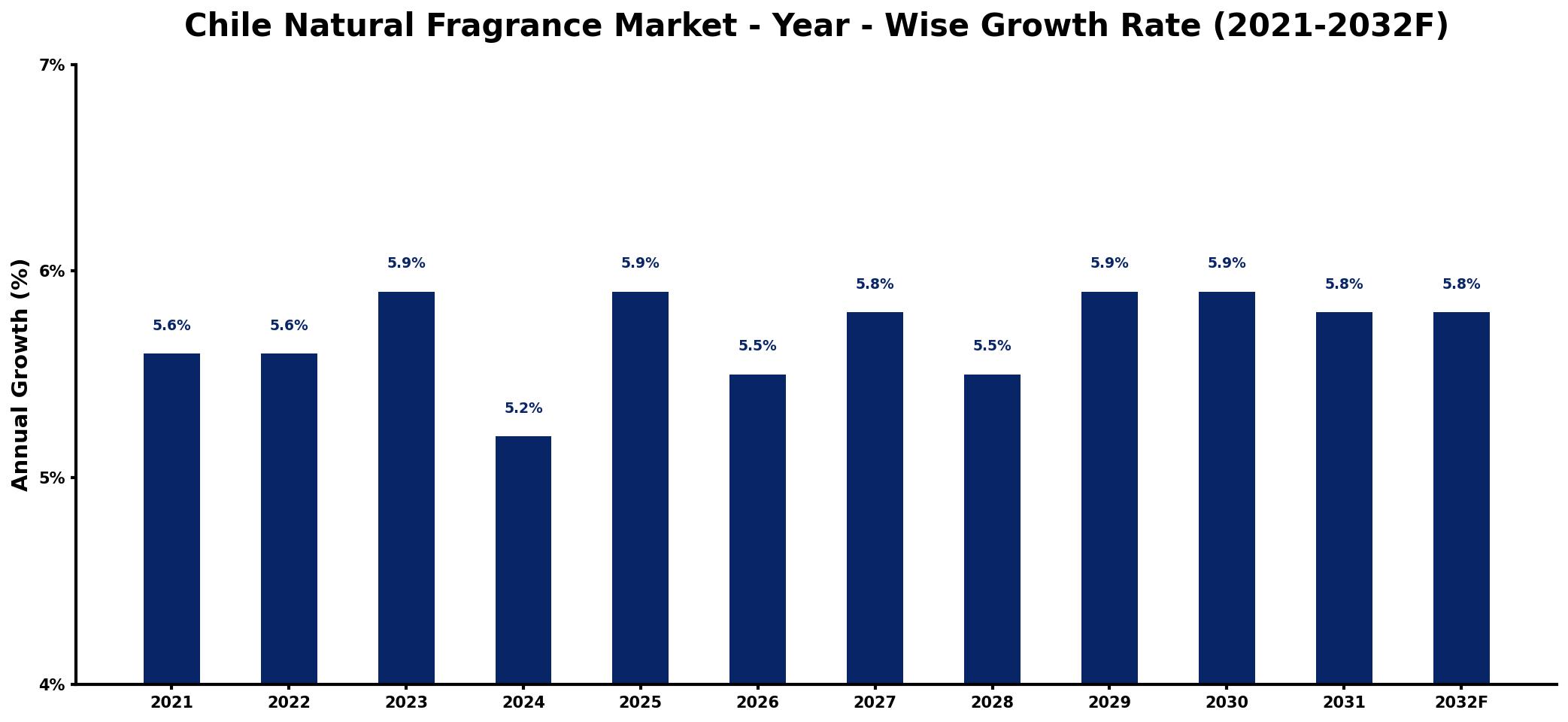
The table below presents the year‑wise growth rates along with the key drivers influencing the market
| Year | Growth Rate | Major Drivers |
| 2021 | 5.6% | Rising consumer health awareness |
| 2022 | 5.6% | Expansion of e-commerce platforms |
| 2023 | 5.9% | Innovations in sustainable sourcing |
| 2024 | 5.2% | Growing interest in eco-friendly products |
| 2025 | 5.9% | Increased investment in marketing |
| 2026 | 5.5% | Emerging trends in holistic wellness |
| 2027 | 5.8% | Strengthening local production capabilities |
| 2028 | 5.5% | Shifts towards artisanal craftsmanship |
| 2029 | 5.9% | Boosting collaborations with influencers |
| 2030 | 5.9% | Enhanced focus on ethical practices |
| 2031 | 5.8% | Diversification of product offerings |
| 2032 | 5.8% | Strengthened global supply chains |
Note: Market size estimations and growth projections presented in this report are based on 6Wresearch's proprietary forecasting methodology, utilizing the latest available industry data, government publications, and primary research inputs.
Chile Natural Fragrance Market Synopsis
The Chile natural fragrance market has gained considerable momentum in recent years, characterized by a significant shift toward organic ingredients and sustainable practices. As consumer awareness continues to rise, the market is on a trajectory toward robust growth, presenting both challenges and opportunities.
Looking ahead, the focus on clean beauty and eco-conscious living will further catalyze market expansion. However, the sector must navigate challenges such as sourcing high-quality raw materials and complying with stringent regulations, which could impact its growth potential.
Chile Natural Fragrance Market Key Takeaways
- The market's projected growth highlights a robust consumer shift towards natural and organic options.
- There is increasing awareness of health concerns related to synthetic fragrances.
- Market expansion is driven by evolving beauty trends and consumer demand for sustainable products.
- Challenges such as sourcing and regulatory compliance pose significant obstacles.
- The landscape is evolving with more entrants prioritizing eco-friendly practices and transparency.
Evaluation of Restraints in Chile Natural Fragrance Market
Despite the promising growth forecast, several restraints hinder the Chile natural fragrance market's progress. Sourcing quality raw materials poses a significant challenge, as sustainable practices are often more complex and costly compared to conventional methods. Additionally, regulatory compliance regarding ingredient transparency and environmental impact adds layers of complexity that can deter new market entrants. The saturation of the beauty market and the competitive landscape, particularly from synthetic fragrance products, complicate the differentiation of natural offerings, making it essential for brands to innovate and communicate their unique value propositions effectively.
Chile Natural Fragrance Market Trends
Current trends indicate a rising demand for personalized and bespoke fragrance options, as consumers increasingly seek unique products that resonate with their individual identities. Additionally, the incorporation of wellness-oriented scents—such as those used in aromatherapy—is gaining traction, further broadening the market's appeal. The trend toward eco-friendly packaging and sustainable sourcing will likely shape future product offerings as consumers demand greater transparency and responsibility from brands.
Chile Natural Fragrance Market Opportunities
There are substantial opportunities for growth in the Chile natural fragrance market, particularly in the realms of innovation and product development. Brands that can successfully blend traditional fragrance crafting techniques with modern, sustainable practices are well-positioned to capture consumer interest. Additionally, exploring untapped market segments, such as men's grooming products or children's fragrances, could lead to increased market share and diversified revenue streams.
Government Initiatives in the Chile Natural Fragrance Market
Government policies in Chile play a crucial role in shaping the natural fragrance market. Regulations regarding cosmetics and environmental protection promote safer and more sustainable practices across the industry. Initiatives aimed at supporting local botanical sourcing and sustainable farming practices are essential for ensuring that the natural fragrance market adheres to environmental standards while bolstering local economies.
Future Insights of the Chile Natural Fragrance Market
Looking ahead to 2026-2032, the Chile natural fragrance market is poised for substantial growth fueled by evolving consumer preferences and ongoing clean beauty trends. As health-conscious and eco-aware consumers increasingly gravitate towards natural options, brands that prioritize authenticity and sustainability will likely thrive. Moreover, leveraging advancements in extraction technology and sustainable agriculture will enhance the availability of high-quality botanicals, further enriching the market landscape.
Chile Natural Fragrance Market Latest Developments (2025 - 2026)
Recent developments in the Chile natural fragrance market indicate a shift towards greater investment in local sourcing and eco-friendly practices. Industry players are increasingly collaborating with local farmers and suppliers to ensure the sustainability of their ingredients. There has also been a marked increase in consumer-driven initiatives focused on promoting transparency in ingredient sourcing and packaging. These movements reflect a broader trend of aligning business practices with consumer values, paving the way for a more responsible and ethically-minded fragrance industry.
Chile Natural Fragrance Market - Key Attractiveness of the Report
- 10 Years of Market Numbers
- Historical Data Starting from 2022 to 2025
- Base Year: 2025
- Forecast Data until 2032
- Key Performance Indicators Impacting the Market
- Major Upcoming Developments and Projects
Key Highlights of the Report:
- Chile Natural Fragrance Market Outlook
- Market Size of Chile Natural Fragrance Market, 2025
- Forecast of Chile Natural Fragrance Market, 2032
- Historical Data and Forecast of Chile Natural Fragrance Revenues & Volume for the Period 2022-2032F
- Chile Natural Fragrance Market Trend Evolution
- Chile Natural Fragrance Market Drivers and Challenges
- Chile Natural Fragrance Price Trends
- Chile Natural Fragrance Porter's Five Forces
- Chile Natural Fragrance Industry Life Cycle
- Historical Data and Forecast of Chile Natural Fragrance Market Revenues & Volume By Ingredient for the Period 2022-2032F
- Historical Data and Forecast of Chile Natural Fragrance Market Revenues & Volume By Essential Oils for the Period 2022-2032F
- Historical Data and Forecast of Chile Natural Fragrance Market Revenues & Volume By Natural Extracts for the Period 2022-2032F
- Historical Data and Forecast of Chile Natural Fragrance Market Revenues & Volume By Type for the Period 2022-2032F
- Historical Data and Forecast of Chile Natural Fragrance Market Revenues & Volume By Top note for the Period 2022-2032F
- Historical Data and Forecast of Chile Natural Fragrance Market Revenues & Volume By Middle Note for the Period 2022-2032F
- Historical Data and Forecast of Chile Natural Fragrance Market Revenues & Volume By Base Note for the Period 2022-2032F
- Historical Data and Forecast of Chile Natural Fragrance Market Revenues & Volume By Application for the Period 2022-2032F
- Historical Data and Forecast of Chile Natural Fragrance Market Revenues & Volume By Fine Fragrances for the Period 2022-2032F
- Historical Data and Forecast of Chile Natural Fragrance Market Revenues & Volume By Personal Care & Cosmetics for the Period 2022-2032F
- Historical Data and Forecast of Chile Natural Fragrance Market Revenues & Volume By Household Care for the Period 2022-2032F
- Chile Natural Fragrance Import Export Trade Statistics
- Market Opportunity Assessment By Ingredient
- Market Opportunity Assessment By Type
- Market Opportunity Assessment By Application
- Chile Natural Fragrance Top Companies Market Share
- Chile Natural Fragrance Competitive Benchmarking By Technical and Operational Parameters
- Chile Natural Fragrance Company Profiles
- Chile Natural Fragrance Key Strategic Recommendations






































