Chile Railway Maintenance Machinery Market Size, Share & Growth Rate
The Chile Railway Maintenance Machinery Market was estimated at USD 1088 Million in 2025 and is projected to reach USD 2024 Million by 2032, growing at a CAGR of 9.3% from 2026 to 2032. This growth is primarily fueled by the Chilean government's commitment to expanding and modernizing the railway infrastructure, as well as increasing investments aimed at enhancing transportation efficiency across the nation. The demand for advanced machinery and innovative technologies that can streamline maintenance processes further propels this upward trajectory.
Chile Railway Maintenance Machinery Market Year-wise Growth Rate and Key Drivers
This graph highlights how the Chile Railway Maintenance Machinery Market has steadily grown over the years, supported by major growth factors.
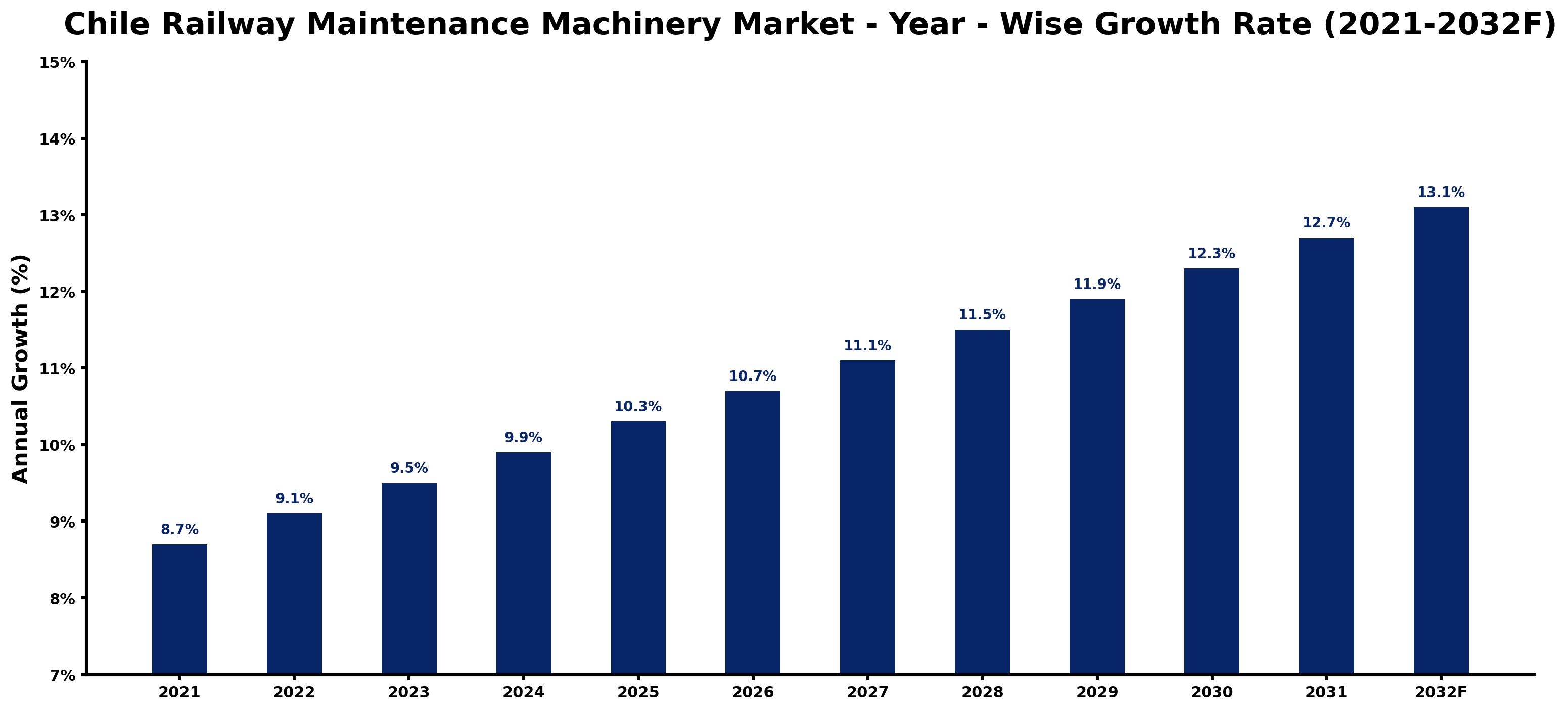
The table below presents the year‑wise growth rates along with the key drivers influencing the market
| Year | Growth Rate | Major Drivers |
| 2021 | 8.7% | Expansion of manufacturing activities |
| 2022 | 9.1% | Growing urbanization and commercial development |
| 2023 | 9.5% | Expansion of manufacturing activities |
| 2024 | 9.9% | Increasing adoption of advanced technologies |
| 2025 | 10.3% | Government infrastructure modernization initiatives |
| 2026 | 10.7% | Government infrastructure modernization initiatives |
| 2027 | 11.1% | Expansion of commercial construction activities |
| 2028 | 11.5% | Expansion of commercial construction activities |
| 2029 | 11.9% | Growing renewable energy integration projects |
| 2030 | 12.3% | Increasing adoption of advanced technologies |
| 2031 | 12.7% | Government infrastructure modernization initiatives |
| 2032 | 13.1% | Rapid growth in telecom and data center sectors |
Note - Market size estimations and growth projections presented in this report are based on 6Wresearch's advanced forecasting approach, validated with industry datasets as of June 2026.
Chile Railway Maintenance Machinery Market Synopsis
The most significant force currently shaping the Chile Railway Maintenance Machinery Market is the government's strategic focus on infrastructure expansion. Ongoing projects aimed at upgrading existing railway lines and constructing new routes reflect a robust commitment to modernization, boosting the demand for state-of-the-art maintenance machinery.
In addition to government initiatives, technological advancements play a critical role in this market's evolution. The increasing adoption of predictive maintenance systems and automation is enabling railway operators to enhance efficiency, reduce downtime, and ultimately deliver safer transportation solutions. This trend signifies a shift towards a more digitally-driven approach to railway maintenance.
Chile Railway Maintenance Machinery Market Key Takeaways
- Growing investment in railway infrastructure is driving the market demand for maintenance machinery.
- Technological innovation, including IoT and AI applications, is reshaping maintenance processes.
- Sustainability considerations are leading to the adoption of eco-friendly maintenance solutions.
- The current focus on modernization creates lucrative investment opportunities for advanced machinery manufacturers.
- Strategic government policies are fostering public-private partnerships to accelerate sector development.
Evaluation of Restraints in Chile Railway Maintenance Machinery Market
Despite the favorable growth trajectory, several factors impede the progress of the Chile Railway Maintenance Machinery Market. Limited investment in routine infrastructure maintenance has resulted in outdated equipment, while the high costs associated with purchasing and maintaining specialized machinery deter potential investors. Furthermore, a shortage of skilled technicians exacerbates operational challenges. The existing bureaucratic processes can also slow down procurement for new equipment, creating additional hurdles for market stakeholders.
Chile Railway Maintenance Machinery Market Trends
The Chile Railway Maintenance Machinery Market is witnessing a discernible trend toward digitalization and automation. Companies are increasingly investing in machinery with integrated sensors and data analytics, which facilitate real-time monitoring of rail infrastructure conditions. This shift not only enhances operational efficiency but also aligns with broader sustainability initiatives aimed at minimizing environmental impact. Additionally, the growing emphasis on predictive maintenance is allowing operators to address issues proactively, thereby reducing operational downtime and costs.
Chile Railway Maintenance Machinery Market Opportunities
Opportunities for investment abound in the Chile Railway Maintenance Machinery Market, particularly for businesses focused on cutting-edge technology and innovative solutions. The ongoing modernization of railway infrastructure creates a heightened demand for advanced machinery, including track inspection systems and automated maintenance vehicles. Collaborating with local railway operators and infrastructure developers presents a strategic avenue for fostering growth, as these partnerships can lead to tailored solutions that address specific operational challenges.
Government Initiatives in the Chile Railway Maintenance Machinery Market
The Chilean government has enacted several initiatives aimed at bolstering the railway maintenance machinery sector. These policies encourage investment in modern equipment and the integration of advanced technologies, while public-private partnerships are promoted to foster collaborative development. Regulatory improvements focus on aligning local standards with international quality and safety norms, which is essential for enhancing competitiveness in the railway sector.
Future Insights of the Chile Railway Maintenance Machinery Market
Looking ahead to 2026-2032, the Chile Railway Maintenance Machinery Market is poised for steady growth fueled by sustained investments in infrastructure. The government's dedication to enhancing the railway network, coupled with increasing market demand for efficient, sustainable solutions, is expected to drive the need for advanced maintenance machinery. Innovations such as artificial intelligence and Internet of Things applications will further transform the market, offering new avenues for efficiency and operational excellence.
Chile Railway Maintenance Machinery Market Latest Developments (May 2025 - June 2026)
Recent developments in the Chile Railway Maintenance Machinery Market indicate a strong directional shift towards innovative solutions. Industry stakeholders are increasingly focusing on partnerships with technology providers to enhance machinery capabilities. Furthermore, there is a notable emphasis on sustainability initiatives, as companies seek to align with environmental regulations and market demands for eco-friendly maintenance practices.
Chile Railway Maintenance Machinery Market - Key Attractiveness of the Report
- 10 Years of Market Numbers
- Historical Data Starting from 2022 to 2025
- Base Year: 2025
- Forecast Data until 2032
- Key Performance Indicators Impacting the Market
- Major Upcoming Developments and Projects
Key Highlights of the Report:
- Chile Railway Maintenance Machinery Market Outlook
- Market Size of Chile Railway Maintenance Machinery Market, 2025
- Forecast of Chile Railway Maintenance Machinery Market, 2032
- Historical Data and Forecast of Chile Railway Maintenance Machinery Revenues & Volume for the Period 2022-2032F
- Chile Railway Maintenance Machinery Market Trend Evolution
- Chile Railway Maintenance Machinery Market Drivers and Challenges
- Chile Railway Maintenance Machinery Price Trends
- Chile Railway Maintenance Machinery Porter's Five Forces
- Chile Railway Maintenance Machinery Industry Life Cycle
- Historical Data and Forecast of Chile Railway Maintenance Machinery Market Revenues & Volume By Type for the Period 2022-2032F
- Historical Data and Forecast of Chile Railway Maintenance Machinery Market Revenues & Volume By Tamping Machine for the Period 2022-2032F
- Historical Data and Forecast of Chile Railway Maintenance Machinery Market Revenues & Volume By Stabilizing Machinery for the Period 2022-2032F
- Historical Data and Forecast of Chile Railway Maintenance Machinery Market Revenues & Volume By Rail Handling Machinery for the Period 2022-2032F
- Historical Data and Forecast of Chile Railway Maintenance Machinery Market Revenues & Volume By Ballast Cleaning Machine for the Period 2022-2032F
- Historical Data and Forecast of Chile Railway Maintenance Machinery Market Revenues & Volume By Other for the Period 2022-2032F
- Historical Data and Forecast of Chile Railway Maintenance Machinery Market Revenues & Volume By Applications for the Period 2022-2032F
- Historical Data and Forecast of Chile Railway Maintenance Machinery Market Revenues & Volume By Ballast Track for the Period 2022-2032F
- Historical Data and Forecast of Chile Railway Maintenance Machinery Market Revenues & Volume By Ballastless Track for the Period 2022-2032F
- Chile Railway Maintenance Machinery Import Export Trade Statistics
- Market Opportunity Assessment By Type
- Market Opportunity Assessment By Applications
- Chile Railway Maintenance Machinery Top Companies Market Share
- Chile Railway Maintenance Machinery Competitive Benchmarking By Technical and Operational Parameters
- Chile Railway Maintenance Machinery Company Profiles
- Chile Railway Maintenance Machinery Key Strategic Recommendations






































