Chile Seafood Processing Market Size, Share & Growth Rate
The Chile Seafood Processing Market was estimated at USD 173 Million in 2025 and is projected to reach USD 235 Million by 2032, growing at a CAGR of 4.5% from 2026 to 2032. This growth trajectory is primarily driven by the rising global demand for high-quality, sustainably sourced seafood, alongside Chile's robust reputation for its diverse marine resources. Innovations in processing technologies and an increasing shift towards value-added products further support this optimistic outlook.
Chile Seafood Processing Market Year-wise Growth Rate and Key Drivers
This graph highlights how the Chile Seafood Processing Market has steadily grown over the years, supported by major growth factors.
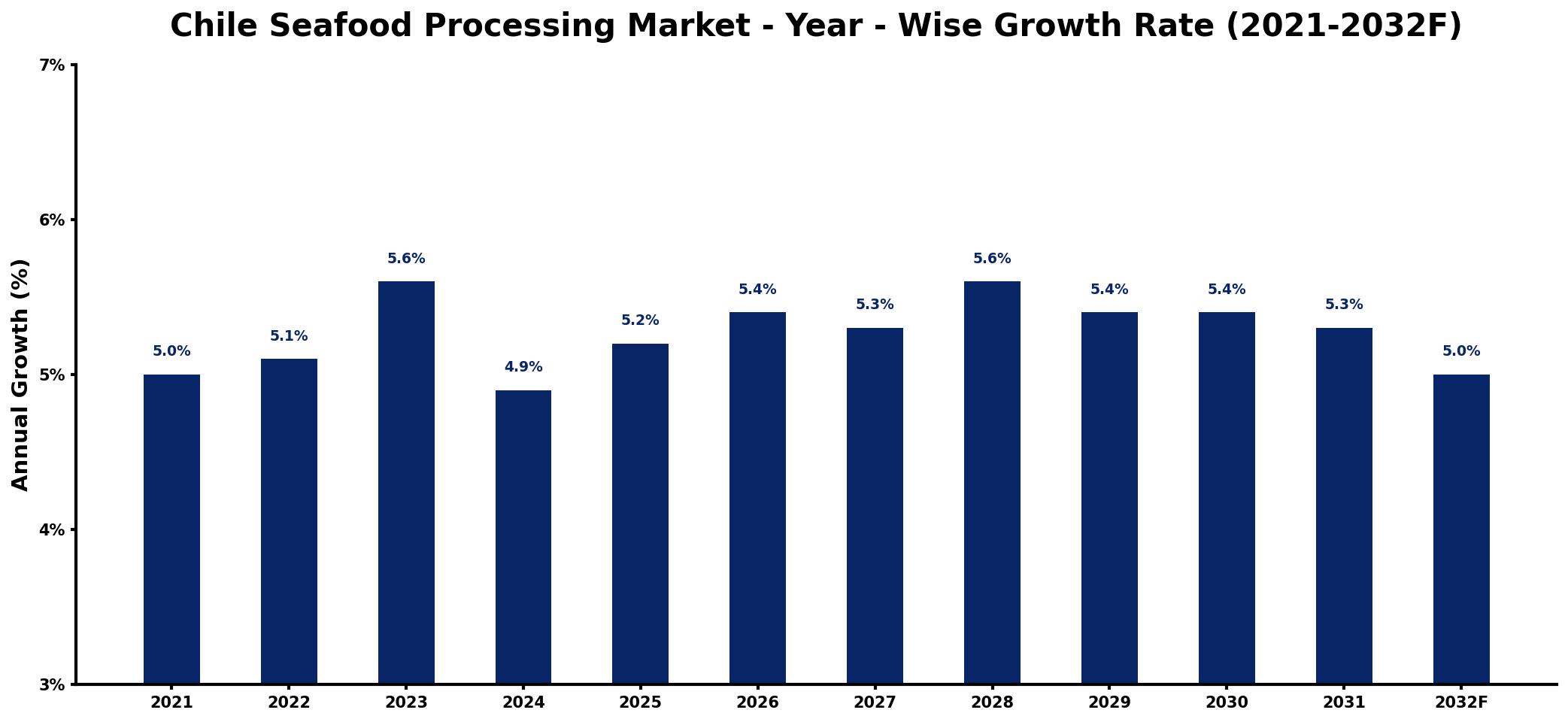
The table below presents the year‑wise growth rates along with the key drivers influencing the market
| Year | Growth Rate | Major Drivers |
| 2021 | 5.0% | Rising global health consciousness |
| 2022 | 5.1% | Increased demand for sustainability |
| 2023 | 5.6% | Expansion of export markets |
| 2024 | 4.9% | Growth in local consumption trends |
| 2025 | 5.2% | Investment in modern facilities |
| 2026 | 5.4% | Technological advancements in logistics |
| 2027 | 5.3% | Surge in eco-friendly practices |
| 2028 | 5.6% | Emerging markets for premium products |
| 2029 | 5.4% | Strengthening of regulatory frameworks |
| 2030 | 5.4% | Increased focus on traceability |
| 2031 | 5.3% | Development of value-added products |
| 2032 | 5.0% | Enhancements in supply chain efficiency |
Note: Market size estimations and growth projections presented in this report are based on 6Wresearch's proprietary forecasting methodology, utilizing the latest available industry data, government publications, and primary research inputs.
Chile Seafood Processing Market Synopsis
Sustainability is the strongest force currently shaping the Chile Seafood Processing Market. With growing consumer awareness regarding environmental and ethical sourcing, Chilean processors are prioritizing sustainable practices and transparency throughout the supply chain. This commitment not only enhances the quality of products but also strengthens Chile's position in international markets.
Additionally, the industry's focus on innovation is paramount. Investment in advanced processing facilities and techniques is allowing Chilean seafood companies to adapt to shifting consumer preferences, particularly for ready-to-eat and health-focused seafood products. This proactive approach fosters continued growth and resilience in a competitive global landscape.
Chile Seafood Processing Market Key Takeaways
- Strong growth forecast with a projected market value of USD 235 Million by 2032.
- Sustainability and transparency in sourcing are becoming essential business practices.
- Investment in value-added products is on the rise, catering to changing consumer tastes.
- Technological advancements are enhancing efficiency and product quality in processing facilities.
- Chile remains a vital player in the global seafood export market.
Evaluation of Restraints in Chile Seafood Processing Market
Despite its strong positioning, the Chile Seafood Processing Market faces several restraints that may impede growth. Fluctuating global demand and variable market prices create uncertainty for producers. Additionally, intense competition from other seafood-exporting nations challenges local companies to maintain their market share. Compliance with stringent regulations surrounding food safety and environmental sustainability also adds pressure, requiring ongoing investment and adaptation. Moreover, logistical issues, particularly in remote areas, can disrupt supply chains and increase operational costs, complicating market expansion efforts.
Chile Seafood Processing Market Trends
The Chile Seafood Processing Market is currently witnessing a significant trend toward sustainable and traceable seafood products. This movement is fueled by consumers demanding accountability in sourcing, driving companies to adopt better practices. Additionally, there is a pronounced shift towards value-added seafood items, such as ready-to-eat meals and snack options, aligning with the fast-paced lifestyle of modern consumers.
Furthermore, automation and digitalization are increasingly integrated into processing operations, allowing businesses to enhance efficiency while ensuring product quality and safety standards are met. This technological evolution is essential for staying competitive in a global market that prioritizes innovation.
Chile Seafood Processing Market Opportunities
Investment opportunities in the Chile Seafood Processing Market are abundant. The country's expansive coastline and rich marine resources lay the groundwork for new processing facilities, which can enhance product efficiency and quality. There is also significant potential in developing innovative, value-added seafood products that cater to the health-conscious consumer segment. Additionally, companies focusing on sustainable practices can tap into the growing demand for responsibly sourced seafood, setting themselves apart in the competitive landscape.
Government Initiatives in the Chile Seafood Processing Market
The Chilean government plays a pivotal role in shaping the seafood processing market through various policies and initiatives. Regulations aimed at controlling overfishing and ensuring the protection of marine resources are in place, including quota systems and the establishment of protected zones. Moreover, stringent food safety standards ensure the quality of seafood products for both domestic and international markets. The government also supports innovation and development in the sector via incentives and programs that facilitate technology adoption, aiming to foster a sustainable and competitive seafood processing industry.
Future Insights of the Chile Seafood Processing Market
Looking ahead to 2026-2032, the Chile Seafood Processing Market is set for steady growth fueled by rising domestic and international demand for quality seafood products. The reputation of Chilean seafood, particularly in premium segments like salmon and sea bass, positions the country favorably in global markets. Anticipated advancements in processing technologies and a continued commitment to sustainability will further enhance the industrys prospects. However, challenges such as environmental sustainability concerns and fluctuating market dynamics will require ongoing adaptation and strategic planning from industry players.
Chile Seafood Processing Market Latest Developments (2025 - 2026)
Recent developments in the Chile Seafood Processing Market indicate a strong movement towards implementing advanced automation and digital technologies across processing facilities. Many companies are embracing Industry 4.0 concepts to optimize operational efficiency and quality. Additionally, there has been an uptick in partnerships focusing on sustainable fishing practices and traceability initiatives aimed at enhancing product integrity. This trend is expected to drive further innovation and growth, ensuring that the industry adapts to evolving consumer preferences and regulatory demands.
Chile Seafood Processing Market - Key Attractiveness of the Report
- 10 Years of Market Numbers
- Historical Data Starting from 2022 to 2025
- Base Year: 2025
- Forecast Data until 2032
- Key Performance Indicators Impacting the Market
- Major Upcoming Developments and Projects
Key Highlights of the Report:
- Chile Seafood Processing Market Outlook
- Market Size of Chile Seafood Processing Market, 2025
- Forecast of Chile Seafood Processing Market, 2032
- Historical Data and Forecast of Chile Seafood Processing Revenues & Volume for the Period 2022-2032F
- Chile Seafood Processing Market Trend Evolution
- Chile Seafood Processing Market Drivers and Challenges
- Chile Seafood Processing Price Trends
- Chile Seafood Processing Porter's Five Forces
- Chile Seafood Processing Industry Life Cycle
- Historical Data and Forecast of Chile Seafood Processing Market Revenues & Volume By Equipment Type for the Period 2022-2032F
- Historical Data and Forecast of Chile Seafood Processing Market Revenues & Volume By Gutting Equipment for the Period 2022-2032F
- Historical Data and Forecast of Chile Seafood Processing Market Revenues & Volume By Sealing Equipment for the Period 2022-2032F
- Historical Data and Forecast of Chile Seafood Processing Market Revenues & Volume By Filleting Equipment for the Period 2022-2032F
- Historical Data and Forecast of Chile Seafood Processing Market Revenues & Volume By Deboning Equipment for the Period 2022-2032F
- Historical Data and Forecast of Chile Seafood Processing Market Revenues & Volume By other Equipment for the Period 2022-2032F
- Historical Data and Forecast of Chile Seafood Processing Market Revenues & Volume By Category for the Period 2022-2032F
- Historical Data and Forecast of Chile Seafood Processing Market Revenues & Volume By Single-Function Equipment for the Period 2022-2032F
- Historical Data and Forecast of Chile Seafood Processing Market Revenues & Volume By Multi-Function Equipment for the Period 2022-2032F
- Historical Data and Forecast of Chile Seafood Processing Market Revenues & Volume By Seafood Type for the Period 2022-2032F
- Historical Data and Forecast of Chile Seafood Processing Market Revenues & Volume By Fish for the Period 2022-2032F
- Historical Data and Forecast of Chile Seafood Processing Market Revenues & Volume By Crustaceans for the Period 2022-2032F
- Historical Data and Forecast of Chile Seafood Processing Market Revenues & Volume By Mollusks for the Period 2022-2032F
- Historical Data and Forecast of Chile Seafood Processing Market Revenues & Volume By others for the Period 2022-2032F
- Chile Seafood Processing Import Export Trade Statistics
- Market Opportunity Assessment By Equipment Type
- Market Opportunity Assessment By Category
- Market Opportunity Assessment By Seafood Type
- Chile Seafood Processing Top Companies Market Share
- Chile Seafood Processing Competitive Benchmarking By Technical and Operational Parameters
- Chile Seafood Processing Company Profiles
- Chile Seafood Processing Key Strategic Recommendations






































