Sri Lanka Seafood Processing Market Size, Share & Growth Rate
The Sri Lanka Seafood Processing Market was estimated at USD 345 Million in 2025 and is projected to reach USD 469 Million by 2032, growing at a CAGR of 4.5% from 2026 to 2032. This growth trajectory is primarily driven by a rising global appetite for seafood, coupled with Sri Lanka's advantageous location that provides access to abundant marine resources. The growing emphasis on quality and sustainability among consumers is further propelling the demand for processed seafood products both locally and internationally.
Sri Lanka Seafood Processing Market Year-wise Growth Rate and Key Drivers
This graph highlights how the Sri Lanka Seafood Processing Market has steadily grown over the years, supported by major growth factors.
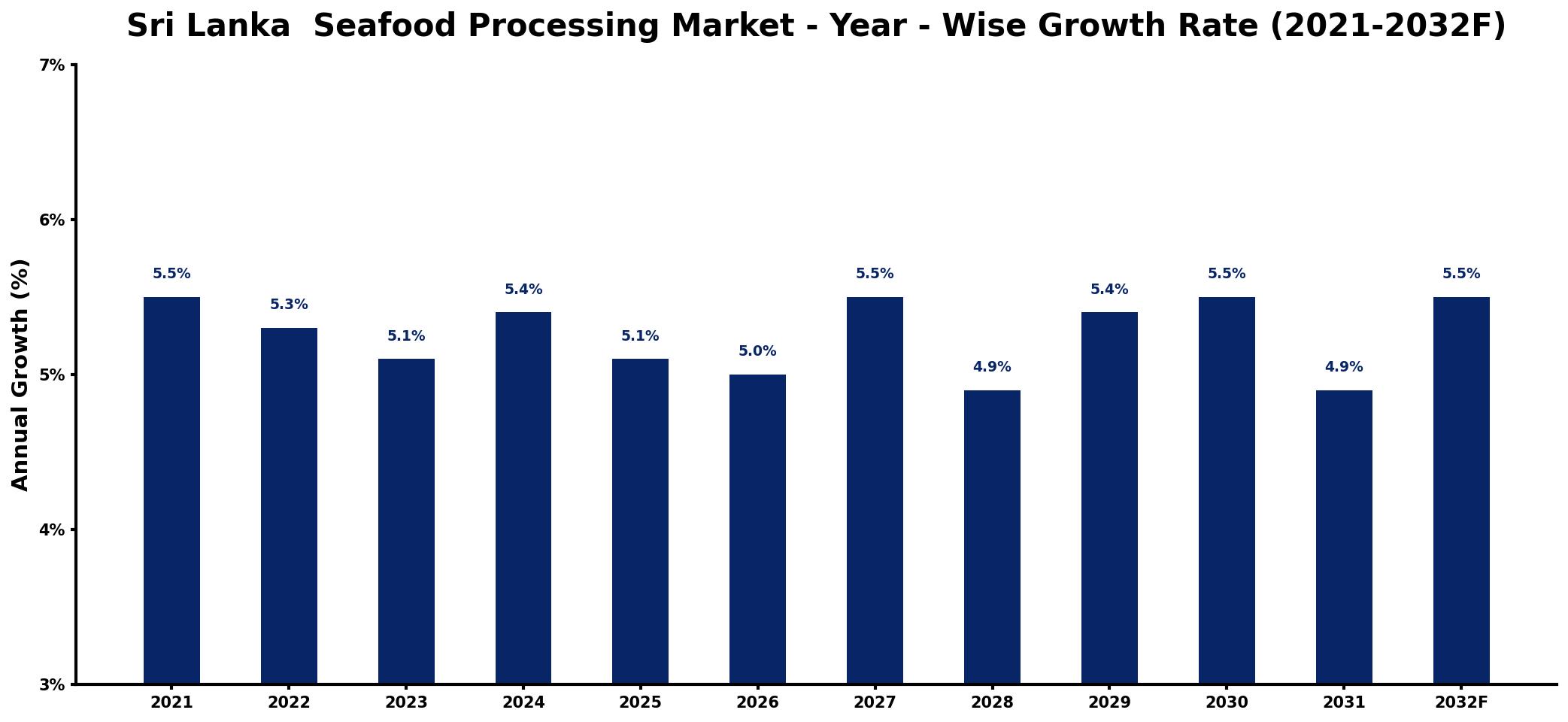
The table below presents the year‑wise growth rates along with the key drivers influencing the market
| Year | Growth Rate | Major Drivers |
| 2021 | 5.5% | Rising global demand for proteins |
| 2022 | 5.3% | Expansion of export markets globally |
| 2023 | 5.1% | Increased investment in technology |
| 2024 | 5.4% | Growth in sustainable sourcing practices |
| 2025 | 5.1% | Development of new product lines |
| 2026 | 5.0% | Strengthening of supply chain networks |
| 2027 | 5.5% | Enhancement of distribution channels efficiency |
| 2028 | 4.9% | Emergence of health-conscious consumers |
| 2029 | 5.4% | Increased collaboration with retailers |
| 2030 | 5.5% | Innovation in packaging solutions |
| 2031 | 4.9% | Broadened access to international markets |
| 2032 | 5.5% | Focus on value-added offerings |
Note: Market size estimations and growth projections presented in this report are based on 6Wresearch's proprietary forecasting methodology, utilizing the latest available industry data, government publications, and primary research inputs.
Sri Lanka Seafood Processing Market Synopsis
In recent years, the Sri Lanka seafood processing market has experienced notable momentum, reflecting robust domestic and international demand for high-quality seafood products. As the market continues to evolve, it is transitioning toward increased innovation and value addition, with processors focusing on modern techniques and enhanced product offerings.
Looking forward, the market is poised for steady growth driven by a combination of expanding export opportunities and local consumption. Enhanced infrastructure and government support for modernization initiatives are expected to facilitate this growth, thereby establishing Sri Lanka as a competitive player in the global seafood processing arena.
Sri Lanka Seafood Processing Market Key Takeaways
- The market is on track for steady growth, expected to reach USD 469 Million by 2032.
- Increasing consumer focus on sustainably sourced seafood is reshaping product offerings.
- Modernization of processing facilities is crucial for meeting international standards.
- The rise of e-commerce is providing new distribution channels for seafood products.
- Government incentives are fostering innovation and infrastructure development in the sector.
Evaluation of Restraints in Sri Lanka Seafood Processing Market
Despite its growth potential, the Sri Lanka seafood processing market grapples with significant restraints. Maintaining consistent quality standards amidst varying international regulations poses a considerable challenge. Additionally, outdated infrastructure hampers operational efficiency and competitiveness, limiting market players' ability to scale effectively. Furthermore, environmental factors leading to fluctuating fish stocks and the threat of overfishing complicate sustainable sourcing efforts. These challenges necessitate strategic investments in technology and infrastructure to bolster the industry's resilience and market positioning.
Sri Lanka Seafood Processing Market Trends
Current trends in the Sri Lanka seafood processing market indicate a shift toward eco-conscious practices, with consumers increasingly demanding traceable and sustainably sourced products. Additionally, there is a growing preference for value-added offerings such as ready-to-eat meals and convenient seafood snacks, which cater to evolving consumer lifestyles. Moreover, advancements in processing technologies are enhancing efficiency and ensuring superior product quality, positioning Sri Lanka favorably in a competitive landscape. The proliferation of e-commerce platforms further supports market expansion, enabling processors to reach a broader audience.
Sri Lanka Seafood Processing Market Opportunities
The Sri Lanka seafood processing market presents substantial investment opportunities fueled by its rich marine resources and rising global demand for premium seafood. Key areas ripe for investment include the modernization of processing facilities to align with international standards, expansion into value-added product lines, and the implementation of sustainable practices that ensure long-term viability. Additionally, enhancing production efficiency through technological innovations can provide companies with a competitive edge, paving the way for profitable ventures in this expanding market.
Government Initiatives in the Sri Lanka Seafood Processing Market
The Sri Lankan government has introduced several initiatives aimed at promoting sustainable practices within the seafood processing sector. Regulations focusing on responsible fishing methods have been implemented to safeguard marine resources against overfishing. Furthermore, the government provides incentives to seafood processing companies that invest in modern technology and infrastructure, ultimately enhancing productivity and competitiveness. These policies are designed to nurture a robust, environmentally responsible seafood processing industry in the country.
Future Insights of the Sri Lanka Seafood Processing Market
As the Sri Lanka seafood processing market navigates the future from 2026 to 2032, significant growth opportunities are anticipated. Increasing consumer awareness of seafood health benefits and changing dietary preferences will likely boost demand for processed seafood products. Additionally, improvements in supply chain infrastructure and processing technologies will further accelerate market growth. However, sustainability concerns and competitive pressures from other seafood-exporting nations will require strategic adjustments by local processors. Overall, the future looks promising for the industry, offering numerous pathways for innovation and expansion.
Sri Lanka Seafood Processing Market Latest Developments (2025 - 2026)
In the last year, the Sri Lanka seafood processing market has shown increased momentum with processors investing in state-of-the-art technologies to enhance product quality and efficiency. The rise of online grocery delivery services has created new distribution channels, allowing companies to connect with consumers in innovative ways. Industry stakeholders are also prioritizing sustainability, with several firms adopting eco-friendly practices to meet growing consumer demand for responsibly sourced seafood. These developments illustrate a dynamic shift within the market, aligning with global trends toward healthier and more sustainable food choices.
Sri Lanka Seafood Processing Market - Key Attractiveness of the Report
- 10 Years of Market Numbers
- Historical Data Starting from 2022 to 2025
- Base Year: 2025
- Forecast Data until 2032
- Key Performance Indicators Impacting the Market
- Major Upcoming Developments and Projects
Key Highlights of the Report:
- Sri Lanka Seafood Processing Market Outlook
- Market Size of Sri Lanka Seafood Processing Market, 2025
- Forecast of Sri Lanka Seafood Processing Market, 2032
- Historical Data and Forecast of Sri Lanka Seafood Processing Revenues & Volume for the Period 2022-2032F
- Sri Lanka Seafood Processing Market Trend Evolution
- Sri Lanka Seafood Processing Market Drivers and Challenges
- Sri Lanka Seafood Processing Price Trends
- Sri Lanka Seafood Processing Porter's Five Forces
- Sri Lanka Seafood Processing Industry Life Cycle
- Historical Data and Forecast of Sri Lanka Seafood Processing Market Revenues & Volume By Equipment Type for the Period 2022-2032F
- Historical Data and Forecast of Sri Lanka Seafood Processing Market Revenues & Volume By Gutting Equipment for the Period 2022-2032F
- Historical Data and Forecast of Sri Lanka Seafood Processing Market Revenues & Volume By Sealing Equipment for the Period 2022-2032F
- Historical Data and Forecast of Sri Lanka Seafood Processing Market Revenues & Volume By Filleting Equipment for the Period 2022-2032F
- Historical Data and Forecast of Sri Lanka Seafood Processing Market Revenues & Volume By Deboning Equipment for the Period 2022-2032F
- Historical Data and Forecast of Sri Lanka Seafood Processing Market Revenues & Volume By other Equipment for the Period 2022-2032F
- Historical Data and Forecast of Sri Lanka Seafood Processing Market Revenues & Volume By Category for the Period 2022-2032F
- Historical Data and Forecast of Sri Lanka Seafood Processing Market Revenues & Volume By Single-Function Equipment for the Period 2022-2032F
- Historical Data and Forecast of Sri Lanka Seafood Processing Market Revenues & Volume By Multi-Function Equipment for the Period 2022-2032F
- Historical Data and Forecast of Sri Lanka Seafood Processing Market Revenues & Volume By Seafood Type for the Period 2022-2032F
- Historical Data and Forecast of Sri Lanka Seafood Processing Market Revenues & Volume By Fish for the Period 2022-2032F
- Historical Data and Forecast of Sri Lanka Seafood Processing Market Revenues & Volume By Crustaceans for the Period 2022-2032F
- Historical Data and Forecast of Sri Lanka Seafood Processing Market Revenues & Volume By Mollusks for the Period 2022-2032F
- Historical Data and Forecast of Sri Lanka Seafood Processing Market Revenues & Volume By others for the Period 2022-2032F
- Sri Lanka Seafood Processing Import Export Trade Statistics
- Market Opportunity Assessment By Equipment Type
- Market Opportunity Assessment By Category
- Market Opportunity Assessment By Seafood Type
- Sri Lanka Seafood Processing Top Companies Market Share
- Sri Lanka Seafood Processing Competitive Benchmarking By Technical and Operational Parameters
- Sri Lanka Seafood Processing Company Profiles
- Sri Lanka Seafood Processing Key Strategic Recommendations






































