Chile Small Wind Turbine Market Top 5 Importing Countries and Market Competition (HHI) Analysis
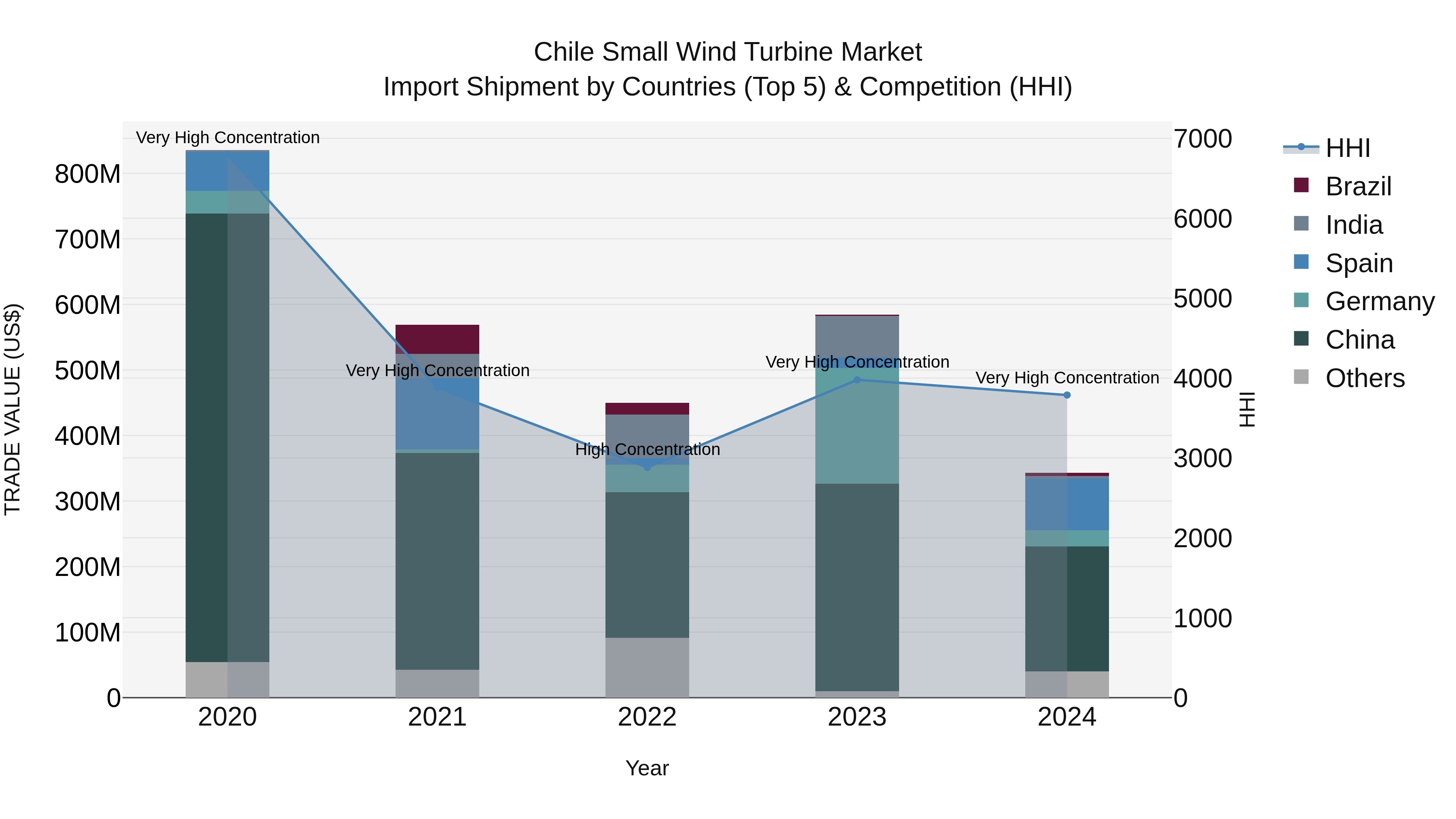
Despite a decline in growth rate in 2024, Chile continued to be a key destination for small wind turbine imports. The top exporting countries to Chile, including China, Spain, Mexico, Germany, and the USA, maintained a strong presence in the market. The high Herfindahl-Hirschman Index (HHI) indicates a concentrated market, suggesting potential challenges for new entrants. With a negative Compound Annual Growth Rate (CAGR) and a significant decrease in growth rate from 2023 to 2024, it will be interesting to see how the market dynamics evolve in the coming years.
Chile Small Wind Turbine Market Overview
The Chile Small Wind Turbine Market is experiencing steady growth driven by increasing government support for renewable energy initiatives and the country`s favorable wind energy potential. The market is primarily dominated by small-scale wind turbine installations for residential, rural, and off-grid applications. Key players in the market include local and international manufacturers offering a range of small wind turbine systems tailored to meet the diverse needs of consumers. With Chile`s commitment to increasing its renewable energy capacity and reducing carbon emissions, the small wind turbine market is expected to witness further expansion in the coming years. Factors such as technological advancements, declining costs, and growing awareness about the benefits of wind energy are likely to fuel the market`s growth and attract more investments in this sector.
Chile Small Wind Turbine Market Trends
The Chile small wind turbine market is experiencing significant growth driven by the increasing demand for renewable energy sources and the government`s push towards clean energy initiatives. Key trends in the market include a rising adoption of small wind turbines for residential and commercial applications, particularly in remote areas where grid connectivity is limited. Technological advancements in small wind turbine design, such as improved efficiency and durability, are also fueling market growth. Moreover, the availability of government incentives and subsidies for renewable energy projects is further boosting the market. Overall, the Chile small wind turbine market is expected to continue its upward trajectory as the country strives to diversify its energy mix and reduce carbon emissions.
Chile Small Wind Turbine Market Challenges
In the Chile Small Wind Turbine Market, there are several challenges that hinder its growth. One major challenge is the high initial investment required for installing small wind turbines, which can be a deterrent for potential buyers. Additionally, the lack of awareness and understanding about the benefits of small wind turbines among consumers and businesses poses a challenge. The intermittent nature of wind energy and the variability of wind patterns in certain regions of Chile also impact the efficiency and reliability of small wind turbines. Furthermore, regulatory barriers and limited government incentives for renewable energy projects can make it difficult for small wind turbine manufacturers and developers to penetrate the market and compete with other forms of energy generation. Overall, addressing these challenges will be crucial for the sustainable growth of the Small Wind Turbine Market in Chile.
Chile Small Wind Turbine Market Investment Opportunities
The Chile small wind turbine market presents promising investment opportunities due to the country`s increasing focus on renewable energy and sustainability. With Chile aiming to diversify its energy sources and reduce its reliance on traditional fossil fuels, the demand for small wind turbines is expected to grow. Additionally, the country`s favorable wind resources, especially in regions like Patagonia and the northern coast, provide ample opportunities for wind energy projects. Investors can consider entering the market by partnering with local renewable energy companies, participating in government-led initiatives promoting wind energy, or developing small-scale wind projects for industries or remote communities. Overall, the Chile small wind turbine market offers potential for growth and sustainability-focused investments in the renewable energy sector.
Chile Small Wind Turbine Market Government Policy
In Chile, the government has implemented various policies to promote the small wind turbine market. One key policy is the Net Metering System, which allows small wind turbine owners to sell excess electricity back to the grid at a fixed price. Additionally, the Renewable Portfolio Standard requires a percentage of electricity to come from renewable sources, including wind energy, providing a market incentive for small wind turbine installations. The government has also established tax incentives, such as accelerated depreciation and exemptions on import duties for wind turbine equipment. These policies aim to incentivize investment in small wind turbines, reduce reliance on fossil fuels, and contribute to Chile`s renewable energy targets.
Chile Small Wind Turbine Market Future Outlook
The future outlook for the Chile Small Wind Turbine Market appears promising, with steady growth expected in the coming years. Factors driving this growth include increasing awareness of renewable energy sources, government incentives for clean energy projects, and the need to reduce carbon emissions. As Chile works towards its goal of achieving carbon neutrality by 2050, the demand for small wind turbines is likely to rise, particularly in rural and remote areas where grid connectivity is limited. Additionally, advancements in technology and decreasing costs of wind turbine installations are making small wind power more accessible to a wider range of consumers. Overall, the Chile Small Wind Turbine Market is poised for expansion as the country continues to prioritize sustainable energy solutions.
Key Highlights of the Report:
- Chile Small Wind Turbine Market Outlook
- Market Size of Chile Small Wind Turbine Market, 2024
- Forecast of Chile Small Wind Turbine Market, 2031
- Historical Data and Forecast of Chile Small Wind Turbine Revenues & Volume for the Period 2021 - 2031
- Chile Small Wind Turbine Market Trend Evolution
- Chile Small Wind Turbine Market Drivers and Challenges
- Chile Small Wind Turbine Price Trends
- Chile Small Wind Turbine Porter's Five Forces
- Chile Small Wind Turbine Industry Life Cycle
- Historical Data and Forecast of Chile Small Wind Turbine Market Revenues & Volume By Axis Type for the Period 2021 - 2031
- Historical Data and Forecast of Chile Small Wind Turbine Market Revenues & Volume By Horizontal Axis Wind Turbine for the Period 2021 - 2031
- Historical Data and Forecast of Chile Small Wind Turbine Market Revenues & Volume By Vertical Axis Wind Turbine for the Period 2021 - 2031
- Historical Data and Forecast of Chile Small Wind Turbine Market Revenues & Volume By Application for the Period 2021 - 2031
- Historical Data and Forecast of Chile Small Wind Turbine Market Revenues & Volume By On-grid for the Period 2021 - 2031
- Historical Data and Forecast of Chile Small Wind Turbine Market Revenues & Volume By Off-grid for the Period 2021 - 2031
- Chile Small Wind Turbine Import Export Trade Statistics
- Market Opportunity Assessment By Axis Type
- Market Opportunity Assessment By Application
- Chile Small Wind Turbine Top Companies Market Share
- Chile Small Wind Turbine Competitive Benchmarking By Technical and Operational Parameters
- Chile Small Wind Turbine Company Profiles
- Chile Small Wind Turbine Key Strategic Recommendations






































