Chile Table Olives Market Top 5 Importing Countries and Market Competition (HHI) Analysis
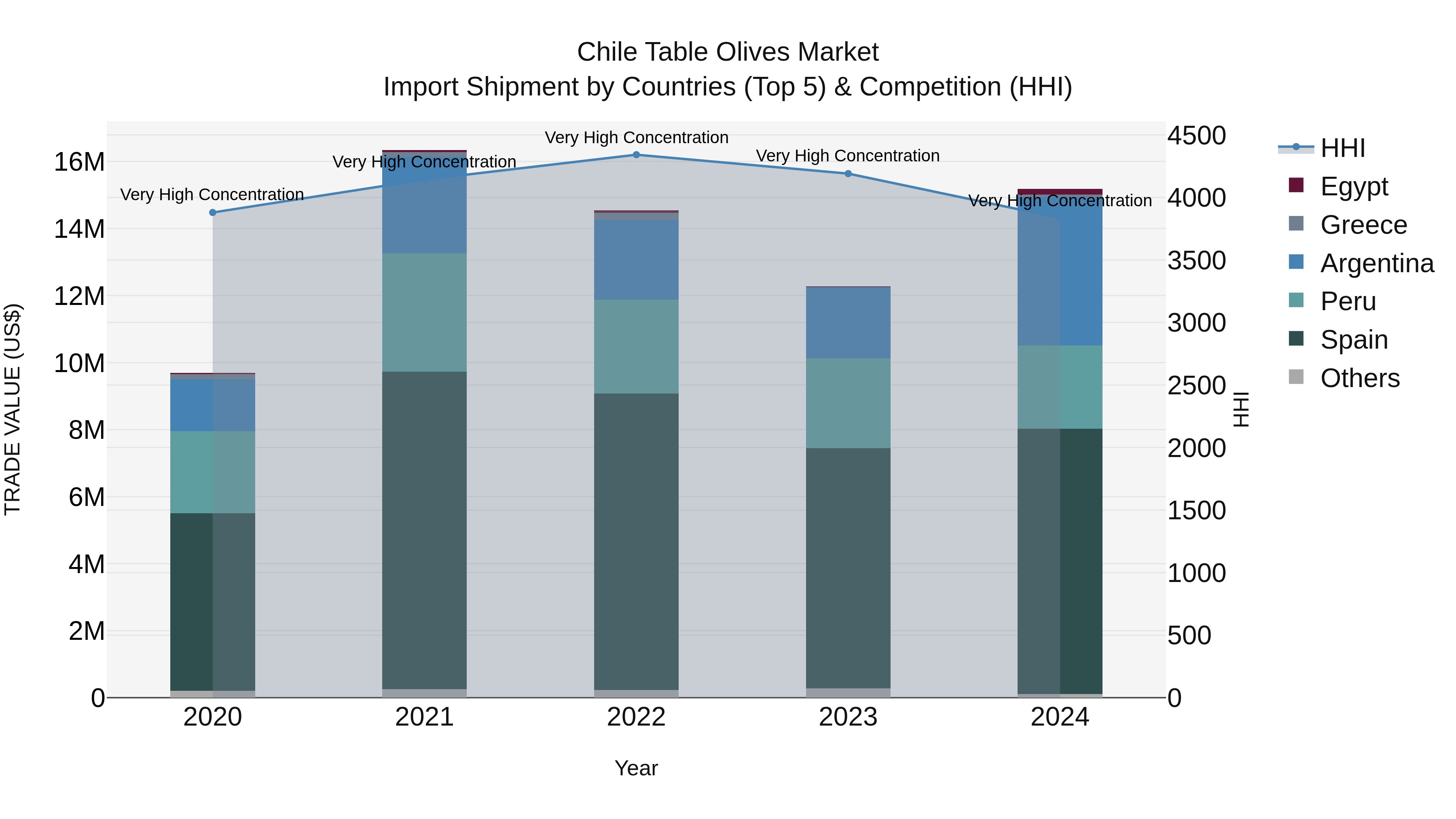
The Chilean market for table olives continues to see strong growth, with key exporting countries such as Spain, Argentina, Peru, Egypt, and Greece dominating the import shipments in 2024. The high concentration levels, as indicated by the Herfindahl-Hirschman Index (HHI), suggest a competitive landscape among these top exporting nations. The impressive compound annual growth rate (CAGR) of 11.89% over the period 2020-2024, coupled with a notable growth rate of 23.76% in 2024, indicates a robust demand for table olives in Chile and highlights the opportunities for further market expansion in the sector.
Chile Table Olives Market Synopsis
The Chile table olives market is experiencing steady growth driven by increasing consumer awareness of the health benefits associated with olives, such as being rich in antioxidants and healthy fats. The market is characterized by a wide variety of olive cultivars, including Manzanilla, Sevillana, and Arbequina, catering to diverse consumer preferences. Chile`s favorable climate and fertile soil provide optimal conditions for olive cultivation, leading to high-quality olives being produced. The market is also witnessing a rise in demand for organic and locally sourced olives, reflecting a growing trend towards sustainability and ethical consumerism. Key players in the Chile table olives market include small-scale producers and larger companies focusing on both domestic sales and exports to international markets, particularly in North America and Europe.
Chile Table Olives Market Trends
The Chile Table Olives Market is experiencing a growing demand for healthier food options, leading to an increased interest in olives for their health benefits and versatility. Consumers are seeking natural and minimally processed products, driving the demand for premium and organic table olives. There is also a rising trend towards innovative flavors and packaging, appealing to a younger demographic looking for unique culinary experiences. Opportunities exist for companies to capitalize on this trend by expanding product offerings, investing in sustainable and organic production practices, and leveraging digital marketing to reach a wider audience. Additionally, exporting Chilean table olives to new markets presents a significant growth opportunity for industry players looking to diversify and expand their global presence.
Chile Table Olives Market Challenges
In the Chile Table Olives market, some of the challenges faced include increasing competition from imported table olives, fluctuating weather conditions affecting olive production, and the need to adhere to strict quality and safety standards to meet international market requirements. Additionally, rising production costs, limited marketing efforts to promote Chilean table olives globally, and the impact of global trade policies and tariffs on export opportunities pose challenges for the industry. To overcome these challenges, stakeholders in the Chile Table Olives market may need to focus on enhancing product quality, investing in sustainable farming practices, expanding market reach through targeted marketing strategies, and fostering collaborations within the supply chain to improve competitiveness in the global market.
Chile Table Olives Market Investment Opportunities
The Chile Table Olives Market is primarily driven by increasing consumer awareness of the health benefits associated with olives, such as their high content of antioxidants and healthy fats. The growing trend towards healthier eating habits and a preference for natural, organic products has also contributed to the rising demand for table olives in Chile. Additionally, the versatility of olives in various cuisines and dishes, along with their long shelf life and convenience as a snack or ingredient, further fuel market growth. Furthermore, the expansion of distribution channels, including online retail platforms, has made table olives more accessible to consumers across different demographics, driving overall market expansion in Chile.
Chile Table Olives Market Government Polices
In Chile, government policies related to the Table Olives Market focus on supporting the industry through various initiatives. The government provides subsidies to encourage olive cultivation and production, as well as invests in research and development to enhance the quality and competitiveness of Chilean table olives in the global market. Additionally, there are regulations in place to ensure food safety standards are met, including labeling requirements and quality control measures. The government also promotes exports of Chilean table olives through trade agreements and market access programs, aiming to increase international demand and expand the market reach for local producers. Overall, government policies in Chile are geared towards fostering growth and sustainability in the Table Olives Market.
Chile Table Olives Market Future Outlook
The future outlook for the Chile Table Olives Market looks promising, driven by increasing consumer awareness of the health benefits associated with olives, such as being high in antioxidants and good fats. Furthermore, the growing trend towards Mediterranean cuisine and the rising popularity of olive-based products in the food industry are expected to boost market growth. Additionally, Chile`s favorable climate conditions for olive cultivation and the government`s support for the agriculture sector are likely to contribute to the expansion of the table olives market. With a focus on sustainable farming practices and innovation in processing techniques, Chile is well-positioned to capitalize on the growing demand for high-quality table olives both domestically and internationally.
Key Highlights of the Report:
- Chile Table Olives Market Outlook
- Market Size of Chile Table Olives Market, 2024
- Forecast of Chile Table Olives Market, 2031
- Historical Data and Forecast of Chile Table Olives Revenues & Volume for the Period 2021- 2031
- Chile Table Olives Market Trend Evolution
- Chile Table Olives Market Drivers and Challenges
- Chile Table Olives Price Trends
- Chile Table Olives Porter's Five Forces
- Chile Table Olives Industry Life Cycle
- Historical Data and Forecast of Chile Table Olives Market Revenues & Volume By Type for the Period 2021- 2031
- Historical Data and Forecast of Chile Table Olives Market Revenues & Volume By Black Olive for the Period 2021- 2031
- Historical Data and Forecast of Chile Table Olives Market Revenues & Volume By Green Olive for the Period 2021- 2031
- Historical Data and Forecast of Chile Table Olives Market Revenues & Volume By Application for the Period 2021- 2031
- Historical Data and Forecast of Chile Table Olives Market Revenues & Volume By Online Store for the Period 2021- 2031
- Historical Data and Forecast of Chile Table Olives Market Revenues & Volume By Supermarket for the Period 2021- 2031
- Historical Data and Forecast of Chile Table Olives Market Revenues & Volume By Convenience Store for the Period 2021- 2031
- Historical Data and Forecast of Chile Table Olives Market Revenues & Volume By Other for the Period 2021- 2031
- Chile Table Olives Import Export Trade Statistics
- Market Opportunity Assessment By Type
- Market Opportunity Assessment By Application
- Chile Table Olives Top Companies Market Share
- Chile Table Olives Competitive Benchmarking By Technical and Operational Parameters
- Chile Table Olives Company Profiles
- Chile Table Olives Key Strategic Recommendations






































