Philippines Table Olives Market Top 5 Importing Countries and Market Competition (HHI) Analysis
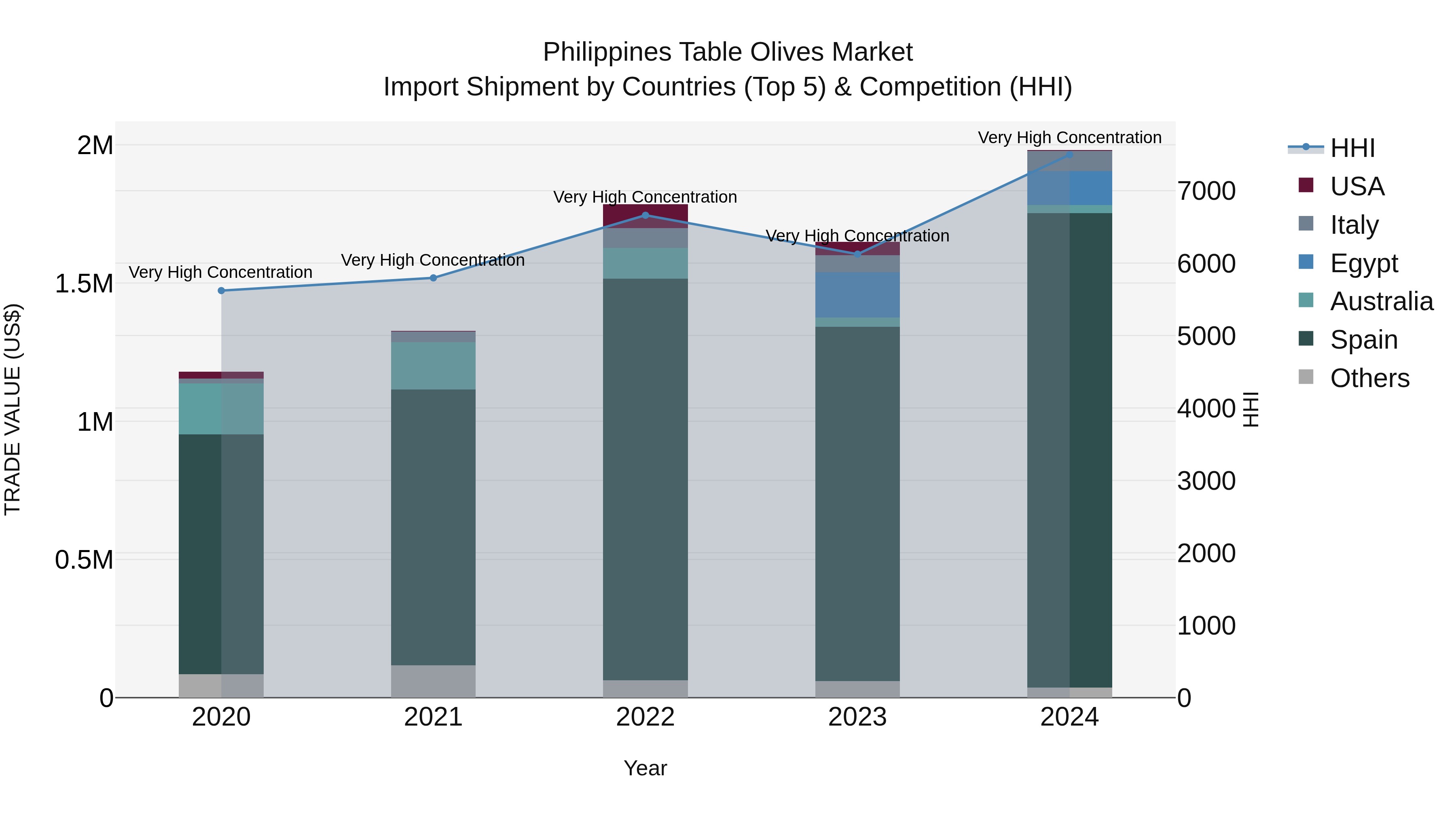
The Philippines saw a significant increase in table olives imports in 2024, with top exporting countries being Spain, Egypt, Italy, Australia, and Singapore. The market remains highly concentrated, as indicated by the high Herfindahl-Hirschman Index (HHI). The industry experienced a strong compound annual growth rate (CAGR) of 13.83% from 2020 to 2024, with a notable growth rate of 20.09% from 2023 to 2024. This data suggests a growing demand for table olives in the Philippines, with key players continuing to dominate the market.
Philippines Table Olives Market Overview
The market for table olives in the Philippines is gradually expanding, largely driven by growing interest in Mediterranean cuisine and healthy snacking. While imports dominate the supply, there is increasing potential for value-added olive products and flavored variants. Retail and foodservice channels are key contributors to market growth.
Drivers of the market
Table olives are gradually gaining popularity in the Philippines, especially among urban consumers exposed to Mediterranean cuisine. Imports dominate the market, but demand is rising for both whole and pitted variants, supported by their health appeal and use in food service and gourmet cooking.
Challenges of the market
The table olives market struggles with limited domestic production and a reliance on imported varieties, which raises prices and restricts accessibility for middle-income consumers. Consumer unfamiliarity with olives as a regular food item, coupled with preservation challenges in a humid climate, further complicate the markets expansion efforts.
Investment opportunities in the Market
Though still a niche segment, the growing popularity of Mediterranean diets in the Philippines supports demand for table olives. Import substitution through local processing or distribution agreements with international brands can be profitable ventures in this sector.
Government Policy of the market
While olives are not traditionally cultivated in the Philippines, the government encourages agricultural diversification and import substitution strategies. Import regulations and food safety standards enforced by the Bureau of Customs and Food and Drug Administration (FDA) ensure quality control. Incentives under agribusiness investment programs may apply if local cultivation and processing are developed.
Key Highlights of the Report:
- Philippines Table Olives Market Outlook
- Market Size of Philippines Table Olives Market, 2024
- Forecast of Philippines Table Olives Market, 2031
- Historical Data and Forecast of Philippines Table Olives Revenues & Volume for the Period 2021- 2031
- Philippines Table Olives Market Trend Evolution
- Philippines Table Olives Market Drivers and Challenges
- Philippines Table Olives Price Trends
- Philippines Table Olives Porter's Five Forces
- Philippines Table Olives Industry Life Cycle
- Historical Data and Forecast of Philippines Table Olives Market Revenues & Volume By Type for the Period 2021- 2031
- Historical Data and Forecast of Philippines Table Olives Market Revenues & Volume By Black Olive for the Period 2021- 2031
- Historical Data and Forecast of Philippines Table Olives Market Revenues & Volume By Green Olive for the Period 2021- 2031
- Historical Data and Forecast of Philippines Table Olives Market Revenues & Volume By Application for the Period 2021- 2031
- Historical Data and Forecast of Philippines Table Olives Market Revenues & Volume By Online Store for the Period 2021- 2031
- Historical Data and Forecast of Philippines Table Olives Market Revenues & Volume By Supermarket for the Period 2021- 2031
- Historical Data and Forecast of Philippines Table Olives Market Revenues & Volume By Convenience Store for the Period 2021- 2031
- Historical Data and Forecast of Philippines Table Olives Market Revenues & Volume By Other for the Period 2021- 2031
- Philippines Table Olives Import Export Trade Statistics
- Market Opportunity Assessment By Type
- Market Opportunity Assessment By Application
- Philippines Table Olives Top Companies Market Share
- Philippines Table Olives Competitive Benchmarking By Technical and Operational Parameters
- Philippines Table Olives Company Profiles
- Philippines Table Olives Key Strategic Recommendations






































