Chile Thermostats Market Summary
The chile thermostats market was estimated at USD 479 Million in 2025 and is projected to reach USD 672 Million by 2032, growing at a CAGR of 5.6% from 2026 to 2032.
Chile Thermostats Market Year-wise Growth Rate and Key Drivers
This graph highlights how the Chile Thermostats Market has steadily grown over the past five years, supported by major growth factors.
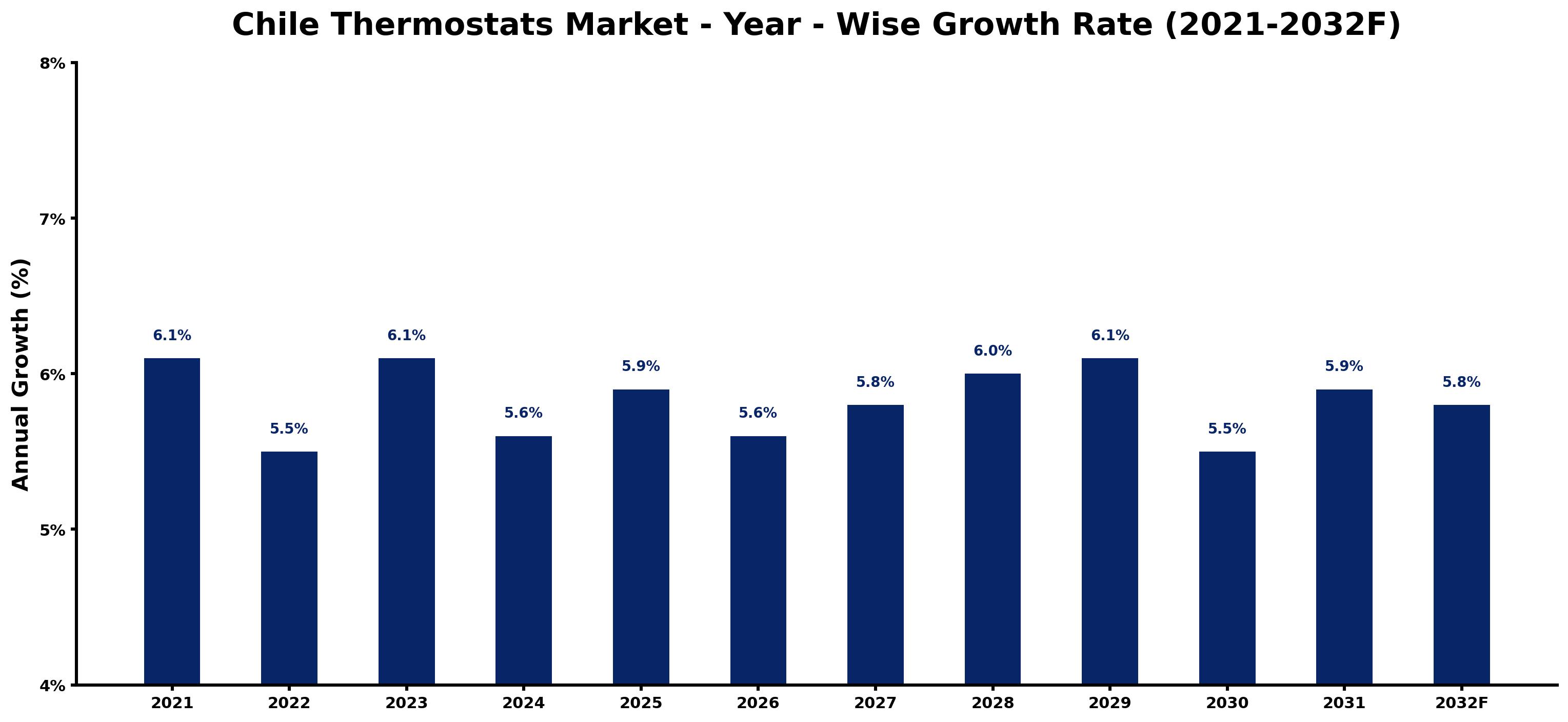
The table below presents the year wise growth rates along with the key drivers influencing the market
| Year | Growth Rate | Major Drivers |
| 2021 | 6.1% | Post-lockdown retail projects boosted home improvement spending in urban areas. |
| 2022 | 5.5% | Energy efficiency concerns prompted increased interest in smart home technologies. |
| 2023 | 6.1% | Climate fluctuations heightened the need for reliable temperature control solutions. |
| 2024 | 5.6% | Local manufacturers began investing in advanced thermostat technologies and features. |
| 2025 | 5.9% | Emerging IoT integration transformed user experiences through seamless connectivity. |
| 2026 | 5.6% | Rising electricity costs pushed consumers towards energy-saving thermostat options. |
| 2027 | 5.8% | Home automation trends attracted tech-savvy consumers seeking innovative products. |
| 2028 | 6.0% | Real estate developments incorporated smart thermostats as standard features. |
| 2029 | 6.1% | Interest in sustainable living prompted eco-friendly thermostat product lines. |
| 2030 | 5.5% | Regional climatic changes necessitated adaptive temperature regulation systems. |
| 2031 | 5.9% | Corporate responsibility initiatives urged manufacturers to prioritize sustainable practices. |
| 2032 | 5.8% | Increasing digital literacy made advanced HVAC solutions more accessible to households. |
Note - Market size estimations and growth projections presented in this report are based on 6Wresearch's advanced forecasting approach, validated with industry datasets as of June 2026.
Chile Thermostats Market Synopsis
The Chile Thermostats Market is projected to reach 5.6% and witness significant growth during the forecast period (2026-2032). The anticipated market size of USD 6.9 million by 2026 reflects a compound annual growth rate (CAGR) of 4.3% driven by various factors, including increasing investments in both residential and commercial construction projects throughout Chile. As the economy expands, demand for energy-efficient products, particularly smart thermostats and digital control systems, is likely to gain traction, further propelling the growth of the thermostat market.
Chile Thermostats Market Growth Drivers
The growth of the Chile thermostats market can be attributed to several interrelated factors:
- The surge in residential and commercial construction projects fuels demand for advanced thermostat solutions, catering to modern buildings' sophisticated climate control needs.
- Increasing awareness of energy conservation drives customers' preference for energy-efficient products, including smart and programmable thermostats.
- Technological advancements in heating, ventilation, and air conditioning (HVAC) systems lead to enhanced indoor temperature control, further stimulating market growth.
- Government initiatives promoting energy efficiency and sustainability encourage consumers to invest in smart technologies, such as wireless programmable thermostats.
- The ability of modern thermostats to integrate with smart home technologies enhances user convenience, shifting consumer preferences toward connected solutions.
Chile Thermostats Market Trends and Opportunities
In the evolving landscape of the Chile thermostats market, several trends and opportunities are emerging:
- The growing trend of smart home integration presents manufacturers with opportunities to innovate and develop connected thermostat solutions compatible with various smart devices.
- As consumers become increasingly tech-savvy, the demand for advanced features such as occupancy detection and learning algorithms in thermostats is expected to rise.
- The push towards sustainability in building practices opens avenues for the introduction of eco-friendly thermostats designed to optimize energy use.
- Investment in renewable energy sources and energy-efficient retrofits will further expand the market for sophisticated thermostat systems tailored to optimize performance.
- Collaboration between technology companies and HVAC firms can yield innovative product offerings, driving market growth through synergies in expertise and resources.
Chile Thermostats Market Challenges and Restraints
Despite the promising growth trajectory, the Chile thermostats market faces several challenges:
- The initial investment cost associated with smart thermostats may deter some consumers from upgrading, especially in economically sensitive segments.
- A lack of awareness regarding the benefits of advanced thermostat systems might limit market penetration, particularly in rural areas.
- Competition from traditional mechanical thermostats could pose a challenge as consumers weigh cost against functionality.
- Technological complexities and privacy concerns surrounding smart home integration may hinder consumer acceptance of connected thermostat solutions.
- Fluctuations in raw material costs can impact manufacturing, leading to potentially higher prices for end consumers.
Chile Thermostats Market Government Investment and Initiatives
The role of government policy and public spending is pivotal in shaping the Chile thermostats market. Authorities are increasingly focused on fostering energy efficiency and sustainability initiatives. Various incentives aimed at promoting the adoption of energy-efficient systems have been introduced, including subsidies for households investing in smart technology.
Furthermore, the Chilean government has implemented regulations aimed at reducing energy consumption in residential and commercial buildings. Support for research and development in energy-efficient products positions the thermostats market to benefit from potential grants and funding opportunities.
Chile Thermostats Market Latest Developments (May 2025 - June 2026)
From May 2025 to June 2026, the Chile thermostats market experienced several notable developments. Increased investments in smart technology were observed as companies introduced more sophisticated thermostat models targeting enhanced user experience. The focus on energy-efficient solutions intensified, leading to a wider acceptance of wireless programmable thermostats among consumers.
Innovations in connectivity features and compatibility with various smart home systems became prominent trends during this period. Manufacturers showcased their commitment to sustainability through the rollout of eco-friendly thermostat options. Additionally, educational campaigns raised consumer awareness about the advantages of advanced temperature control systems, facilitating broader market adoption.
Chile Thermostats Market - Key Attractiveness of the Report
- 10 Years of Market Numbers
- Historical Data Starting from 2022 to 2025
- Base Year: 2025
- Forecast Data until 2032
- Key Performance Indicators Impacting the Market
- Major Upcoming Developments and Projects
Key Highlights of the Report:
- Chile Thermostats Market Outlook
- Market Size of Chile Thermostats Market, 2025
- Forecast of Chile Thermostats Market, 2032F
- Historical Data and Forecast of Chile Thermostats Revenues & Volume for the Period 2022-2032F
- Chile Thermostats Market Trend Evolution
- Chile Thermostats Market Drivers and Challenges
- Chile Thermostats Price Trends
- Chile Thermostats Porter's Five Forces
- Chile Thermostats Industry Life Cycle
- Historical Data and Forecast of Chile Thermostats Market Revenues & Volume By Products for the Period 2022-2032F
- Historical Data and Forecast of Chile Thermostats Market Revenues & Volume By Smart Thermostat for the Period 2022-2032F
- Historical Data and Forecast of Chile Thermostats Market Revenues & Volume By Mechanical Thermostat for the Period 2022-2032F
- Historical Data and Forecast of Chile Thermostats Market Revenues & Volume By Programmable Thermostat for the Period 2022-2032F
- Historical Data and Forecast of Chile Thermostats Market Revenues & Volume By Distribution Channel for the Period 2022-2032F
- Historical Data and Forecast of Chile Thermostats Market Revenues & Volume By Utility for the Period 2022-2032F
- Historical Data and Forecast of Chile Thermostats Market Revenues & Volume By Retail for the Period 2022-2032F
- Historical Data and Forecast of Chile Thermostats Market Revenues & Volume By Security for the Period 2022-2032F
- Historical Data and Forecast of Chile Thermostats Market Revenues & Volume By HVAC for the Period 2022-2032F
- Historical Data and Forecast of Chile Thermostats Market Revenues & Volume By Mode of Operations for the Period 2022-2032F
- Historical Data and Forecast of Chile Thermostats Market Revenues & Volume By Line Voltage for the Period 2022-2032F
- Historical Data and Forecast of Chile Thermostats Market Revenues & Volume By Low Voltage for the Period 2022-2032F
- Historical Data and Forecast of Chile Thermostats Market Revenues & Volume By Millivolt for the Period 2022-2032F
- Historical Data and Forecast of Chile Thermostats Market Revenues & Volume By Applications for the Period 2022-2032F
- Historical Data and Forecast of Chile Thermostats Market Revenues & Volume By Residential for the Period 2022-2032F
- Historical Data and Forecast of Chile Thermostats Market Revenues & Volume By Commercial for the Period 2022-2032F
- Chile Thermostats Import Export Trade Statistics
- Market Opportunity Assessment By Products
- Market Opportunity Assessment By Distribution Channel
- Market Opportunity Assessment By Mode of Operations
- Market Opportunity Assessment By Applications
- Chile Thermostats Top Companies Market Share
- Chile Thermostats Competitive Benchmarking By Technical and Operational Parameters
- Chile Thermostats Company Profiles
- Chile Thermostats Key Strategic Recommendations






































