Chile Three Wheeler Market Size, Share & Growth Rate
The Chile Three Wheeler Market was estimated at USD 383 Million in 2025 and is projected to reach USD 511 Million by 2032, growing at a CAGR of 4.2% from 2026 to 2032. This growth trajectory is primarily fueled by the increasing demand for efficient and cost-effective transportation solutions in both urban and rural settings. The rising adoption of eco-friendly vehicles, particularly electric three-wheelers, is expected to further contribute to market expansion, reflecting a shift in consumer preferences and governmental support for sustainable mobility options.
Chile Three Wheeler Market Year-wise Growth Rate and Key Drivers
This graph highlights how the Chile Three Wheeler Market has steadily grown over the years, supported by major growth factors.
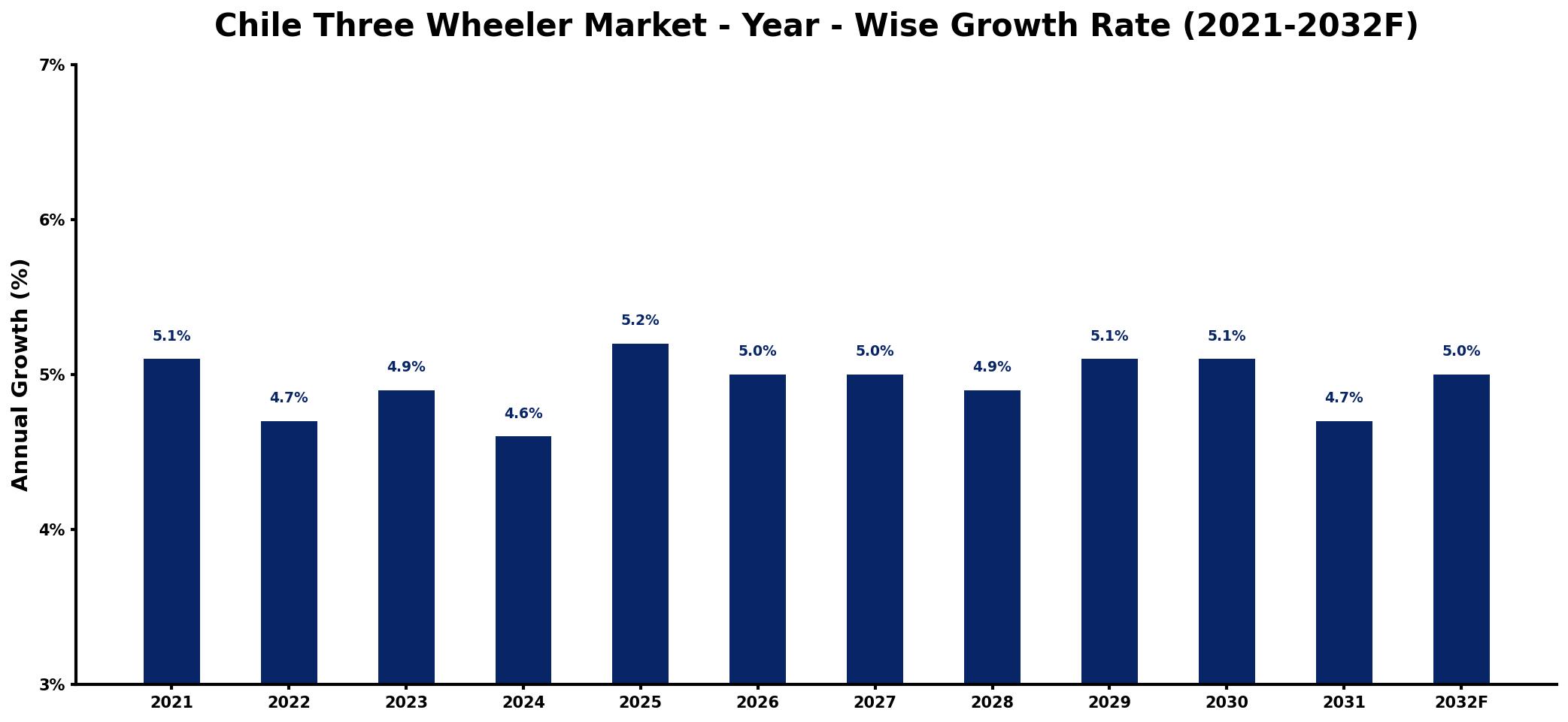
The table below presents the year‑wise growth rates along with the key drivers influencing the market
| Year | Growth Rate | Major Drivers |
| 2021 | 5.1% | Rising urban mobility solutions demand |
| 2022 | 4.7% | Expansion of local manufacturing capabilities |
| 2023 | 4.9% | Increased investment in logistics networks |
| 2024 | 4.6% | Growing popularity of ride-sharing services |
| 2025 | 5.2% | Surge in eco-friendly transportation options |
| 2026 | 5.0% | Strengthening of last-mile delivery systems |
| 2027 | 5.0% | Enhanced infrastructure for urban transport |
| 2028 | 4.9% | increased overall sector activity |
| 2029 | 5.1% | Growing adoption of electric vehicles |
| 2030 | 5.1% | Increasing focus on sustainable mobility |
| 2031 | 4.7% | Development of regional trade agreements |
| 2032 | 5.0% | Advancements in technology and innovation |
Note: Market size estimations and growth projections presented in this report are based on 6Wresearch's proprietary forecasting methodology, utilizing the latest available industry data, government publications, and primary research inputs.
Chile Three Wheeler Market Synopsis
The Chilean market for three-wheelers is increasingly recognized as a viable solution for last-mile delivery, as businesses seek to enhance their logistics efficiency. This mode of transport is becoming indispensable for small goods transport in congested urban areas where traditional vehicles may face limitations.
Additionally, the government's commitment to sustainability is manifested in policies that encourage the adoption of three-wheelers, particularly those powered by electric and hybrid technologies. As infrastructure for charging and maintenance continues to improve, consumer confidence in these vehicles is expected to rise, enhancing their market acceptance.
Chile Three Wheeler Market Key Takeaways
- The market is witnessing a transformation with the introduction of electric and hybrid models.
- Government incentives are playing a critical role in promoting the adoption of three-wheelers.
- Consumer demand is increasingly shifting towards customized and eco-friendly transport solutions.
- Urban logistics and last-mile delivery are key drivers of market growth.
- Investment opportunities are robust in manufacturing, distribution, and ride-sharing collaborations.
Evaluation of Restraints in Chile Three Wheeler Market
Despite its promising trajectory, the Chile Three Wheeler Market faces several constraints that could hinder its growth. Limited consumer awareness around the benefits of three-wheelers as a viable transportation option poses a challenge to market penetration. Furthermore, the strong competition from traditional four-wheeled vehicles presents an additional hurdle. Regulatory requirements, particularly concerning safety and emissions, can also impose significant barriers. The infrastructure dedicated to three-wheelers remains underdeveloped, including the absence of specific parking facilities and maintenance services. These factors collectively necessitate targeted efforts to enhance market education and infrastructure support.
Chile Three Wheeler Market Trends
The trend towards electrification is a key theme in the Chile Three Wheeler Market, with both manufacturers and consumers leaning towards eco-friendly alternatives. Advances in battery technology are enhancing the practicality and appeal of electric three-wheelers by improving their range and lowering operational costs. Additionally, customization options are gaining traction, as consumers express interest in unique features that reflect their personal style and needs. This evolving landscape signifies a shift towards greater innovation and customer-centric product offerings.
Chile Three Wheeler Market Opportunities
The Chile Three Wheeler Market offers a myriad of investment opportunities, particularly in the areas of manufacturing and distribution of electric and hybrid vehicles. The increasing need for affordable transport solutions in both urban and rural settings points to a burgeoning market waiting to be tapped. Moreover, partnerships with local dealerships and ride-sharing services can provide a strategic advantage for investors. The government's commitment to clean energy initiatives further reinforces the potential for growth in this sector, making it an attractive avenue for forward-thinking investors.
Government Initiatives in the Chile Three Wheeler Market
The Chilean government has enacted several policies aimed at regulating the three-wheeler market. These include comprehensive safety regulations, strict emission standards, and licensing requirements designed to ensure vehicle quality and environmental compliance. Furthermore, incentives such as tax breaks and subsidies are being offered to companies that manufacture or operate electric three-wheelers, supporting a greener transportation landscape. Import tariffs have also been imposed to protect domestic producers, striking a balance between market growth and local industry support.
Future Insights of the Chile Three Wheeler Market
Looking ahead to the years 2026 through 2032, the Chile Three Wheeler Market is set to experience robust growth driven by evolving consumer preferences and enhanced government initiatives aimed at promoting sustainability. The increase in urban congestion will continue to propel demand for efficient transportation solutions, while the embrace of electric vehicles will redefine the market landscape. Coupled with advancements in technology that improve performance, the outlook remains positive as the market aligns itself with global trends towards sustainable transport.
Chile Three Wheeler Market Latest Developments (2025 - 2026)
Recent developments in the Chile Three Wheeler Market indicate a growing momentum towards electric vehicles. Numerous initiatives are being launched to enhance charging infrastructure, facilitating the transition to eco-friendly transportation. Furthermore, companies are increasingly emphasizing the importance of innovative features and customer personalization in their offerings. Market stakeholders are also focusing on strategic partnerships aimed at improving logistics and delivery services, thereby enhancing the functionality of three-wheelers in commercial applications.
Chile Three Wheeler Market - Key Attractiveness of the Report
- 10 Years of Market Numbers
- Historical Data Starting from 2022 to 2025
- Base Year: 2025
- Forecast Data until 2032
- Key Performance Indicators Impacting the Market
- Major Upcoming Developments and Projects
Key Highlights of the Report:
- Chile Three Wheeler Market Outlook
- Market Size of Chile Three Wheeler Market, 2025
- Forecast of Chile Three Wheeler Market, 2032
- Historical Data and Forecast of Chile Three Wheeler Revenues & Volume for the Period 2022-2032F
- Chile Three Wheeler Market Trend Evolution
- Chile Three Wheeler Market Drivers and Challenges
- Chile Three Wheeler Price Trends
- Chile Three Wheeler Porter's Five Forces
- Chile Three Wheeler Industry Life Cycle
- Historical Data and Forecast of Chile Three Wheeler Market Revenues & Volume By Fuel Type for the Period 2022-2032F
- Historical Data and Forecast of Chile Three Wheeler Market Revenues & Volume By Petrol/CNG for the Period 2022-2032F
- Historical Data and Forecast of Chile Three Wheeler Market Revenues & Volume By Diesel for the Period 2022-2032F
- Historical Data and Forecast of Chile Three Wheeler Market Revenues & Volume By Electric for the Period 2022-2032F
- Historical Data and Forecast of Chile Three Wheeler Market Revenues & Volume By Vehicle Type for the Period 2022-2032F
- Historical Data and Forecast of Chile Three Wheeler Market Revenues & Volume By Passenger Carrier for the Period 2022-2032F
- Historical Data and Forecast of Chile Three Wheeler Market Revenues & Volume By Load Carrier for the Period 2022-2032F
- Chile Three Wheeler Import Export Trade Statistics
- Market Opportunity Assessment By Fuel Type
- Market Opportunity Assessment By Vehicle Type
- Chile Three Wheeler Top Companies Market Share
- Chile Three Wheeler Competitive Benchmarking By Technical and Operational Parameters
- Chile Three Wheeler Company Profiles
- Chile Three Wheeler Key Strategic Recommendations






































