Chile Workplace Safety Market Size & Growth Rate (2026-2032)
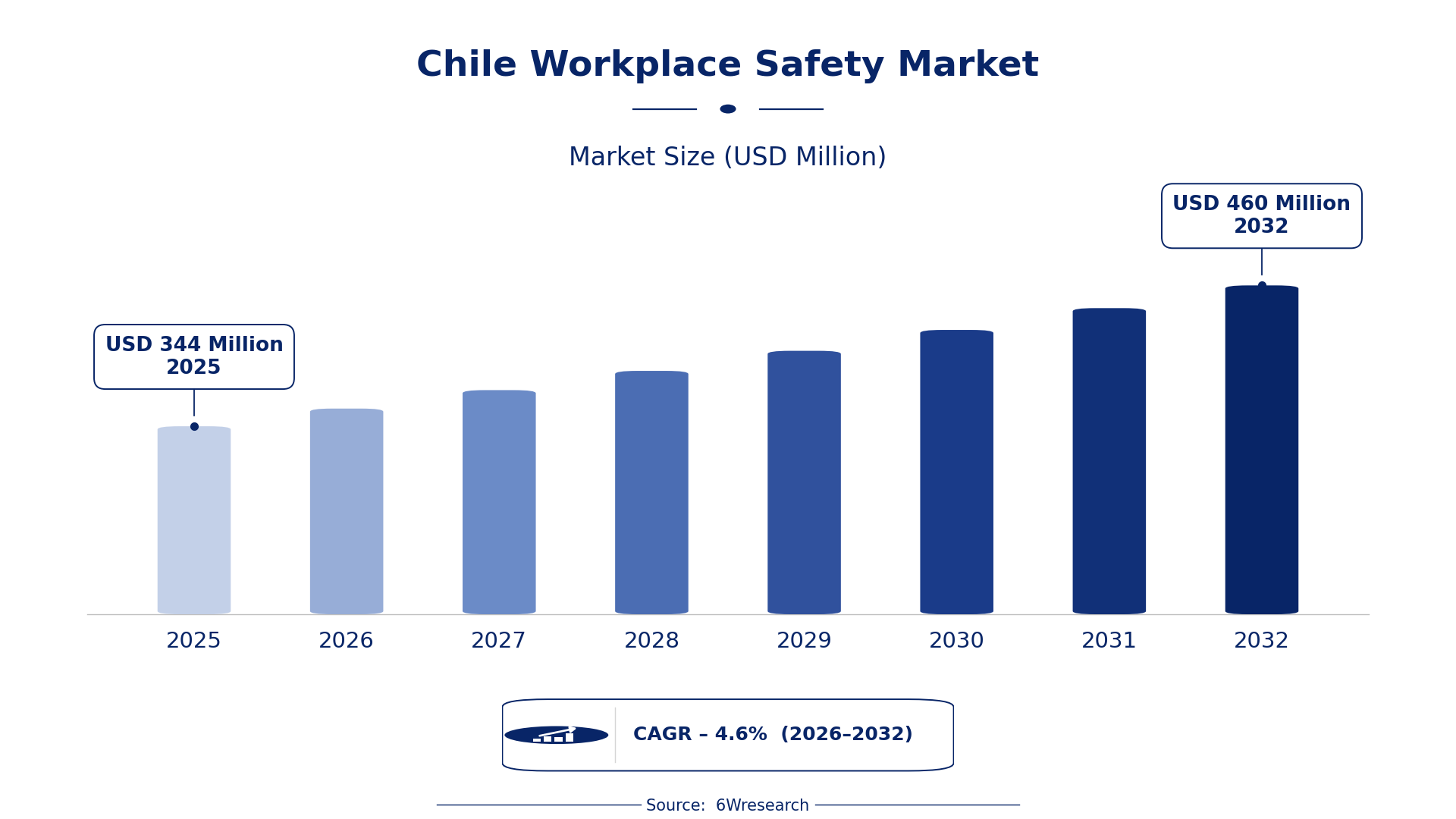
The Chile Workplace Safety Market was estimated at USD 344 Million in 2025 and is projected to reach USD 460 Million by 2032, growing at a CAGR of 4.6% from 2026 to 2032.
Chile Workplace Safety Market Synopsis
The most significant force currently shaping the Chile Workplace Safety Market is the increasing emphasis on occupational health and safety regulations. Employers are becoming more aware of their responsibilities, prompting a shift towards comprehensive safety solutions that protect employees across various sectors.
Market dynamics are also being influenced by advancements in technology. The integration of IoT devices, wearables, and data analytics is facilitating real-time monitoring of workplace safety, pushing companies to adopt innovative solutions that enhance their compliance with safety regulations.
Chile Workplace Safety Market Year-wise Growth Rate and Key Drivers
This graph illustrates the annual growth rates of the Chile Workplace Safety Market from 2021 to 2032, highlighting a steady upward trajectory and projected expansion over the forecast period.
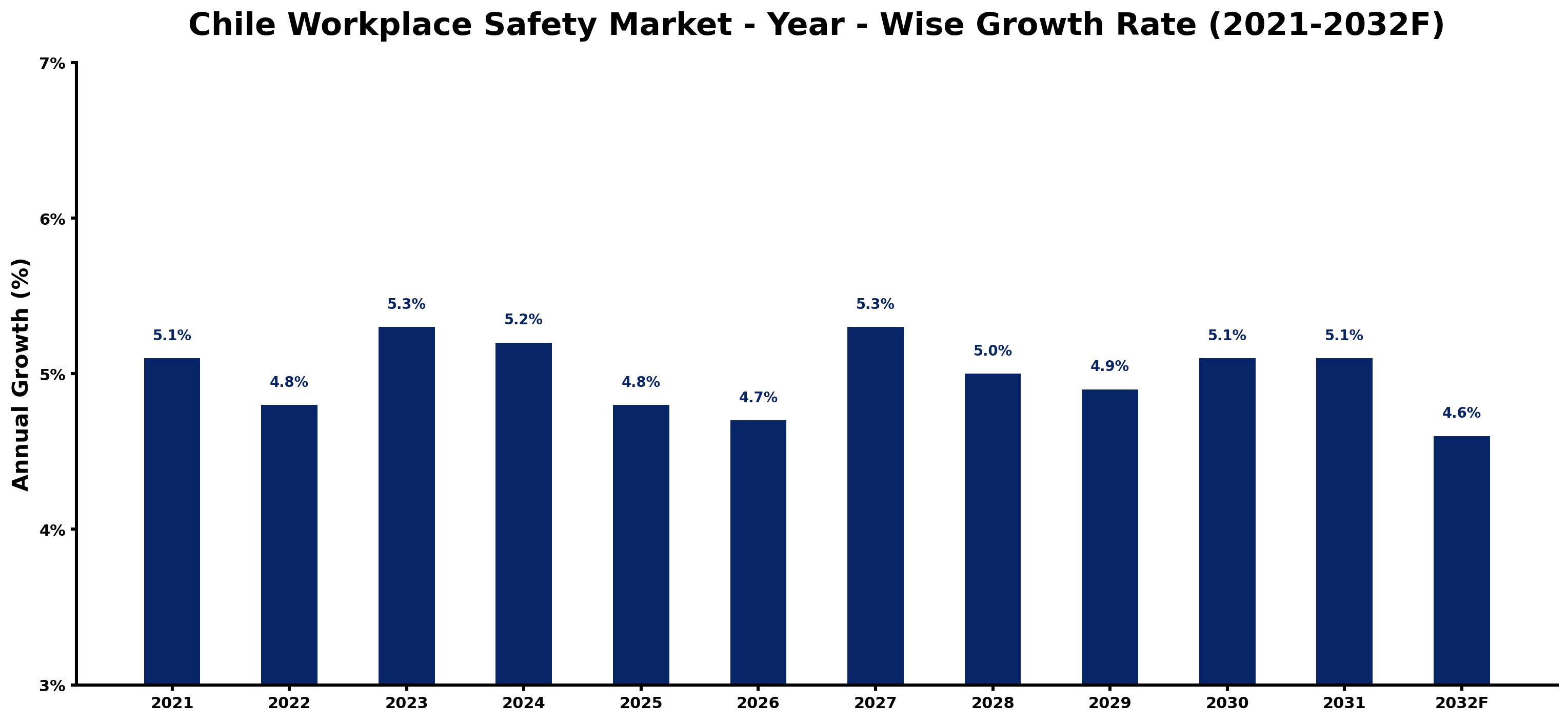
The table below presents the year‑wise growth rates along with the key drivers influencing the market
| Year | Growth Rate | Major Drivers |
| 2021 | 5.1% | Increased investments in mining safety technologies. |
| 2022 | 4.8% | Enhanced enforcement of workplace safety regulations by ACHS. |
| 2023 | 5.3% | Surge in remote working necessitating safety training. |
| 2024 | 5.2% | Government incentives for companies enhancing employee safety. |
| 2025 | 4.8% | Rising awareness of mental health in workplace safety. |
| 2026 | 4.7% | Implementation of ISOs focusing on occupational health standards. |
| 2027 | 5.3% | Growth in construction projects boosting safety equipment demand. |
| 2028 | 5.0% | Support programs for SMEs improving workplace safety compliance. |
| 2029 | 4.9% | Focus on ergonomic solutions in industrial workplaces. |
| 2030 | 5.1% | Increased demand for safety audits across industries. |
| 2031 | 5.1% | Technological advancements in personal protective equipment. |
| 2032 | 4.6% | Regulatory shifts emphasizing proactive workplace safety measures. |
Note: Market size estimations and growth projections presented in this report are based on 6Wresearch's proprietary forecasting methodology, utilizing the latest available industry data, government publications, and primary research inputs.
Chile Workplace Safety Market Key Takeaways
Below are some of the specific key takeaways from the market, including:
- Rapid technological advancements are reshaping safety protocols, with increased adoption of IoT and AI.
- There is a rising demand for customized safety solutions tailored to specific industries and employee roles.
- Regulatory compliance is becoming a primary focus as companies strive to minimize workplace accidents.
- The government’s commitment to improving occupational safety standards is driving market growth.
- Investments in training programs and consultancy services are on the rise as organizations prioritize safety culture.
Evaluation of Restraints in Chile Workplace Safety Market
Despite the positive trends, the Chile Workplace Safety Market faces challenges that impede its full potential. A significant barrier is the inconsistent compliance with safety regulations among companies, leading to inadequate implementation of safety protocols. Many organizations lack the resources or knowledge to effectively educate their workforce on safety measures. Additionally, the disparity in safety standards across industries complicates the ability to enforce uniform practices. The financial burden of acquiring the latest safety technology also poses a challenge, as smaller companies struggle to make such investments, hindering overall progress in workplace safety enhancements.
Chile Workplace Safety Market Trends
The Chile Workplace Safety Market is currently witnessing a pronounced trend towards integrating advanced technologies in safety measures. Companies are investing heavily in IoT-enabled devices and wearable technology to monitor workplace environments in real-time. There's also an increasing focus on creating a culture of safety through comprehensive training programs that extend beyond mere compliance with regulations. The impact of the COVID-19 pandemic has accelerated the adoption of hygiene-focused practices, prompting firms to seek contactless solutions and remote monitoring technologies.
Chile Workplace Safety Market Opportunities
For investors and businesses, the Chile Workplace Safety Market presents substantial opportunities for growth. With an increasing awareness of safety standards and a supportive regulatory environment, there is a growing demand for personal protective equipment (PPE) and specialized training programs. The rise of technology-driven solutions opens doors for startups and innovative companies aiming to fill gaps in safety monitoring and compliance. Furthermore, there is potential for public-private partnerships to develop comprehensive safety solutions that will meet the evolving needs of various industries.
Government Initiatives in the Chile Workplace Safety Market
The Chilean government is actively shaping the workplace safety market through a series of strategic initiatives aimed at enhancing worker protection and reducing occupational hazards. Regulatory measures are increasingly focusing on enforcing compliance with safety standards while promoting a culture of prevention among employers. This proactive stance is crucial for fostering a safer working environment in Chile.
- A national regulatory program recently launched in 2023 that mandates enhanced safety training for high-risk industries.
- Current initiatives include regular inspections by the Ministry of Labor to ensure compliance with occupational safety standards.
- A planned public awareness campaign set for 2024 aims to educate both employers and employees about workplace safety rights and responsibilities.
- Ongoing collaborations between government agencies and private sector players to create innovative safety technologies are underway.
- Recent guidelines established by the National Health and Safety Directorate focus on reducing workplace incidents by promoting better emergency response protocols.
Future Insights of the Chile Workplace Safety Market
Looking ahead to 2026-2032, the Chile Workplace Safety Market is likely to experience steady growth driven by heightened awareness of occupational health and safety. Companies are expected to increasingly prioritize safety measures as they recognize the correlation between employee well-being and productivity. The integration of advanced technologies will continue to transform safety protocols, enabling organizations to proactively manage risks and improve compliance. As the government implements further initiatives to enhance safety standards, the demand for safety solutions will only grow stronger, solidifying this market's trajectory for expansion.
Chile Workplace Safety Market Latest Developments
In the past 12-14 months, activity in the Chile Workplace Safety Market has accelerated, marked by significant advancements in safety protocols and technology adoption. Organizations across various sectors are making considerable investments to elevate their safety standards and ensure compliance with new regulations.
- A major technology vendor launched a new line of wearable safety devices in early 2023 that monitor employee health metrics.
- In Q2 2023, a leading regional operator completed a partnership with a software company to develop a comprehensive safety management platform.
- A public-private initiative focused on enhancing safety training programs is currently underway, aiming to reach all industrial sectors by late 2024.
- Expected in 2025, a new government program will introduce incentives for companies that invest in cutting-edge safety technology.
- In mid-2023, a consultancy service reported increased demand for tailored safety solutions, reflecting a market shift towards more customized approaches.
Chile Workplace Safety Market - Key Attractiveness of the Report
- 10 Years of Market Numbers
- Historical Data Starting from 2022 to 2025
- Base Year: 2025
- Forecast Data until 2032
- Key Performance Indicators Impacting the Market
- Major Upcoming Developments and Projects
Recent government initiatives include a new regulatory program mandating enhanced safety training for high-risk industries, and ongoing inspections to enforce compliance with safety standards. These efforts underscore the government’s commitment to improving workplace safety.
Key Highlights of the Report:
- Chile Workplace Safety Market Outlook
- Market Size of Chile Workplace Safety Market, 2025
- Forecast of Chile Workplace Safety Market, 2032
- Historical Data and Forecast of Chile Workplace Safety Revenues & Volume for the Period 2022-2032F
- Chile Workplace Safety Market Trend Evolution
- Chile Workplace Safety Market Drivers and Challenges
- Chile Workplace Safety Price Trends
- Chile Workplace Safety Porter's Five Forces
- Chile Workplace Safety Industry Life Cycle
- Historical Data and Forecast of Chile Workplace Safety Market Revenues & Volume By Component for the Period 2022-2032F
- Historical Data and Forecast of Chile Workplace Safety Market Revenues & Volume By Hardware for the Period 2022-2032F
- Historical Data and Forecast of Chile Workplace Safety Market Revenues & Volume By Software for the Period 2022-2032F
- Historical Data and Forecast of Chile Workplace Safety Market Revenues & Volume By Services for the Period 2022-2032F
- Historical Data and Forecast of Chile Workplace Safety Market Revenues & Volume By Application for the Period 2022-2032F
- Historical Data and Forecast of Chile Workplace Safety Market Revenues & Volume By Incident for the Period 2022-2032F
- Historical Data and Forecast of Chile Workplace Safety Market Revenues & Volume By Emergency Management for the Period 2022-2032F
- Historical Data and Forecast of Chile Workplace Safety Market Revenues & Volume By Asset Tracking for the Period 2022-2032F
- Historical Data and Forecast of Chile Workplace Safety Market Revenues & Volume By PPE Detection for the Period 2022-2032F
- Historical Data and Forecast of Chile Workplace Safety Market Revenues & Volume By System for the Period 2022-2032F
- Historical Data and Forecast of Chile Workplace Safety Market Revenues & Volume By Environmental Health and Safety for the Period 2022-2032F
- Historical Data and Forecast of Chile Workplace Safety Market Revenues & Volume By Access Control and Surveillance System for the Period 2022-2032F
- Historical Data and Forecast of Chile Workplace Safety Market Revenues & Volume By Real Time Location Monitoring for the Period 2022-2032F
- Historical Data and Forecast of Chile Workplace Safety Market Revenues & Volume By Others for the Period 2022-2032F
- Historical Data and Forecast of Chile Workplace Safety Market Revenues & Volume By Deployment Mode for the Period 2022-2032F
- Historical Data and Forecast of Chile Workplace Safety Market Revenues & Volume By On-premise for the Period 2022-2032F
- Historical Data and Forecast of Chile Workplace Safety Market Revenues & Volume By Cloud for the Period 2022-2032F
- Historical Data and Forecast of Chile Workplace Safety Market Revenues & Volume By End User for the Period 2022-2032F
- Historical Data and Forecast of Chile Workplace Safety Market Revenues & Volume By Energy and Utilities for the Period 2022-2032F
- Historical Data and Forecast of Chile Workplace Safety Market Revenues & Volume By Construction and Engineering for the Period 2022-2032F
- Historical Data and Forecast of Chile Workplace Safety Market Revenues & Volume By Chemical and Materials for the Period 2022-2032F
- Historical Data and Forecast of Chile Workplace Safety Market Revenues & Volume By Government and Defense for the Period 2022-2032F
- Historical Data and Forecast of Chile Workplace Safety Market Revenues & Volume By Healthcare for the Period 2022-2032F
- Historical Data and Forecast of Chile Workplace Safety Market Revenues & Volume By Food and Beverages for the Period 2022-2032F
- Historical Data and Forecast of Chile Workplace Safety Market Revenues & Volume By Others for the Period 2022-2032F
- Chile Workplace Safety Import Export Trade Statistics
- Market Opportunity Assessment By Component
- Market Opportunity Assessment By Application
- Market Opportunity Assessment By System
- Market Opportunity Assessment By Deployment Mode
- Market Opportunity Assessment By End User
- Chile Workplace Safety Top Companies Market Share
- Chile Workplace Safety Competitive Benchmarking By Technical and Operational Parameters
- Chile Workplace Safety Company Profiles
- Chile Workplace Safety Key Strategic Recommendations






































