China Aircraft Seat Upholstery Market Size, Share & Growth Rate
The China Aircraft Seat Upholstery Market was estimated at USD 342 Million in 2025 and is projected to reach USD 460 Million by 2032, growing at a CAGR of 4.3% from 2026 to 2032. This growth trajectory is largely fueled by the surge in air travel demand, which has been particularly pronounced in recent years as more consumers choose air travel. The rapid expansion of China's aviation sector, including the continual increase in airline fleet sizes, also underscores the urgent need for innovative and high-quality upholstery solutions that enhance passenger comfort.
China Aircraft Seat Upholstery Market Year-wise Growth Rate and Key Drivers
This graph highlights how the China Aircraft Seat Upholstery Market has steadily grown over the years, supported by major growth factors.
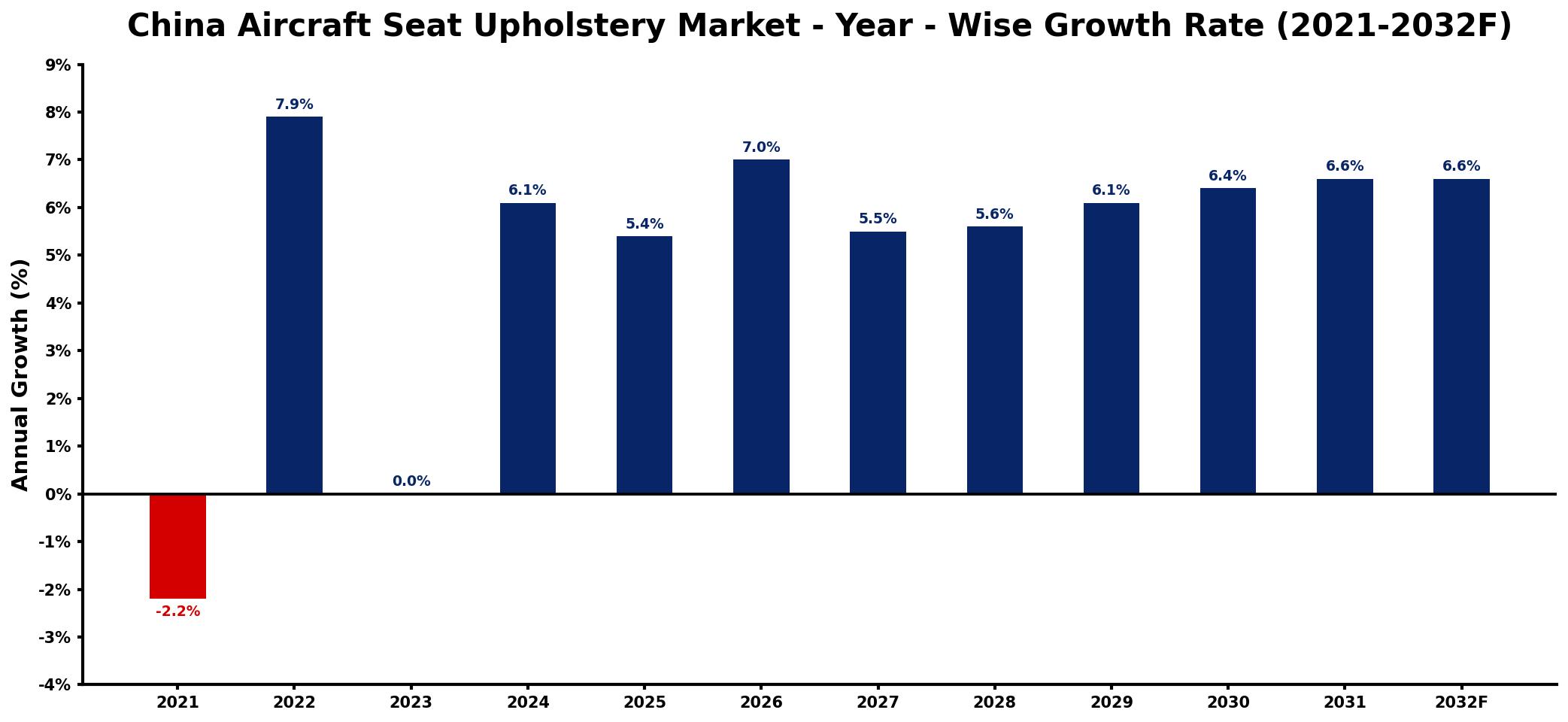
The table below presents the year‑wise growth rates along with the key drivers influencing the market
| Year | Growth Rate | Major Drivers |
| 2021 | -2.2% | decrease in manufacturing investments |
| 2022 | 7.9% | increased passenger travel demand |
| 2023 | 0.0% | growth in airline refurbishments |
| 2024 | 6.1% | rising demand for comfort |
| 2025 | 5.4% | growing emerging market penetration |
| 2026 | 7.0% | innovation in material technology |
| 2027 | 5.5% | increased focus on sustainability |
| 2028 | 5.6% | improved processing technologies adoption |
| 2029 | 6.1% | expansion of regional airlines |
| 2030 | 6.4% | rising disposable income levels |
| 2031 | 6.6% | increased airline fleet orders |
| 2032 | 6.6% | growing demand for luxury travel |
Note: Market size estimations and growth projections presented in this report are based on 6Wresearch's proprietary forecasting methodology, utilizing the latest available industry data, government publications, and primary research inputs.
China Aircraft Seat Upholstery Market Synopsis
Recent developments in the China Aircraft Seat Upholstery Market have reflected strong momentum due to rising passenger expectations for comfort and aesthetics. As we look ahead, the market is set to experience further expansion driven by ongoing investments in upgrading aircraft interiors and a shift towards sustainable materials.
With airlines increasingly focused on enhancing the passenger experience, the demand for lightweight and durable upholstery materials is becoming crucial. This trend signifies a growing alignment with global standards while catering to the unique requirements of China's bustling aviation environment.
China Aircraft Seat Upholstery Market Key Takeaways
- The market is projected to reach USD 460 Million by 2032, driven by increased air travel and fleet expansions.
- There is a notable shift towards sustainable materials, reflecting broader ecological trends in the industry.
- Customization options are rising in popularity, allowing airlines to differentiate their offerings.
- Ongoing innovation in materials is pivotal for enhancing passenger comfort and reducing operational costs.
- Government initiatives are bolstering domestic manufacturers and encouraging research and development in the sector.
Evaluation of Restraints in China Aircraft Seat Upholstery Market
The China Aircraft Seat Upholstery Market faces various restraints, primarily stemming from intense competition. Manufacturers are pressured to meet the rising demand for high-quality, aesthetically pleasing materials while maintaining competitive pricing. Additionally, compliance with stringent regulatory standards set by aviation authorities adds complexity to operations. Fluctuations in raw material costs, particularly for specialized fabrics, further complicate profitability. Lastly, the need for continuous innovation to stay ahead of evolving passenger expectations and advancements in aircraft technology represents a significant challenge for market players.
China Aircraft Seat Upholstery Market Trends
The market is experiencing several transformative trends. Firstly, theres a marked demand for lightweight materials that enhance fuel efficiency, which in turn reduces operational costs for airlines. Additionally, comfort is increasingly paramount; manufacturers are adopting innovative materials that provide superior cushioning and support. Sustainability also plays a crucial role, with eco-friendly and recyclable materials gaining traction as airlines strive to align with environmental regulations. Furthermore, customization has emerged as a key focus area as airlines look to craft unique cabin interiors that cater to diverse passenger preferences.
China Aircraft Seat Upholstery Market Opportunities
The China Aircraft Seat Upholstery Market presents numerous investment opportunities. With the surge in air travel and airline expansions, there is a robust need for innovative upholstery solutions that enhance the flying experience. Manufacturers and suppliers offering advanced, sustainable upholstery materials can tap into a growing market segment. Additionally, investing in research and development for eco-friendly solutions can yield significant returns, particularly as the industry pivots towards sustainability.
Government Initiatives in the China Aircraft Seat Upholstery Market
The Chinese government has actively implemented policies to foster the growth of the aircraft seat upholstery market. These initiatives include financial incentives for domestic manufacturers, technological support, and strategies designed to facilitate market access. Furthermore, regulations ensuring quality and safety standards in production underscore the government's commitment to enhancing the industrys competitiveness on a global scale. This supportive framework is likely to encourage ongoing innovation and bolster production capabilities in the years ahead.
Future Insights of the China Aircraft Seat Upholstery Market
Looking forward to the period from 2026 to 2032, the outlook for the China Aircraft Seat Upholstery Market is remarkably positive. The continuous rise in air travel demand, coupled with an expanding fleet, points towards sustained market growth. The industrys focus on refurbishing older aircraft interiors will further necessitate high-quality, durable upholstery solutions. Advancements in material technology, including the development of lightweight and flame-retardant fabrics, are expected to play a crucial role in meeting the evolving demands of both airlines and passengers. This promising trajectory suggests a vibrant future for players within the market.
China Aircraft Seat Upholstery Market Latest Developments (2025 - 2026)
Recent trends indicate a significant pivot within the industry towards more sustainable upholstery materials. Concurrently, innovation is a key focus, with advancements in manufacturing processes aimed at enhancing durability while minimizing environmental impact. The customization of seat upholstery is also gaining momentum, as airlines seek to create distinct and appealing cabin environments to attract passengers. This focus on differentiation is expected to continue shaping the market landscape in the near future.
China Aircraft Seat Upholstery Market - Key Attractiveness of the Report
- 10 Years of Market Numbers
- Historical Data Starting from 2022 to 2025
- Base Year: 2025
- Forecast Data until 2032
- Key Performance Indicators Impacting the Market
- Major Upcoming Developments and Projects
Key Highlights of the Report:
- China Aircraft Seat Upholstery Market Outlook
- Market Size of China Aircraft Seat Upholstery Market, 2025
- Forecast of China Aircraft Seat Upholstery Market, 2032
- Historical Data and Forecast of China Aircraft Seat Upholstery Revenues & Volume for the Period 2022-2032F
- China Aircraft Seat Upholstery Market Trend Evolution
- China Aircraft Seat Upholstery Market Drivers and Challenges
- China Aircraft Seat Upholstery Price Trends
- China Aircraft Seat Upholstery Porter's Five Forces
- China Aircraft Seat Upholstery Industry Life Cycle
- Historical Data and Forecast of China Aircraft Seat Upholstery Market Revenues & Volume By Material Type for the Period 2022-2032F
- Historical Data and Forecast of China Aircraft Seat Upholstery Market Revenues & Volume By Fabric for the Period 2022-2032F
- Historical Data and Forecast of China Aircraft Seat Upholstery Market Revenues & Volume By Leather for the Period 2022-2032F
- Historical Data and Forecast of China Aircraft Seat Upholstery Market Revenues & Volume By Vinyl for the Period 2022-2032F
- Historical Data and Forecast of China Aircraft Seat Upholstery Market Revenues & Volume By Seat Cover Type for the Period 2022-2032F
- Historical Data and Forecast of China Aircraft Seat Upholstery Market Revenues & Volume By Bottom Covers for the Period 2022-2032F
- Historical Data and Forecast of China Aircraft Seat Upholstery Market Revenues & Volume By Back Rest for the Period 2022-2032F
- Historical Data and Forecast of China Aircraft Seat Upholstery Market Revenues & Volume By Armrests for the Period 2022-2032F
- Historical Data and Forecast of China Aircraft Seat Upholstery Market Revenues & Volume By Headrests for the Period 2022-2032F
- Historical Data and Forecast of China Aircraft Seat Upholstery Market Revenues & Volume By Seat Rear Pockets for the Period 2022-2032F
- Historical Data and Forecast of China Aircraft Seat Upholstery Market Revenues & Volume By Seat Type for the Period 2022-2032F
- Historical Data and Forecast of China Aircraft Seat Upholstery Market Revenues & Volume By First Class for the Period 2022-2032F
- Historical Data and Forecast of China Aircraft Seat Upholstery Market Revenues & Volume By Business Class for the Period 2022-2032F
- Historical Data and Forecast of China Aircraft Seat Upholstery Market Revenues & Volume By Premium Economy Class for the Period 2022-2032F
- Historical Data and Forecast of China Aircraft Seat Upholstery Market Revenues & Volume By Economy Class for the Period 2022-2032F
- Historical Data and Forecast of China Aircraft Seat Upholstery Market Revenues & Volume By Aircraft Type for the Period 2022-2032F
- Historical Data and Forecast of China Aircraft Seat Upholstery Market Revenues & Volume By Narrow-body Aircraft for the Period 2022-2032F
- Historical Data and Forecast of China Aircraft Seat Upholstery Market Revenues & Volume By Wide-body Aircraft for the Period 2022-2032F
- Historical Data and Forecast of China Aircraft Seat Upholstery Market Revenues & Volume By Very Large Aircraft for the Period 2022-2032F
- Historical Data and Forecast of China Aircraft Seat Upholstery Market Revenues & Volume By Regional Transport Aircraft for the Period 2022-2032F
- Historical Data and Forecast of China Aircraft Seat Upholstery Market Revenues & Volume By Business Jets for the Period 2022-2032F
- Historical Data and Forecast of China Aircraft Seat Upholstery Market Revenues & Volume By General Aviation Aircraft for the Period 2022-2032F
- Historical Data and Forecast of China Aircraft Seat Upholstery Market Revenues & Volume By Helicopters for the Period 2022-2032F
- China Aircraft Seat Upholstery Import Export Trade Statistics
- Market Opportunity Assessment By Material Type
- Market Opportunity Assessment By Seat Cover Type
- Market Opportunity Assessment By Seat Type
- Market Opportunity Assessment By Aircraft Type
- China Aircraft Seat Upholstery Top Companies Market Share
- China Aircraft Seat Upholstery Competitive Benchmarking By Technical and Operational Parameters
- China Aircraft Seat Upholstery Company Profiles
- China Aircraft Seat Upholstery Key Strategic Recommendations






































