China Alunite Market Size, Share & Growth Rate
The China Alunite Market was estimated at USD 180 Million in 2025 and is projected to reach USD 209 Million by 2032, growing at a CAGR of 2.2% from 2026 to 2032. This growth trajectory is driven by increasing demand from industries such as ceramics and water treatment, which leverage alunite's unique properties. Additionally, the government's push towards sustainable practices is encouraging wider adoption across various sectors, further propelling market expansion.
China Alunite Market Year-wise Growth Rate and Key Drivers
This graph highlights how the China Alunite Market has steadily grown over the years, supported by major growth factors.
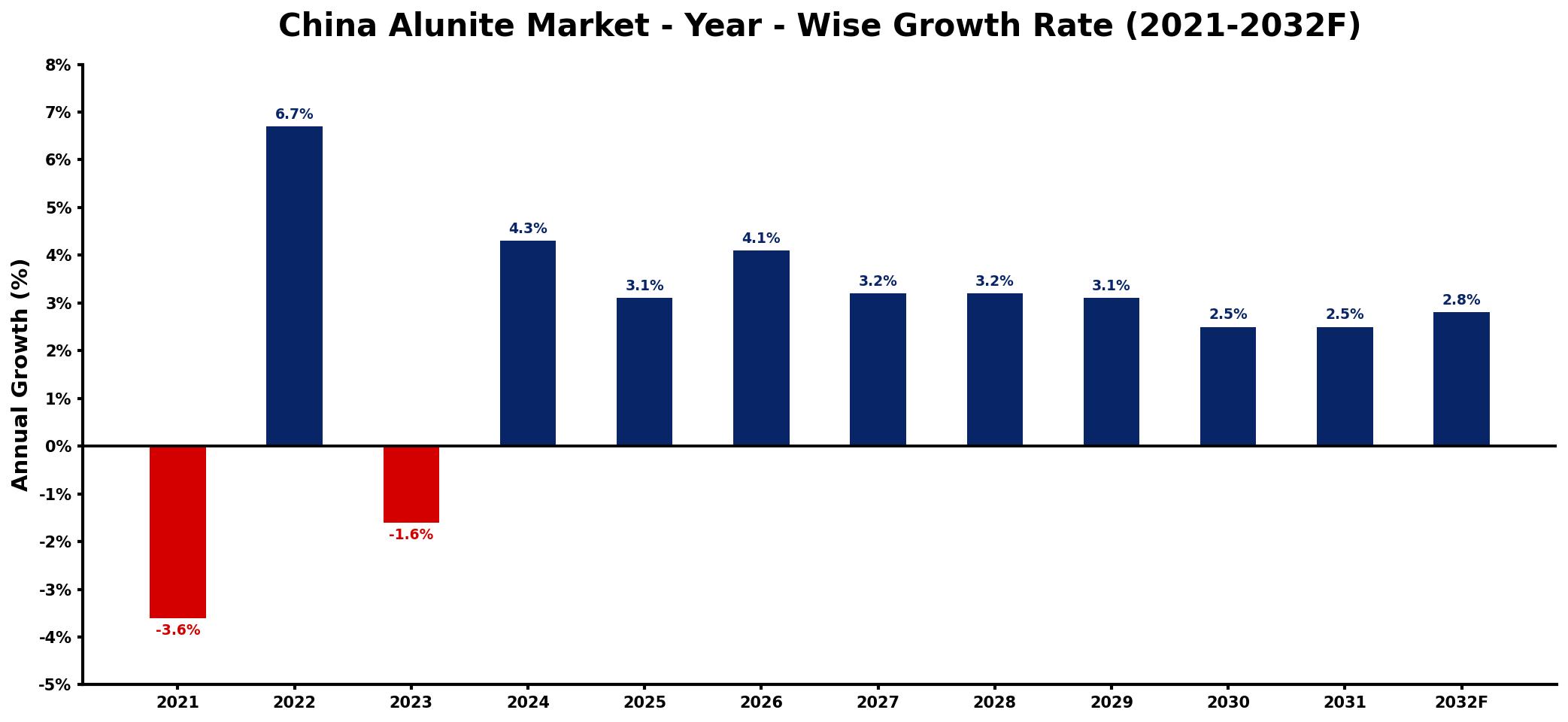
The table below presents the year‑wise growth rates along with the key drivers influencing the market
| Year | Growth Rate | Major Drivers |
| 2021 | -3.6% | decreased industrial mineral demand |
| 2022 | 6.7% | increased construction sector investments |
| 2023 | -1.6% | decline in mining activities |
| 2024 | 4.3% | expansion of renewable energy projects |
| 2025 | 3.1% | growing environmental regulations compliance |
| 2026 | 4.1% | rising investments in infrastructure |
| 2027 | 3.2% | increased demand for sustainable materials |
| 2028 | 3.2% | growth in agricultural applications |
| 2029 | 3.1% | growing downstream application demand |
| 2030 | 2.5% | increased utilization in ceramics |
| 2031 | 2.5% | increased domestic production output |
| 2032 | 2.8% | rising demand for specialty chemicals |
Note: Market size estimations and growth projections presented in this report are based on 6Wresearch's proprietary forecasting methodology, utilizing the latest available industry data, government publications, and primary research inputs.
China Alunite Market Synopsis
Alunite, a crucial mineral for the production of alumina and aluminum metal, is gaining traction in China due to its multifaceted applications. The country's rich deposits of alunite ore coupled with supportive government policies ensure a robust supply chain that is vital for sustaining growth in several industrial sectors.
Furthermore, the mineral's ability to aid in water treatment by efficiently removing phosphorus is positioning it as an essential component in environmental management solutions. This trend is gaining momentum, as industries seek to comply with stringent environmental regulations, leading to heightened demand for sustainable materials.
China Alunite Market Key Takeaways
- Robust demand across ceramics, chemical, and metallurgy sectors enhances market growth prospects.
- Significant investments in infrastructure projects bolster the consumption of alunite-based products.
- Environmental regulations stimulate interest in alunite as a sustainable alternative.
- Government initiatives promote domestic mining and processing, securing the supply chain.
- Market innovation is fostering advancements in extraction and processing technologies.
Evaluation of Restraints in China Alunite Market
Despite its growth potential, the China Alunite market faces several restraints that could impede progress. Fluctuating raw material prices pose a challenge, as they can directly impact production costs and profit margins for manufacturers. Moreover, the stringent environmental regulations surrounding mining operations necessitate compliance measures that may incur additional expenses. Lastly, competition from alternative materials, particularly bauxite, places pressure on alunite producers to enhance product differentiation and maintain competitive pricing.
China Alunite Market Trends
Current trends indicate a burgeoning interest in the use of alunite in sustainable agricultural practices, as it enriches soil and reduces the need for chemical fertilizers. Additionally, the market is witnessing a shift towards innovation, with companies focusing on enhancing the efficiency and performance of alunite-based applications. The growing awareness about environmental impacts is driving a preference for natural and low-impact materials, creating a favorable environment for alunite's expansion.
China Alunite Market Opportunities
Opportunities within the China Alunite market are ripe for the taking, especially in sectors that are increasingly adopting sustainable practices. The rising demand for alunite in pharmaceuticals and agriculture presents lucrative avenues for investment. Companies that invest in advanced technologies for more efficient extraction and processing methods stand to capitalize on the expanding market. Furthermore, the strategic exploration of alunite's potential in emerging applications can significantly enhance its market reach.
Government Initiatives in the China Alunite Market
The Chinese government has established policies to regulate the alunite market comprehensively, balancing economic development with environmental conservation. Regulations promote sustainable mining practices, encouraging companies to adopt green technologies that mitigate environmental impact. Additionally, measures are in place to ensure a stable domestic supply by imposing restrictions on alunite exports, thereby supporting local industries and jobs.
Future Insights of the China Alunite Market
Looking ahead to 2026-2032, the China Alunite market appears positioned for steady growth driven by increasing infrastructural developments and a rising array of applications for alunite in industrial processes. As the emphasis on sustainability continues to strengthen, market players are likely to explore innovative uses for alunite, expanding its role in sectors beyond its traditional applications. The continued support from government policies will also play a crucial role in shaping the markets positive outlook.
China Alunite Market Latest Developments (2025 - 2026)
Recent developments in the China Alunite market include increased focus on research and development aimed at improving alunite extraction efficiency. Industry players are also actively engaging in partnerships to enhance the sustainability of their practices. Furthermore, there is a noticeable shift towards diversifying product offerings to meet the growing demand across various sectors, including environmental management and chemical production.
China Alunite Market - Key Attractiveness of the Report
- 10 Years of Market Numbers
- Historical Data Starting from 2022 to 2025
- Base Year: 2025
- Forecast Data until 2032
- Key Performance Indicators Impacting the Market
- Major Upcoming Developments and Projects
Key Highlights of the Report:
- China Alunite Market Outlook
- Market Size of China Alunite Market, 2025
- Forecast of China Alunite Market, 2032
- Historical Data and Forecast of China Alunite Revenues & Volume for the Period 2022-2032F
- China Alunite Market Trend Evolution
- China Alunite Market Drivers and Challenges
- China Alunite Price Trends
- China Alunite Porter's Five Forces
- China Alunite Industry Life Cycle
- Historical Data and Forecast of China Alunite Market Revenues & Volume By Product for the Period 2022-2032F
- Historical Data and Forecast of China Alunite Market Revenues & Volume By Natroalunite for the Period 2022-2032F
- Historical Data and Forecast of China Alunite Market Revenues & Volume By Potassium alunite for the Period 2022-2032F
- Historical Data and Forecast of China Alunite Market Revenues & Volume By End User for the Period 2022-2032F
- Historical Data and Forecast of China Alunite Market Revenues & Volume By Pharmaceuticals for the Period 2022-2032F
- Historical Data and Forecast of China Alunite Market Revenues & Volume By Cosmetics for the Period 2022-2032F
- Historical Data and Forecast of China Alunite Market Revenues & Volume By FMCG for the Period 2022-2032F
- Historical Data and Forecast of China Alunite Market Revenues & Volume By Others for the Period 2022-2032F
- China Alunite Import Export Trade Statistics
- Market Opportunity Assessment By Product
- Market Opportunity Assessment By End User
- China Alunite Top Companies Market Share
- China Alunite Competitive Benchmarking By Technical and Operational Parameters
- China Alunite Company Profiles
- China Alunite Key Strategic Recommendations






































