China Apiculture Market Size, Share & Growth Rate
The China Apiculture Market was estimated at USD 152 Million in 2025 and is projected to reach USD 174 Million by 2032, growing at a CAGR of 1.9% from 2026 to 2032. This growth trajectory is primarily driven by rising consumer demand for honey as a natural sweetener and health product. Additionally, increased awareness of the vital role bees play in maintaining ecosystem balance is further propelling market expansion.
China Apiculture Market Year-wise Growth Rate and Key Drivers
This graph highlights how the China Apiculture Market has steadily grown over the years, supported by major growth factors.
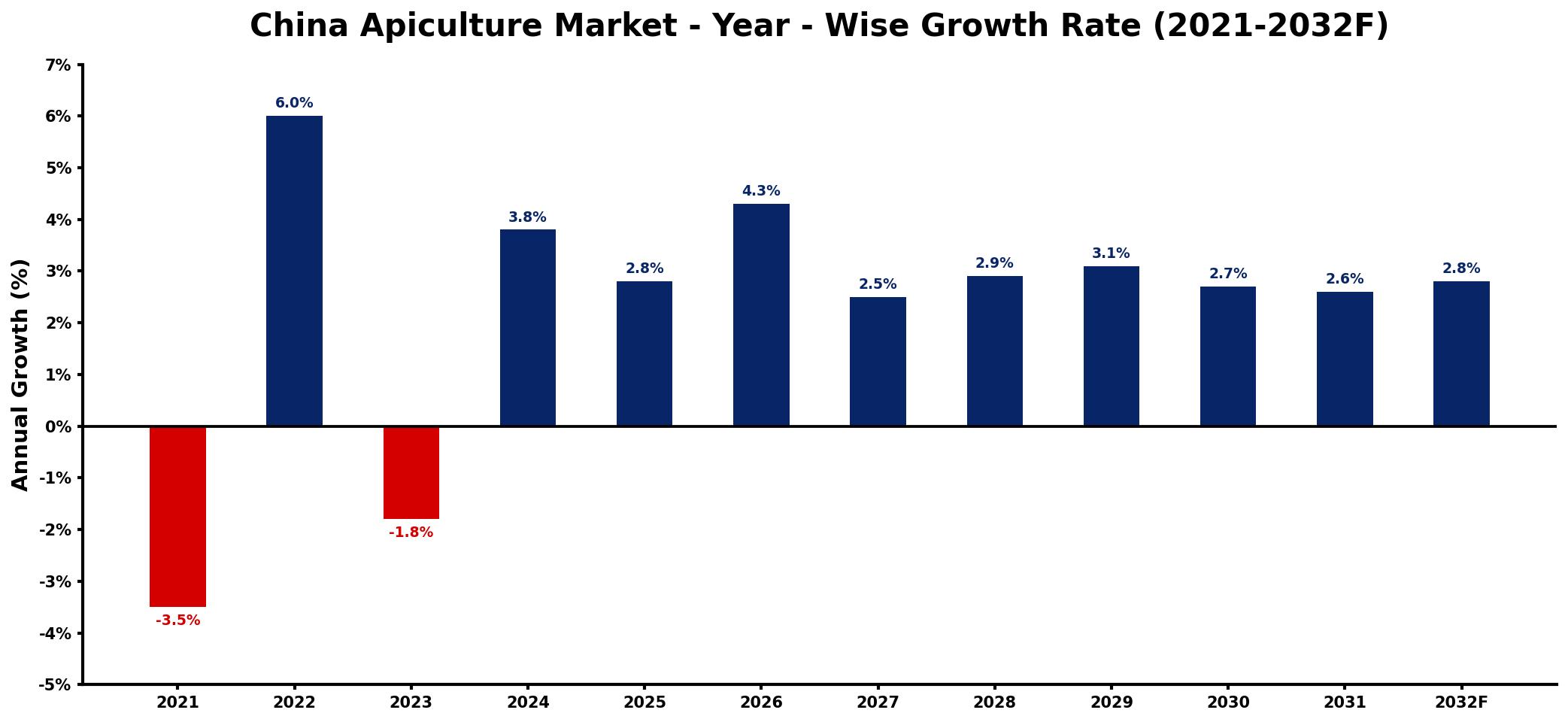
The table below presents the year‑wise growth rates along with the key drivers influencing the market
| Year | Growth Rate | Major Drivers |
| 2021 | -3.5% | Supply chain disruptions affecting production |
| 2022 | 6.0% | Rising consumer health consciousness trends |
| 2023 | -1.8% | Environmental factors reducing yield |
| 2024 | 3.8% | Increased investments in sustainable practices |
| 2025 | 2.8% | Growing popularity of natural alternatives |
| 2026 | 4.3% | Expansion of organic farming initiatives |
| 2027 | 2.5% | Emerging market demand for exports |
| 2028 | 2.9% | Technological advancements in production |
| 2029 | 3.1% | Enhanced distribution networks efficiency |
| 2030 | 2.7% | Rising awareness of nutritional benefits |
| 2031 | 2.6% | Strengthening local agricultural partnerships |
| 2032 | 2.8% | Increasing support for local economies |
Note: Market size estimations and growth projections presented in this report are based on 6Wresearch's proprietary forecasting methodology, utilizing the latest available industry data, government publications, and primary research inputs.
China Apiculture Market Synopsis
The most significant force shaping the China Apiculture Market today is the growing consumer demand for high-quality honey products. As health-conscious consumers pivot towards natural alternatives, honey is increasingly being recognized for its nutritional benefits over refined sugar. This shift is transforming the market, as beekeepers adapt their practices to meet this heightened expectation.
Moreover, government initiatives that support sustainable apiculture practices are playing a crucial role in the market's development. With efforts to mitigate challenges like pesticide use and bee health crises, the industry is set on a path of revitalization, ensuring that bee populations remain robust and honey production continues to thrive.
China Apiculture Market Key Takeaways
- China is the worlds largest honey producer and exporter, dominating global trade.
- Increasing health awareness among consumers is propelling demand for honey as a natural sweetener.
- Organic honey production is emerging as a key trend, attracting premium-priced segments.
- The government is actively implementing policies to foster sustainable beekeeping practices.
- E-commerce platforms are enhancing market reach and facilitating direct consumer connections.
Evaluation of Restraints in China Apiculture Market
Despite its promising outlook, the China Apiculture Market faces multiple restraints that could hinder its growth. Pollution and habitat loss have become significant threats to bee populations, negatively impacting honey yields. Furthermore, competition from lower-cost honey imports raises quality concerns, as many consumers are increasingly discerning about the authenticity of honey products. Additionally, the industry's fragmented regulatory landscape results in inconsistent quality control, which can undermine consumer trust and stifle market expansion.
China Apiculture Market Trends
Current trends indicate a strong move towards organic honey production, with consumers seeking products free from pesticides and chemicals. The e-commerce landscape is also evolving rapidly, allowing beekeepers to sell directly to consumers, thus enhancing product visibility and brand loyalty. Additionally, there is a noticeable shift toward utilizing technology in beekeeping practices, including smart monitoring systems that ensure bee health and hive productivity, reflecting an industry increasingly driven by innovation.
China Apiculture Market Opportunities
Investors will find numerous opportunities within the burgeoning China Apiculture Market. The potential for growth lies in establishing honey production facilities and manufacturing beekeeping equipment. Moreover, there is a burgeoning interest in value-added products, such as royal jelly and propolis, that cater to health-conscious consumers. With supportive governmental policies promoting sustainable agriculture, investments in modern hive technologies and bee health monitoring systems could prove particularly rewarding.
Government Initiatives in the China Apiculture Market
The Chinese government has introduced several initiatives aimed at bolstering the apiculture industry. These include subsidies for local beekeepers to stimulate production and regulations to ensure product safety and quality. Furthermore, there is ongoing support for research into disease prevention and control, helping to safeguard bee populations against various threats. Such proactive measures highlight the government's commitment to developing a sustainable and competitive apiculture sector.
Future Insights of the China Apiculture Market
Looking ahead to 2026-2032, the outlook for the China Apiculture Market remains robust. The steady increase in demand for honey and other bee-related products is expected to continue, fueled by consumer preferences for natural and organic offerings. As the industry adapts to embrace sustainable practices and advanced technologies, China is poised to not only enhance its production capabilities but also expand its presence in international markets.
China Apiculture Market Latest Developments (2025 - 2026)
Recent developments in the China Apiculture Market indicate a significant shift towards sustainability, with numerous initiatives launched to promote organic honey production. Beekeepers are increasingly adopting technology-driven practices that improve both yield and bee health. Additionally, collaborations between public institutions and private enterprises are paving the way for innovative research in beekeeping techniques and disease management.
China Apiculture Market - Key Attractiveness of the Report
- 10 Years of Market Numbers
- Historical Data Starting from 2022 to 2025
- Base Year: 2025
- Forecast Data until 2032
- Key Performance Indicators Impacting the Market
- Major Upcoming Developments and Projects
Key Highlights of the Report:
- China Apiculture Market Outlook
- Market Size of China Apiculture Market, 2025
- Forecast of China Apiculture Market, 2032
- Historical Data and Forecast of China Apiculture Revenues & Volume for the Period 2022-2032F
- China Apiculture Market Trend Evolution
- China Apiculture Market Drivers and Challenges
- China Apiculture Price Trends
- China Apiculture Porter's Five Forces
- China Apiculture Industry Life Cycle
- Historical Data and Forecast of China Apiculture Market Revenues & Volume By Product Type for the Period 2022-2032F
- Historical Data and Forecast of China Apiculture Market Revenues & Volume By Honey for the Period 2022-2032F
- Historical Data and Forecast of China Apiculture Market Revenues & Volume By Beeswax for the Period 2022-2032F
- Historical Data and Forecast of China Apiculture Market Revenues & Volume By Live-bees for the Period 2022-2032F
- Historical Data and Forecast of China Apiculture Market Revenues & Volume By Others for the Period 2022-2032F
- Historical Data and Forecast of China Apiculture Market Revenues & Volume By Application for the Period 2022-2032F
- Historical Data and Forecast of China Apiculture Market Revenues & Volume By Medical for the Period 2022-2032F
- Historical Data and Forecast of China Apiculture Market Revenues & Volume By Food Beverages for the Period 2022-2032F
- Historical Data and Forecast of China Apiculture Market Revenues & Volume By Cosmetics for the Period 2022-2032F
- Historical Data and Forecast of China Apiculture Market Revenues & Volume By Others for the Period 2022-2032F
- China Apiculture Import Export Trade Statistics
- Market Opportunity Assessment By Product Type
- Market Opportunity Assessment By Application
- China Apiculture Top Companies Market Share
- China Apiculture Competitive Benchmarking By Technical and Operational Parameters
- China Apiculture Company Profiles
- China Apiculture Key Strategic Recommendations






































