China Art and Sculpture Market Size, Share & Growth Rate
The China Art and Sculpture Market was estimated at USD 184 Million in 2025 and is projected to reach USD 212 Million by 2032, growing at a CAGR of 2.0% from 2026 to 2032. This upward trajectory is primarily driven by the rising disposable incomes of the middle class, which is increasingly investing in cultural assets. Coupled with a growing appreciation for both traditional and contemporary art forms, the market is poised for sustained growth as more collectors enter the fray.
China Art and Sculpture Market Year-wise Growth Rate and Key Drivers
This graph highlights how the China Art and Sculpture Market has steadily grown over the years, supported by major growth factors.
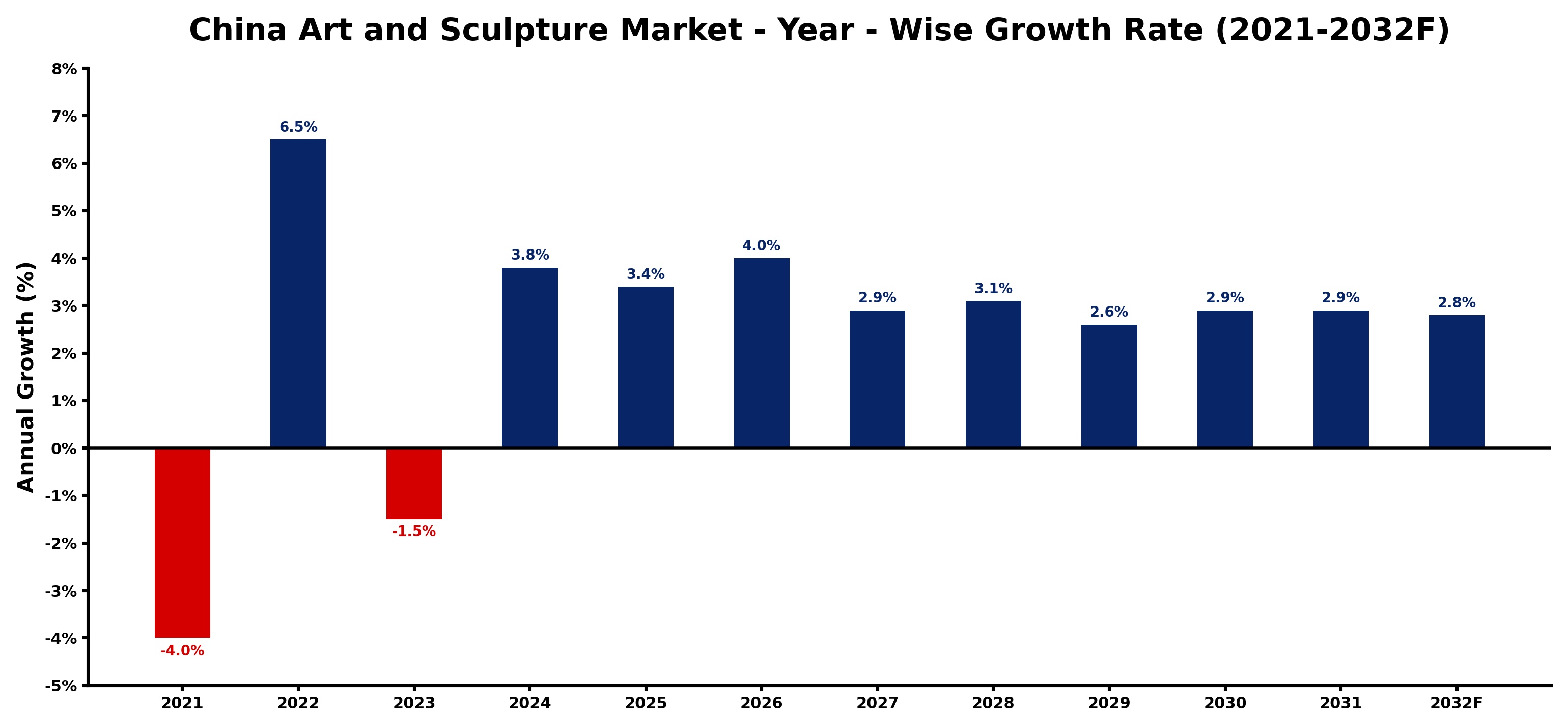
The table below presents the year‑wise growth rates along with the key drivers influencing the market
| Year | Growth Rate | Major Drivers |
| 2021 | -4.0% | Growing urbanization and commercial development |
| 2022 | 6.5% | Growing renewable energy integration projects |
| 2023 | -1.5% | Government infrastructure modernization initiatives |
| 2024 | 3.8% | Rising electricity demand across industries |
| 2025 | 3.4% | Growing urbanization and commercial development |
| 2026 | 4.0% | Expansion of transportation and logistics networks |
| 2027 | 2.9% | Government infrastructure modernization initiatives |
| 2028 | 3.1% | Increasing industrial automation investments |
| 2029 | 2.6% | Expansion of commercial construction activities |
| 2030 | 2.9% | Increasing industrial automation investments |
| 2031 | 2.9% | Expansion of transportation and logistics networks |
| 2032 | 2.8% | Expansion of transportation and logistics networks |
Note - Market size estimations and growth projections presented in this report are based on 6Wresearch's advanced forecasting approach, validated with industry datasets as of June 2026.
China Art and Sculpture Market Synopsis
While the China Art and Sculpture Market has thrived recently, the landscape is rapidly evolving with a notable shift towards contemporary styles. Emerging artists are redefining the boundaries of artistic expression, appealing to a younger demographic that prioritizes modernism alongside traditional craftsmanship.
As traditional art forms maintain their value and significance, the increasing prominence of digital platforms has democratized access to art, allowing a wider audience to engage. This dual focus on heritage and innovation will likely shape the market's future, enhancing both domestic and international appeal.
China Art and Sculpture Market Key Takeaways
- The market is currently transitioning, with rising demand for contemporary Chinese art juxtaposed against the enduring value of traditional forms.
- Government support is a significant driver, fostering an environment for cultural appreciation and artist development.
- Online platforms are becoming essential for transactions, opening new avenues for artists and collectors alike.
- Emerging artists are gaining traction, presenting fresh investment opportunities in a market dominated by established names.
- Intellectual property concerns and market saturation remain pivotal challenges that require strategic navigation.
Evaluation of Restraints in China Art and Sculpture Market
The China Art and Sculpture Market grapples with multiple constraints that could hinder its growth. Chief among these are the persistent issues surrounding intellectual property rights, which create a precarious environment for both artists and collectors. The saturation of the market with counterfeit products complicates the landscape further, eroding trust. Moreover, the rapidly changing preferences of consumers mean that artists must continuously adapt their offerings, often at the cost of recognizing and marketing emerging talent amidst dominant players. These factors necessitate a nuanced understanding of market dynamics for effective engagement.
China Art and Sculpture Market Trends
Current trends reveal a heightened interest in large-scale installations and mixed media works that engage with contemporary themes. Younger collectors are increasingly drawn to innovative expressions that challenge traditional aesthetics, reflecting broader societal shifts. Digital engagement, through online sales and virtual exhibitions, is reshaping the buying experience, facilitating real-time connections between artists and collectors.
Moreover, the integration of technology, such as blockchain for provenance verification, is slowly gaining traction, promising to enhance authenticity and trust in the marketplace. As these trends converge, they are set to redefine how art is perceived and valued in China.
China Art and Sculpture Market Opportunities
The growth of the China Art and Sculpture Market presents numerous investment opportunities. With a cultural heritage that is both rich and revered, investors can benefit from acquiring works by established artists whose reputations are recognized globally. In tandem, the emerging talents with unique, innovative styles represent an exciting frontier for potential high returns as they carve out their niche in the market.
Furthermore, the expanding global interest in Chinese art creates opportunities for international investors to engage with this dynamic sector, broadening their portfolios while supporting the growth of the local art scene.
Government Initiatives in the China Art and Sculpture Market
The Chinese government is proactive in fostering the development of the art and sculpture market. Policies aimed at promoting cultural heritage preservation are complemented by initiatives that encourage the growth of the creative industry. Support for emerging artists is evident through funding opportunities and platforms aimed at enhancing visibility and market access. Regulations designed to combat counterfeit art bolster the market's integrity, while cultural exchanges promote collaboration and enhance the competitiveness of Chinese artists globally.
Future Insights of the China Art and Sculpture Market
Looking ahead to 2026-2032, the China Art and Sculpture Market is expected to flourish, bolstered by increased disposable incomes and a deepening appreciation for artistic endeavors. The continued rise of online platforms will enhance accessibility, inviting a broader audience to participate in the art world. As technology and traditional artistry intersect, the potential for unique art forms will likely expand, offering exciting opportunities for both creators and investors. This combination of cultural enrichment and economic potential is set to solidify China's position in the global art landscape.
China Art and Sculpture Market Latest Developments (May 2025 - June 2026)
Recent developments indicate a vibrant shift in the industry, with a notable increase in collaborative projects between traditional artists and contemporary creators. Art fairs and exhibitions are increasingly embracing digital formats, allowing for virtual participation and broader audience engagement. This innovative direction reflects the market's adaptability to changing consumer preferences and technological advancements, ultimately enriching the overall artistic ecosystem in China.
China Art and Sculpture Market - Key Attractiveness of the Report
- 10 Years of Market Numbers
- Historical Data Starting from 2022 to 2025
- Base Year: 2025
- Forecast Data until 2032
- Key Performance Indicators Impacting the Market
- Major Upcoming Developments and Projects
Key Highlights of the Report:
- China Art and Sculpture Market Outlook
- Market Size of China Art and Sculpture Market, 2025
- Forecast of China Art and Sculpture Market, 2032
- Historical Data and Forecast of China Art and Sculpture Revenues & Volume for the Period 2022-2032F
- China Art and Sculpture Market Trend Evolution
- China Art and Sculpture Market Drivers and Challenges
- China Art and Sculpture Price Trends
- China Art and Sculpture Porter's Five Forces
- China Art and Sculpture Industry Life Cycle
- Historical Data and Forecast of China Art and Sculpture Market Revenues & Volume By Types for the Period 2022-2032F
- Historical Data and Forecast of China Art and Sculpture Market Revenues & Volume By Artifacts for the Period 2022-2032F
- Historical Data and Forecast of China Art and Sculpture Market Revenues & Volume By Sculpture for the Period 2022-2032F
- Historical Data and Forecast of China Art and Sculpture Market Revenues & Volume By Sales Channel for the Period 2022-2032F
- Historical Data and Forecast of China Art and Sculpture Market Revenues & Volume By Auction Houses for the Period 2022-2032F
- Historical Data and Forecast of China Art and Sculpture Market Revenues & Volume By Dealers for the Period 2022-2032F
- Historical Data and Forecast of China Art and Sculpture Market Revenues & Volume By Galleries for the Period 2022-2032F
- Historical Data and Forecast of China Art and Sculpture Market Revenues & Volume By Art Fairs for the Period 2022-2032F
- Historical Data and Forecast of China Art and Sculpture Market Revenues & Volume By Online Sales for the Period 2022-2032F
- Historical Data and Forecast of China Art and Sculpture Market Revenues & Volume By Retail Outlets for the Period 2022-2032F
- Historical Data and Forecast of China Art and Sculpture Market Revenues & Volume By Artists Studios for the Period 2022-2032F
- Historical Data and Forecast of China Art and Sculpture Market Revenues & Volume By Others for the Period 2022-2032F
- Historical Data and Forecast of China Art and Sculpture Market Revenues & Volume By End-user for the Period 2022-2032F
- Historical Data and Forecast of China Art and Sculpture Market Revenues & Volume By Private Collectors for the Period 2022-2032F
- Historical Data and Forecast of China Art and Sculpture Market Revenues & Volume By Museums for the Period 2022-2032F
- Historical Data and Forecast of China Art and Sculpture Market Revenues & Volume By Real Estate Developers for the Period 2022-2032F
- Historical Data and Forecast of China Art and Sculpture Market Revenues & Volume By Interior Designers for the Period 2022-2032F
- Historical Data and Forecast of China Art and Sculpture Market Revenues & Volume By Residential Individual Buyers for the Period 2022-2032F
- Historical Data and Forecast of China Art and Sculpture Market Revenues & Volume By Other Professionals for the Period 2022-2032F
- China Art and Sculpture Import Export Trade Statistics
- Market Opportunity Assessment By Types
- Market Opportunity Assessment By Sales Channel
- Market Opportunity Assessment By End-user
- China Art and Sculpture Top Companies Market Share
- China Art and Sculpture Competitive Benchmarking By Technical and Operational Parameters
- China Art and Sculpture Company Profiles
- China Art and Sculpture Key Strategic Recommendations






































