China Automotive Aftermarket Market Size, Share & Growth Rate
The China Automotive Aftermarket Market was estimated at USD 81 Million in 2025 and is projected to reach USD 93 Million by 2032, growing at a CAGR of 2.0% from 2026 to 2032. This growth trajectory is primarily driven by the expanding vehicle population and increasing consumer preference for maintenance and customization services. As disposable incomes rise and urbanization accelerates, more consumers are inclined to invest in aftermarket products that enhance both the functionality and aesthetics of their vehicles.
China Automotive Aftermarket Market Year-wise Growth Rate and Key Drivers
This graph highlights how the China Automotive Aftermarket Market has steadily grown over the years, supported by major growth factors.
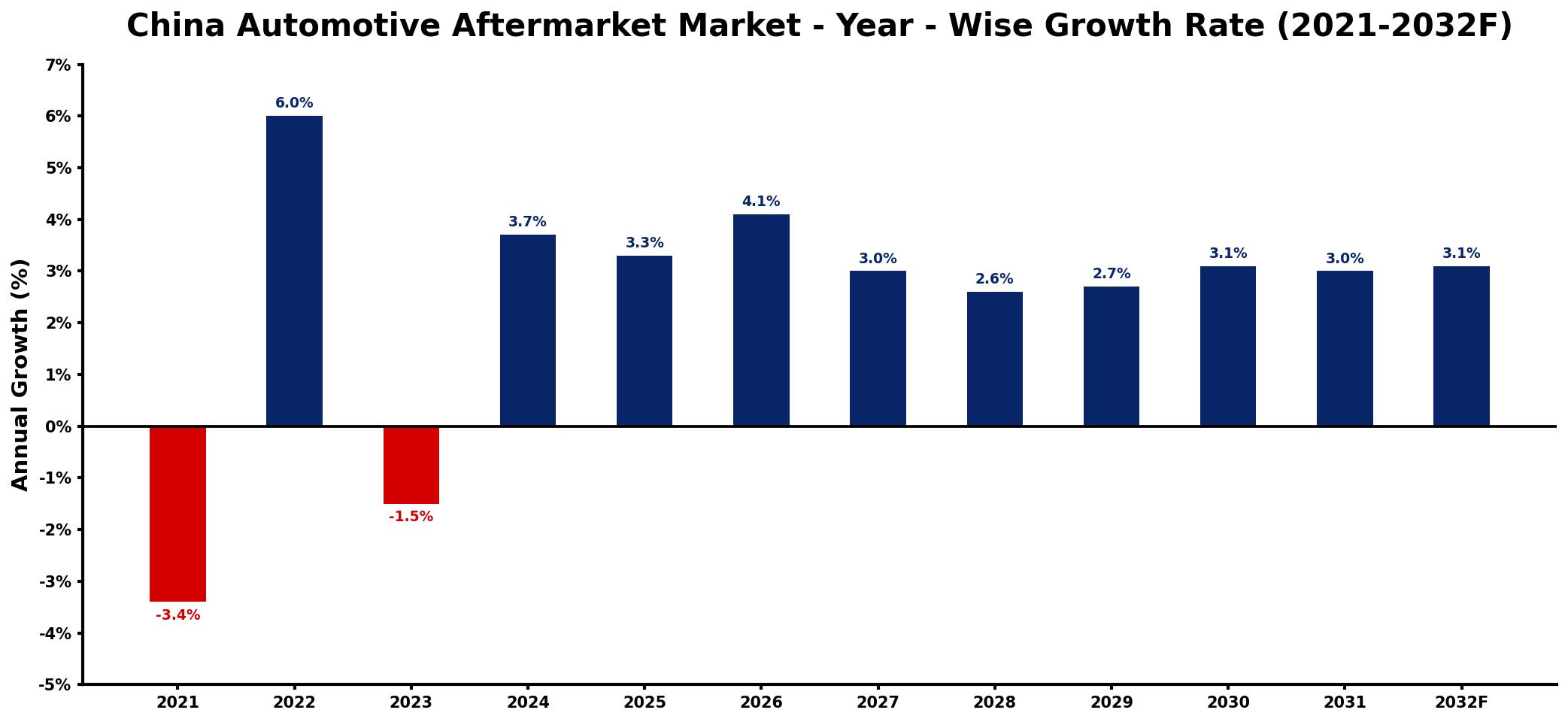
The table below presents the year‑wise growth rates along with the key drivers influencing the market
| Year | Growth Rate | Major Drivers |
| 2021 | -3.4% | decreased consumer spending on repairs |
| 2022 | 6.0% | rise in vehicle ownership rates |
| 2023 | -1.5% | lower demand for replacement parts |
| 2024 | 3.7% | expansion of e-commerce platforms |
| 2025 | 3.3% | increased disposable income levels |
| 2026 | 4.1% | growing interest in vehicle customization |
| 2027 | 3.0% | enhanced logistics and distribution networks |
| 2028 | 2.6% | higher adoption of electric vehicles |
| 2029 | 2.7% | improved consumer awareness initiatives |
| 2030 | 3.1% | strengthened partnerships with suppliers |
| 2031 | 3.0% | increased domestic production output |
| 2032 | 3.1% | growing focus on sustainability practices |
Note: Market size estimations and growth projections presented in this report are based on 6Wresearch's proprietary forecasting methodology, utilizing the latest available industry data, government publications, and primary research inputs.
China Automotive Aftermarket Market Synopsis
A significant force shaping the China Automotive Aftermarket Market is the rapid adoption of e-commerce platforms. These digital avenues not only provide consumers with greater access to a wide variety of spare parts and accessories but also facilitate cost-effective purchasing options. As online shopping continues to dominate, traditional retail channels must adapt or risk losing market share.
Additionally, the growing interest in vehicle customization is fueling demand for aftermarket services and products. Consumers are increasingly seeking personalized enhancements, whether through performance upgrades or aesthetic modifications, further expanding the scope of the aftermarket sector.
China Automotive Aftermarket Market Key Takeaways
- The market is benefitting from an increase in disposable income among Chinese consumers, driving demand for aftermarket products.
- E-commerce is transforming the way consumers purchase automotive parts, creating both challenges and opportunities for traditional retailers.
- Customization trends are on the rise, with consumers increasingly seeking personalized automotive enhancements.
- Sustainability is becoming a critical focus, pushing the market towards eco-friendly products and solutions.
- The growing number of electric vehicles presents unique opportunities for specialized aftermarket services and products.
Evaluation of Restraints in China Automotive Aftermarket Market
Despite its potential, the China Automotive Aftermarket is grappling with challenges that hinder its growth. One of the most pressing issues is the prevalence of counterfeit auto parts, which not only undermine consumer trust but also pose significant safety risks. Additionally, the lack of standardized regulations complicates the identification of genuine products and services, leaving consumers vulnerable to subpar offerings. Furthermore, the competition from unauthorized repair shops provides a cheaper alternative for many, putting pressure on established businesses to maintain competitive pricing without sacrificing quality.
China Automotive Aftermarket Market Trends
Several trends are emerging in the China Automotive Aftermarket that are shaping its future. The digitalization of the sector is a prominent trend, with many consumers turning to online platforms for their automotive needs. This shift is not just about convenience; it is also about access to a broader range of products and services. Moreover, the increasing emphasis on vehicle customization reflects a cultural shift towards personalization in consumer goods. Lastly, as environmental concerns grow, there is a marked rise in demand for sustainable aftermarket products, including eco-friendly components and electric vehicle enhancements.
China Automotive Aftermarket Market Opportunities
Investment opportunities in the China Automotive Aftermarket are abundant. The steady growth in vehicle maintenance and repair services is a direct result of the increasing number of vehicles on the road. In parallel, the trend of consumers opting for aftermarket accessories opens avenues for companies specializing in these products. Furthermore, the expanding e-commerce landscape provides a fertile ground for growth, as more consumers embrace the convenience of online shopping for automotive needs. The government's encouragement of sustainable transportation also signals a lucrative opportunity for eco-friendly aftermarket solutions.
Government Initiatives in the China Automotive Aftermarket Market
The Chinese government has been proactive in implementing policies aimed at regulating the automotive aftermarket. These initiatives focus on standardizing market practices, improving product quality and safety, and fostering innovation within the industry. Additionally, the government has placed a strong emphasis on environmental protection and sustainable development, encouraging the adoption of greener technologies and practices in the automotive sector. These policies are designed to create a more competitive, efficient market that benefits both consumers and businesses.
Future Insights of the China Automotive Aftermarket Market
Looking ahead to 2026-2032, the China Automotive Aftermarket Market is poised for significant growth. Factors such as the increasing vehicle population and the ongoing shift towards e-commerce will continue to fuel demand for aftermarket products and services. Furthermore, the rise of electric vehicles and advancements in automotive technology will unlock new market segments for specialized aftermarket services. However, companies must remain vigilant, as regulatory changes and competition will require ongoing adaptation and innovation to stay competitive.
China Automotive Aftermarket Market Latest Developments (2025 - 2026)
Recent developments in the China Automotive Aftermarket indicate a strategic pivot towards digital integration and sustainability. The emergence of new online platforms has facilitated greater access to aftermarket products, while various stakeholders are increasingly investing in sustainable solutions. Additionally, collaborations and partnerships are being formed to enhance service offerings and improve customer experiences. These trends suggest a market in transition, adapting to the evolving needs and preferences of consumers.
China Automotive Aftermarket Market - Key Attractiveness of the Report
- 10 Years of Market Numbers
- Historical Data Starting from 2022 to 2025
- Base Year: 2025
- Forecast Data until 2032
- Key Performance Indicators Impacting the Market
- Major Upcoming Developments and Projects
Key Highlights of the Report:
- China Automotive Aftermarket Market Outlook
- Market Size of China Automotive Aftermarket Market, 2025
- Forecast of China Automotive Aftermarket Market, 2032
- Historical Data and Forecast of China Automotive Aftermarket Revenues & Volume for the Period 2022-2032F
- China Automotive Aftermarket Market Trend Evolution
- China Automotive Aftermarket Market Drivers and Challenges
- China Automotive Aftermarket Price Trends
- China Automotive Aftermarket Porter's Five Forces
- China Automotive Aftermarket Industry Life Cycle
- Historical Data and Forecast of China Automotive Aftermarket Market Revenues & Volume By Replacement Parts for the Period 2022-2032F
- Historical Data and Forecast of China Automotive Aftermarket Market Revenues & Volume By Tire for the Period 2022-2032F
- Historical Data and Forecast of China Automotive Aftermarket Market Revenues & Volume By Battery for the Period 2022-2032F
- Historical Data and Forecast of China Automotive Aftermarket Market Revenues & Volume By Brake Parts for the Period 2022-2032F
- Historical Data and Forecast of China Automotive Aftermarket Market Revenues & Volume By Filters for the Period 2022-2032F
- Historical Data and Forecast of China Automotive Aftermarket Market Revenues & Volume By Body parts for the Period 2022-2032F
- Historical Data and Forecast of China Automotive Aftermarket Market Revenues & Volume By Lighting & Electronic Components for the Period 2022-2032F
- Historical Data and Forecast of China Automotive Aftermarket Market Revenues & Volume By Wheels for the Period 2022-2032F
- Historical Data and Forecast of China Tire Automotive Aftermarket Market Revenues & Volume By Exhaust components for the Period 2022-2032F
- Historical Data and Forecast of China Automotive Aftermarket Market Revenues & Volume By Distribution Channel for the Period 2022-2032F
- Historical Data and Forecast of China Automotive Aftermarket Market Revenues & Volume By Retailers for the Period 2022-2032F
- Historical Data and Forecast of China Automotive Aftermarket Market Revenues & Volume By Wholesalers & Distributors for the Period 2022-2032F
- Historical Data and Forecast of China Automotive Aftermarket Market Revenues & Volume By Service Channel for the Period 2022-2032F
- Historical Data and Forecast of China Automotive Aftermarket Market Revenues & Volume By DIY (Do it Yourself) for the Period 2022-2032F
- Historical Data and Forecast of China Automotive Aftermarket Market Revenues & Volume By DIFM (Do it for Me) for the Period 2022-2032F
- Historical Data and Forecast of China Automotive Aftermarket Market Revenues & Volume By OE (Delegating to OEM??s) for the Period 2022-2032F
- Historical Data and Forecast of China Automotive Aftermarket Market Revenues & Volume By Certification for the Period 2022-2032F
- Historical Data and Forecast of China Automotive Aftermarket Market Revenues & Volume By Genuine Parts for the Period 2022-2032F
- Historical Data and Forecast of China Automotive Aftermarket Market Revenues & Volume By Certified Parts for the Period 2022-2032F
- Historical Data and Forecast of China Automotive Aftermarket Market Revenues & Volume By Uncertified Parts for the Period 2022-2032F
- China Automotive Aftermarket Import Export Trade Statistics
- Market Opportunity Assessment By Replacement Parts
- Market Opportunity Assessment By Distribution Channel
- Market Opportunity Assessment By Service Channel
- Market Opportunity Assessment By Certification
- China Automotive Aftermarket Top Companies Market Share
- China Automotive Aftermarket Competitive Benchmarking By Technical and Operational Parameters
- China Automotive Aftermarket Company Profiles
- China Automotive Aftermarket Key Strategic Recommendations






































