China Blenders Market Summary
The china blenders market was estimated at USD 156 Million in 2025 and is projected to reach USD 180 Million by 2032, growing at a CAGR of 4.0% from 2026 to 2032.
China Blenders Market Year-wise Growth Rate and Key Drivers
This graph highlights how the China Blenders Market has steadily grown over the past five years, supported by major growth factors.
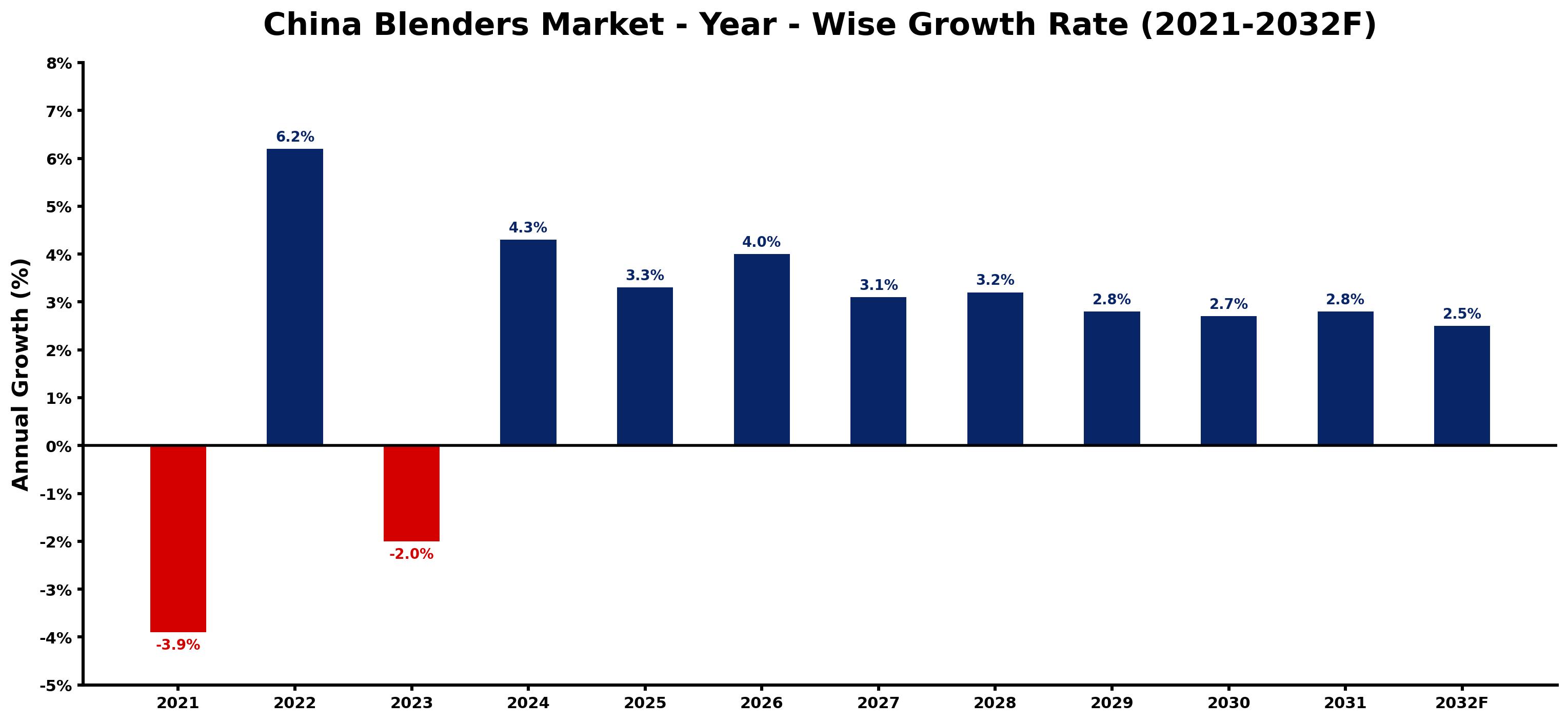
The table below presents the year wise growth rates along with the key drivers influencing the market
| Year | Growth Rate | Major Drivers |
| 2021 | -3.9% | Supply chain disruptions and increased shipping costs hampered product availability, leading to diminished consumer interest. |
| 2022 | 6.2% | Consumer preferences shifted towards multifunctional kitchen appliances with innovative features. |
| 2023 | -2.0% | Increased competition from costeffective alternatives diminished brand loyalty and consumer interest in premium blenders. |
| 2024 | 4.3% | Rising health consciousness led to increased interest in nutritious smoothies and juices. |
| 2025 | 3.3% | Urbanization trends prompted smaller household sizes, boosting personal blender sales sharply. |
| 2026 | 4.0% | Social media influencers began promoting healthy lifestyles, driving blender brand engagement. |
| 2027 | 3.1% | Sustainable materials in appliance manufacturing gained traction among environmentally conscious shoppers. |
| 2028 | 3.2% | Smart home integration technologies encouraged tech-savvy consumers to choose advanced blenders. |
| 2029 | 2.8% | Emerging middle-class consumers increasingly prioritized quality and performance over price. |
| 2030 | 2.7% | Experiential marketing campaigns highlighted versatility, attracting a broader audience to blenders. |
| 2031 | 2.8% | Rapid expansion of health cafes and juice bars created demand for commercial-grade blenders. |
| 2032 | 2.5% | Technological innovations in blender design emphasized energy efficiency and user convenience. |
Note - Market size estimations and growth projections presented in this report are based on 6Wresearch's advanced forecasting approach, validated with industry datasets as of June 2026.
China Blenders Market Synopsis
The China Blenders Market is projected to reach 4.0% and witness significant growth during the forecast period (2026-2032). As the largest market for blenders in Asia, China is becoming increasingly influential in the global landscape. The growth trajectory of this market is being propelled by a variety of factors, particularly heightened consumer awareness of health and wellness trends. This demographic shift is encouraging consumers to invest in high-quality blenders that align with their healthy lifestyle choices.
China Blenders Market Growth Drivers
Several factors underpin the robust growth expected in the China Blenders Market. Among these:
- Increasing health consciousness among consumers is driving demand for blenders that facilitate smoothie preparation and other health-oriented recipes.
- The emergence of a rising middle class, with increased disposable income, enables consumers to spend on premium kitchen appliances, including multi-functional blenders.
- The popularity of home cooking, bolstered by trends in meal prepping and health-oriented diets, is contributing to the demand for versatile blending solutions.
- Technological advancements and innovation in product features are prompting consumers to opt for high-performance blenders that also serve multiple functions such as food processing.
- The influence of social media, where health influencers and culinary experts promote the use of blenders for healthy recipes, is stimulating consumer interest and purchase intent.
China Blenders Market Trends and Opportunities
As the China Blenders Market evolves, several trends are emerging that present opportunities for growth:
- The demand for eco-friendly and energy-efficient blenders is on the rise, as consumers increasingly seek sustainable product options.
- There is a growing preference for smart appliances, integrating technology that allows consumers to control their blenders through mobile applications.
- Health and wellness trends are leading to the development of niche markets, such as blenders specifically designed for fitness enthusiasts and dietary regimes.
- Customization options are becoming more popular, allowing consumers to choose features that best meet their individual needs.
- The expansion of online retail channels provides consumers with greater access to a variety of blender brands and models, enhancing market competition.
China Blenders Market Challenges and Restraints
Despite the optimistic outlook for the China Blenders Market, several challenges and restraints could impact growth:
- Intense competition from both local and international brands may lead to price wars, affecting profit margins across the industry.
- High-quality blenders often come with a premium price tag, which may deter budget-conscious consumers from making a purchase.
- The ongoing global supply chain disruptions can affect the availability of critical components, impacting production timelines and costs.
- Consumer preferences may shift rapidly due to emerging health trends, requiring manufacturers to adapt quickly to maintain relevance.
- Economic fluctuations and uncertainties could influence consumer spending behavior, potentially slowing the growth rate of the market.
China Blenders Market Government Investment and Initiatives
The Chinese government plays a pivotal role in shaping the landscape of the blenders market through various initiatives and investments. Policies aimed at promoting health and wellness through improved nutrition are encouraging the adoption of kitchen appliances like blenders. Investment in research and development is being prioritized to enhance product quality and functionality. Furthermore, incentives for manufacturers focusing on sustainability and energy-efficient production methods are becoming increasingly common. Various public spending programs are aimed at supporting small and medium enterprises within the appliance manufacturing sector, fostering innovation and market competitiveness.
China Blenders Market Latest Developments (May 2025 - June 2026)
The China Blenders Market has witnessed notable developments between May 2025 and June 2026. Market players have increasingly focused on product innovation, with many introducing models featuring enhanced usability and advanced blending technology. The rise of health-conscious living has prompted brands to emphasize the nutritional benefits of using high-quality blenders. Additionally, there has been a marked increase in digital marketing efforts aimed at educating consumers about various blending techniques and recipe ideas. Trade exhibitions and consumer fairs have become platforms for showcasing the latest blender technologies, highlighting increased engagement in the market.
China Blenders Market - Key Attractiveness of the Report
- 10 Years of Market Numbers
- Historical Data Starting from 2022 to 2025
- Base Year: 2025
- Forecast Data until 2032
- Key Performance Indicators Impacting the Market
- Major Upcoming Developments and Projects
Key Highlights of the Report:
- China Blenders Market Outlook
- Market Size of China Blenders Market, 2025
- Forecast of China Blenders Market, 2032
- Historical Data and Forecast of China Blenders Revenues & Volume for the Period 2022-2032
- China Blenders Market Trend Evolution
- China Blenders Market Drivers and Challenges
- China Blenders Price Trends
- China Blenders Porter's Five Forces
- China Blenders Industry Life Cycle
- Historical Data and Forecast of China Blenders Market Revenues & Volume By Types for the Period 2022-2032
- Historical Data and Forecast of China Blenders Market Revenues & Volume By Hand Blenders for the Period 2022-2032
- Historical Data and Forecast of China Blenders Market Revenues & Volume By Single-Serve Blenders for the Period 2022-2032
- Historical Data and Forecast of China Blenders Market Revenues & Volume By Full-Size Blenders for the Period 2022-2032
- Historical Data and Forecast of China Blenders Market Revenues & Volume By Applications for the Period 2022-2032
- Historical Data and Forecast of China Blenders Market Revenues & Volume By Commercial for the Period 2022-2032
- Historical Data and Forecast of China Blenders Market Revenues & Volume By Household for the Period 2022-2032
- China Blenders Import Export Trade Statistics
- Market Opportunity Assessment By Types
- Market Opportunity Assessment By Applications
- China Blenders Top Companies Market Share
- China Blenders Competitive Benchmarking By Technical and Operational Parameters
- China Blenders Company Profiles
- China Blenders Key Strategic Recommendations






































