Portugal Blenders Market Size (2020-2030)
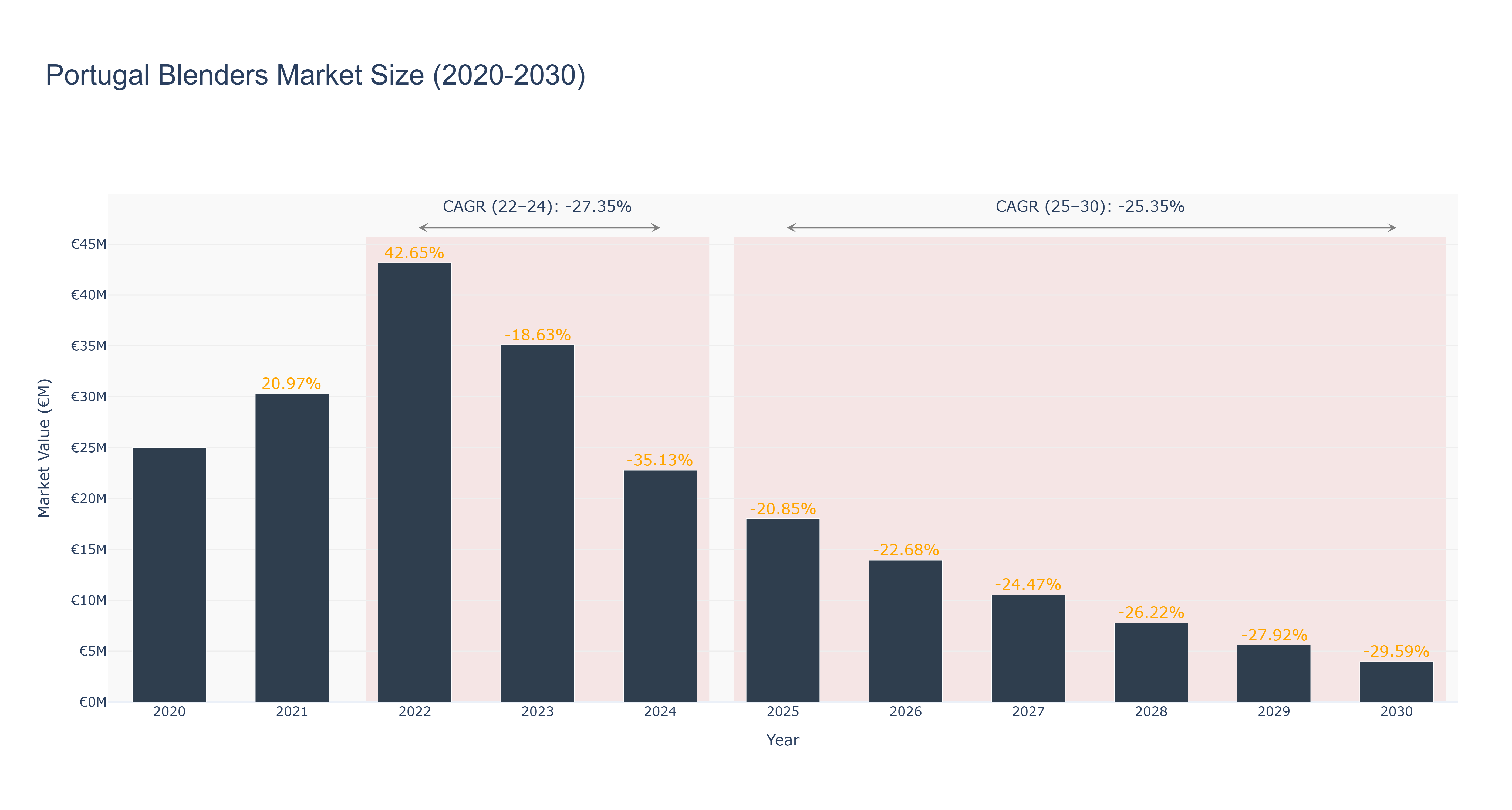
Portugal Blenders Market experienced a peak market size of €43.16 million in 2022, followed by a decline to €22.78 million in 2024. The market is forecasted to further decrease to €3.94 million by 2030. The CAGR from 2022-24 was -27.35%, while the CAGR from 2025-30 is projected to be -25.35%. The market downturn can be attributed to changing consumer preferences, economic challenges, and technological advancements impacting product demand. However, with a focus on sustainability and innovation, the market is expected to witness new product launches and strategic partnerships in the upcoming years. These developments aim to revitalize the market and drive growth amidst evolving market dynamics. Industry drivers such as increasing health awareness and environmental concerns will continue to shape the market landscape, influencing future strategies and market positioning.
Portugal Blenders Market: Production & Trade Performance (2019-2025)
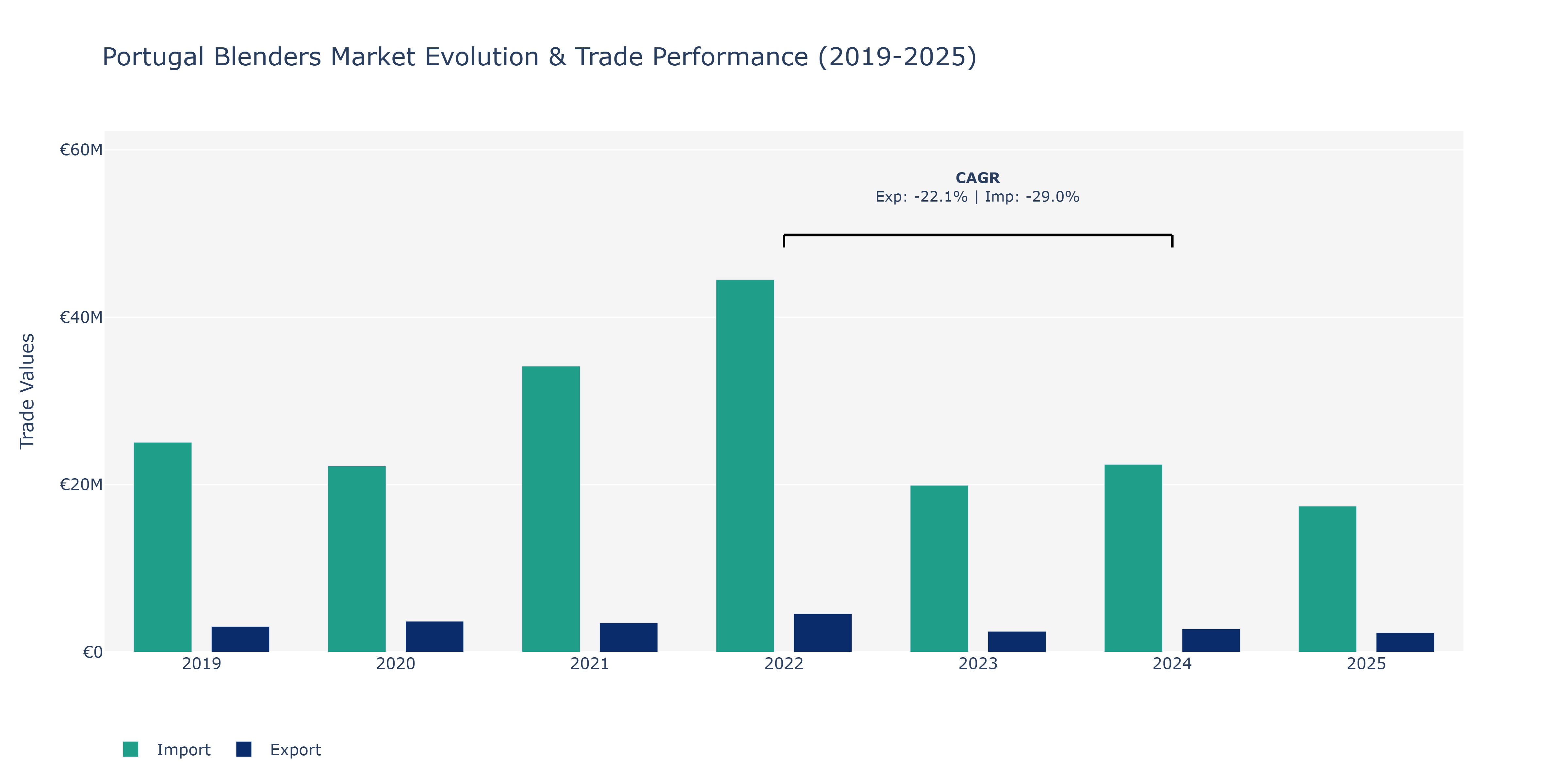
The Portugal Blenders Market saw fluctuations in both Exports and Imports over the years. From 2019 to 2020, Exports surged from €3.05 million to €3.69 million, indicating a significant increase. However, in 2021, Exports decreased slightly to €3.49 million before rebounding in 2022 to €4.58 million, marking a peak point in the market. On the other hand, Imports followed a similar pattern, starting at €25.06 million in 2019, dropping to €22.24 million in 2020, and then sharply rising to €34.17 million in 2021, before reaching the highest value in 2022 at €44.49 million. The market experienced a downturn in 2023, with Exports and Imports declining to €2.48 million and €19.93 million, respectively, before a slight recovery in 2024. The dip in 2023 could be attributed to global economic challenges impacting trade flows, while the subsequent recovery aligns with the overall market stabilization. Additionally, the increased focus on sustainable practices and the adoption of environmentally friendly technologies in the blender market could have influenced trade dynamics during this period.
Key Highlights of the Report:
- Portugal Blenders Market Outlook
- Market Size of Portugal Blenders Market, 2025
- Forecast of Portugal Blenders Market, 2032
- Historical Data and Forecast of Portugal Blenders Revenues & Volume for the Period 2022 - 2032F
- Portugal Blenders Market Trend Evolution
- Portugal Blenders Market Drivers and Challenges
- Portugal Blenders Price Trends
- Portugal Blenders Porter`s Five Forces
- Portugal Blenders Industry Life Cycle
- Historical Data and Forecast of Portugal Blenders Market Revenues & Volume By Types for the Period 2022 - 2032F
- Historical Data and Forecast of Portugal Blenders Market Revenues & Volume By Hand Blenders for the Period 2022 - 2032F
- Historical Data and Forecast of Portugal Blenders Market Revenues & Volume By Single-Serve Blenders for the Period 2022 - 2032F
- Historical Data and Forecast of Portugal Blenders Market Revenues & Volume By Full-Size Blenders for the Period 2022 - 2032F
- Historical Data and Forecast of Portugal Blenders Market Revenues & Volume By Applications for the Period 2022 - 2032F
- Historical Data and Forecast of Portugal Blenders Market Revenues & Volume By Commercial for the Period 2022 - 2032F
- Historical Data and Forecast of Portugal Blenders Market Revenues & Volume By Household for the Period 2022 - 2032F
- Portugal Blenders Import Export Trade Statistics
- Market Opportunity Assessment By Types
- Market Opportunity Assessment By Applications
- Portugal Blenders Top Companies Market Share
- Portugal Blenders Competitive Benchmarking By Technical and Operational Parameters
- Portugal Blenders Company Profiles
- Portugal Blenders Key Strategic Recommendations






































