China Botanical Ingredients Market Top 5 Importing Countries and Market Competition (HHI) Analysis
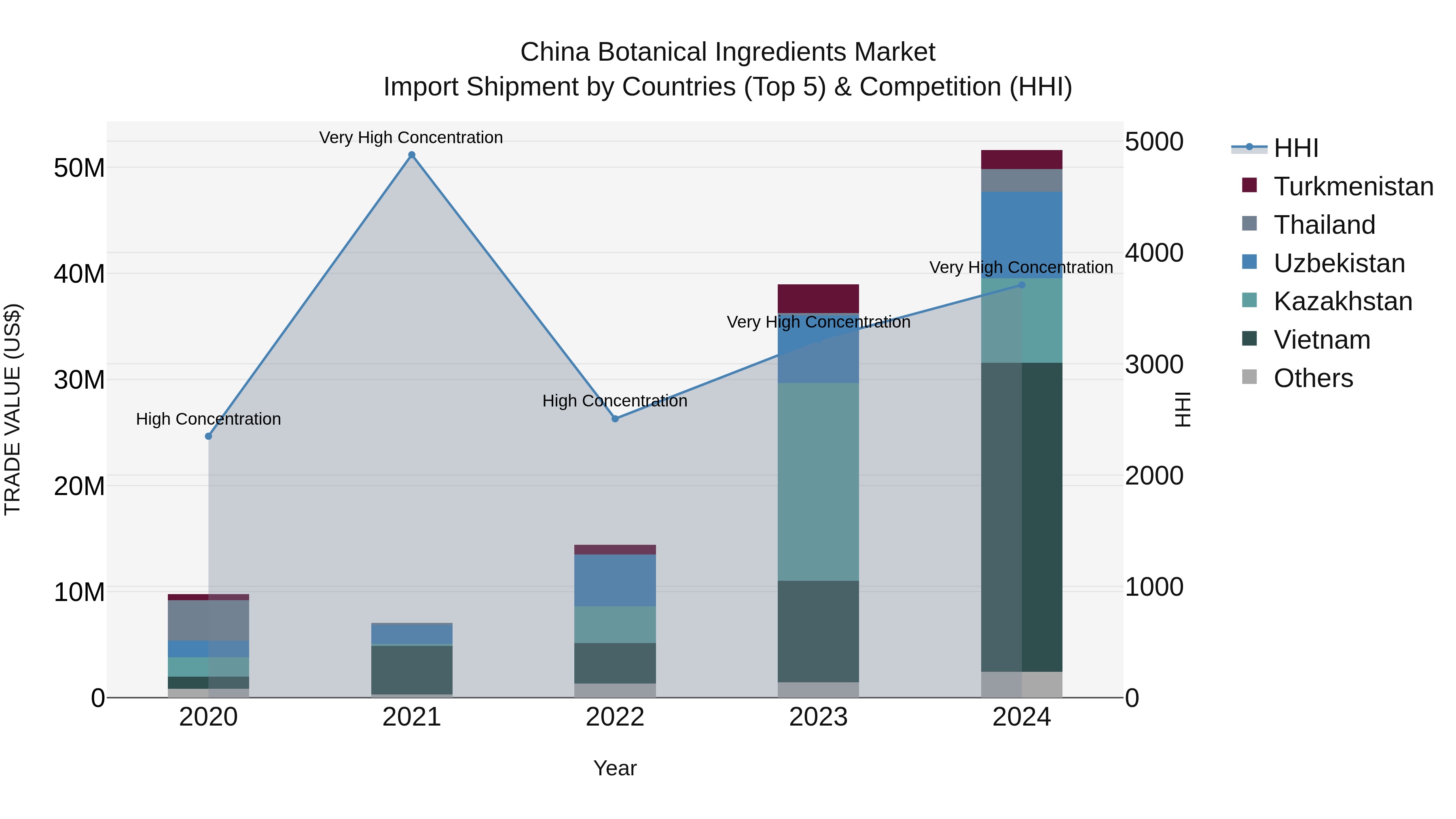
China continues to see significant growth in botanical ingredients import shipments, with top exporting countries such as Vietnam, Uzbekistan, and Kazakhstan leading the way in 2024. The high Herfindahl-Hirschman Index (HHI) indicates a concentrated market, while the impressive Compound Annual Growth Rate (CAGR) of 51.72% from 2020 to 2024 showcases a rapidly expanding industry. The strong growth rate of 32.51% from 2023 to 2024 suggests continued momentum in the market, with China demand for botanical ingredients showing no signs of slowing down.
China Botanical Ingredients Market Synopsis
The China Botanical Ingredients Market is experiencing significant growth driven by increasing consumer awareness about the health benefits of natural ingredients. The market encompasses a wide range of products derived from plants, including herbal extracts, essential oils, and plant-based ingredients used in various industries such as pharmaceuticals, cosmetics, and food & beverages. Factors such as the rising demand for organic and clean-label products, traditional Chinese medicine practices gaining popularity, and the emphasis on sustainable sourcing practices are driving the market growth. Key players in the China botanical ingredients market are focusing on product innovation, research & development, and strategic partnerships to capitalize on the growing demand for natural and plant-based ingredients in the region.
China Botanical Ingredients Market Trends
The China Botanical Ingredients Market is experiencing a surge in demand driven by growing consumer interest in natural and plant-based products. Key trends include a rising preference for traditional Chinese herbal ingredients like ginseng, astragalus, and goji berries for their health benefits and medicinal properties. There is also a focus on sustainability and traceability in sourcing botanical ingredients, with consumers seeking transparency in the supply chain. Additionally, the market is witnessing an increase in research and development efforts to discover new botanical ingredients with potential health and wellness applications. Overall, the China Botanical Ingredients Market is poised for continued growth as consumers prioritize natural, plant-derived products for their dietary and wellness needs.
China Botanical Ingredients Market Challenges
In the China Botanical Ingredients Market, challenges primarily revolve around quality control, sustainability, and regulatory issues. Quality control is a significant concern due to the potential presence of contaminants, pesticides, or heavy metals in botanical ingredients. Ensuring sustainable sourcing practices is another challenge, as overharvesting of certain plants can lead to environmental degradation and threaten biodiversity. Additionally, navigating the complex regulatory landscape in China, which includes stringent regulations on herbal medicines and traditional Chinese medicine, can be a barrier to market entry and product approval. Companies operating in this market need to invest in robust quality assurance processes, sustainable sourcing strategies, and stay abreast of evolving regulatory requirements to succeed in the China Botanical Ingredients Market.
China Botanical Ingredients Market Investment Opportunities
The China Botanical Ingredients Market presents promising investment opportunities due to the growing demand for natural and plant-based products in various industries such as pharmaceuticals, cosmetics, and food and beverages. With China`s rich biodiversity and traditional herbal medicine practices, the market offers a wide range of botanical ingredients with potential health benefits and therapeutic properties. Investors can consider opportunities in the cultivation, processing, and extraction of botanical ingredients, as well as research and development for innovative products. Additionally, the increasing consumer preference for clean label and sustainable products further drives the demand for botanical ingredients in China, making it an attractive market for investment in the ever-expanding natural products industry.
Jordan Agar Market Government Policies
The Chinese government has implemented various policies to regulate and support the botanical ingredients market. These include the Good Agricultural Practices (GAP) certification system to ensure the quality and safety of botanical products, as well as regulations on the sustainable harvesting and trade of endangered plant species. Additionally, the government has issued guidelines for the cultivation and processing of traditional Chinese medicinal herbs to promote standardization and quality control. In recent years, there has been a focus on promoting organic farming practices and the development of eco-friendly botanical ingredients. Overall, the government`s policies aim to enhance the competitiveness of the China botanical ingredients market, protect the environment, and ensure the health and safety of consumers.
China Botanical Ingredients Market Future Outlook
The China Botanical Ingredients Market is poised for significant growth in the coming years driven by increasing consumer awareness and demand for natural and organic products. Factors such as the rising popularity of traditional Chinese medicine, growing emphasis on health and wellness, and the expanding application of botanical ingredients in various industries like food and beverage, cosmetics, and pharmaceuticals are expected to fuel market growth. Additionally, advancements in extraction technologies, sustainable sourcing practices, and favorable government policies supporting the development of the botanical ingredients sector will further contribute to the market`s expansion. With China`s rich biodiversity and heritage of herbal medicine, the country is well-positioned to capitalize on the growing global trend towards natural and plant-based products, making it a key player in the global botanical ingredients market.
Key Highlights of the Report:
- China Botanical Ingredients Market Outlook
- Market Size of China Botanical Ingredients Market, 2021
- Forecast of China Botanical Ingredients Market, 2031
- Historical Data and Forecast of China Botanical Ingredients Revenues & Volume for the Period 2018 - 2031
- China Botanical Ingredients Market Trend Evolution
- China Botanical Ingredients Market Drivers and Challenges
- China Botanical Ingredients Price Trends
- China Botanical Ingredients Porter's Five Forces
- China Botanical Ingredients Industry Life Cycle
- Historical Data and Forecast of China Botanical Ingredients Market Revenues & Volume By Form for the Period 2018 - 2031
- Historical Data and Forecast of China Botanical Ingredients Market Revenues & Volume By Powder for the Period 2018 - 2031
- Historical Data and Forecast of China Botanical Ingredients Market Revenues & Volume By Liquid for the Period 2018 - 2031
- Historical Data and Forecast of China Botanical Ingredients Market Revenues & Volume By Source for the Period 2018 - 2031
- Historical Data and Forecast of China Botanical Ingredients Market Revenues & Volume By Herbs for the Period 2018 - 2031
- Historical Data and Forecast of China Botanical Ingredients Market Revenues & Volume By Leaves for the Period 2018 - 2031
- Historical Data and Forecast of China Botanical Ingredients Market Revenues & Volume By Spices for the Period 2018 - 2031
- Historical Data and Forecast of China Botanical Ingredients Market Revenues & Volume By Flowers for the Period 2018 - 2031
- Historical Data and Forecast of China Botanical Ingredients Market Revenues & Volume By Others for the Period 2018 - 2031
- Historical Data and Forecast of China Botanical Ingredients Market Revenues & Volume By Application for the Period 2018 - 2031
- Historical Data and Forecast of China Botanical Ingredients Market Revenues & Volume By Food & Beverages for the Period 2018 - 2031
- Historical Data and Forecast of China Botanical Ingredients Market Revenues & Volume By Dietary Supplements for the Period 2018 - 2031
- Historical Data and Forecast of China Botanical Ingredients Market Revenues & Volume By Personal Care & Cosmetics for the Period 2018 - 2031
- Historical Data and Forecast of China Botanical Ingredients Market Revenues & Volume By Pharmaceuticals for the Period 2018 - 2031
- Historical Data and Forecast of China Botanical Ingredients Market Revenues & Volume By Others for the Period 2018 - 2031
- China Botanical Ingredients Import Export Trade Statistics
- Market Opportunity Assessment By Form
- Market Opportunity Assessment By Source
- Market Opportunity Assessment By Application
- China Botanical Ingredients Top Companies Market Share
- China Botanical Ingredients Competitive Benchmarking By Technical and Operational Parameters
- China Botanical Ingredients Company Profiles
- China Botanical Ingredients Key Strategic Recommendations






































