China Bromine Market Top 5 Importing Countries and Market Competition (HHI) Analysis
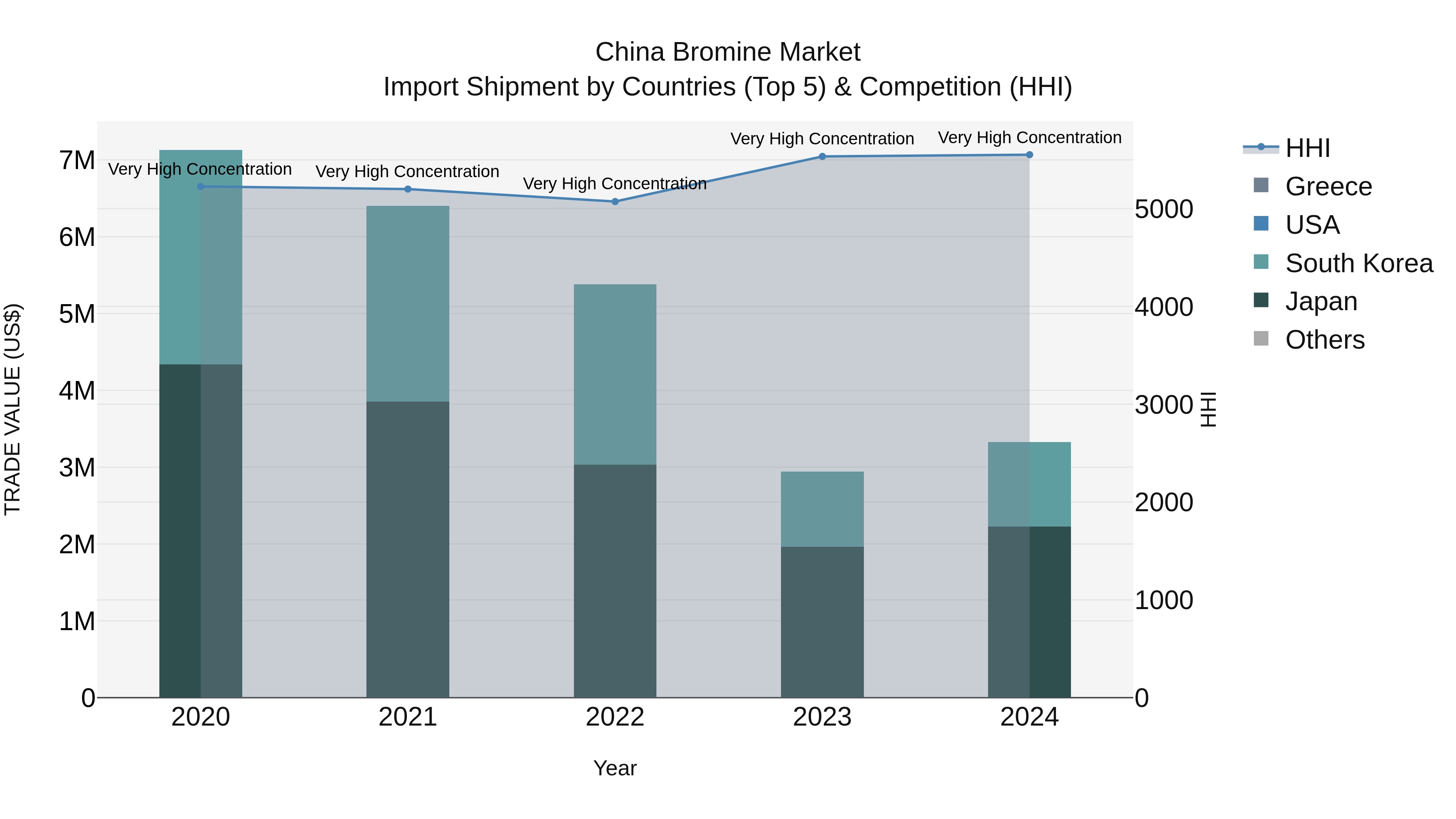
China bromine import market in 2024 continued to be dominated by top exporters such as Japan, South Korea, Greece, and the USA. Despite a challenging CAGR of -17.33% from 2020 to 2024, there was a notable growth rate of 13.06% from 2023 to 2024. The high concentration of market share, as indicated by the HHI, suggests a competitive landscape with a few key players holding significant sway in the market. The dynamics of the bromine import market in China remain intriguing, with potential opportunities for both exporters and domestic players to explore.
China Bromine Market Overview
The China Bromine Market is witnessing significant growth driven by increased demand from various industries such as pharmaceuticals, oil and gas, and flame retardants. China is one of the largest producers and consumers of bromine globally, with key production facilities concentrated in provinces like Shandong and Jiangsu. The market is expected to continue its growth trajectory due to the rising need for bromine compounds in flame retardants for electronics and textiles, as well as in the oil and gas industry for drilling fluids. However, environmental concerns and regulations regarding bromine production and usage may pose challenges to market growth in the coming years. Overall, the China Bromine Market presents opportunities for both domestic and international players looking to capitalize on the country`s expanding bromine industry.
China Bromine Market Trends
The China Bromine Market is currently experiencing growth driven by increasing demand in various industries such as flame retardants, oil and gas drilling, and pharmaceuticals. With the rise in construction activities and automotive production in China, the demand for bromine-based flame retardants has surged. Additionally, the expanding oil and gas exploration activities in the country have increased the need for bromine compounds in drilling fluids. Furthermore, the pharmaceutical industry in China is utilizing bromine in the production of medicines and chemicals. The market is also witnessing advancements in bromine production technologies to meet the growing demand sustainably. Overall, the China Bromine Market is expected to continue its upward trajectory in the coming years due to the diverse applications and increasing industrial activities.
China Bromine Market Challenges
The China Bromine Market faces several challenges, including environmental regulations leading to stricter emission standards for bromine production, increasing competition from alternative flame retardants, and fluctuating raw material prices impacting production costs. Additionally, the market is vulnerable to global economic conditions and trade tensions, which can affect demand and pricing dynamics. Furthermore, concerns over the environmental impact of bromine production and usage have led to growing pressure for sustainable practices and alternatives, posing a challenge for traditional bromine manufacturers to adapt and innovate. Overall, navigating these challenges requires market players to invest in research and development, sustainable production methods, and strategic partnerships to maintain competitiveness and meet evolving regulatory requirements in the China Bromine Market.
China Bromine Market Investment Opportunities
The China Bromine Market offers promising investment opportunities due to the increasing demand for bromine-based products in various industries such as pharmaceuticals, agriculture, and flame retardants. With China being one of the largest producers of bromine globally, investing in bromine production companies or manufacturers in the country could yield significant returns. Additionally, the growing focus on environmental regulations and the shift towards eco-friendly bromine derivatives present opportunities for investing in sustainable bromine technologies. As the Chinese economy continues to expand and diversify, the demand for bromine and its derivatives is expected to rise, making it an attractive sector for investment with potential for long-term growth and profitability. However, investors should closely monitor market dynamics, regulatory changes, and global trends to make informed investment decisions in the China Bromine Market.
China Bromine Market Government Policy
The Chinese government has implemented policies to regulate the bromine market, focusing on environmental protection and resource conservation. These policies include restrictions on bromine production levels to prevent over-exploitation of natural resources and reduce environmental pollution. Additionally, the government has set standards for bromine production processes to ensure compliance with environmental regulations. The implementation of these policies has led to a more sustainable and environmentally friendly bromine industry in China, promoting long-term growth and stability in the market. Overall, the government`s focus on environmental protection and resource conservation has shaped the regulatory framework of the China bromine market, guiding industry players towards more responsible and sustainable practices.
China Bromine Market Future Outlook
The China Bromine Market is expected to show steady growth in the coming years, driven by increasing demand from various industries such as pharmaceuticals, agriculture, and flame retardants. The growth is also anticipated to be supported by the expanding manufacturing sector in China. Additionally, the rising adoption of bromine-based products for water treatment and oil & gas exploration activities is likely to further fuel market growth. However, challenges such as environmental concerns related to bromine production and regulatory restrictions on its usage may pose barriers to market expansion. Overall, the China Bromine Market is projected to experience moderate yet sustainable growth in the foreseeable future, with opportunities for innovation and technological advancements to drive further developments in the industry.
Key Highlights of the Report:
- China Bromine Market Outlook
- Market Size of China Bromine Market, 2021
- Forecast of China Bromine Market, 2031
- Historical Data and Forecast of China Bromine Revenues & Volume for the Period 2021 - 2031
- China Bromine Market Trend Evolution
- China Bromine Market Drivers and Challenges
- China Bromine Price Trends
- China Bromine Porter's Five Forces
- China Bromine Industry Life Cycle
- Historical Data and Forecast of China Bromine Market Revenues & Volume By Derivative for the Period 2021 - 2031
- Historical Data and Forecast of China Bromine Market Revenues & Volume By Organobromine for the Period 2021 - 2031
- Historical Data and Forecast of China Bromine Market Revenues & Volume By Clear Brine Fluids for the Period 2021 - 2031
- Historical Data and Forecast of China Bromine Market Revenues & Volume By Hydrogen Bromide for the Period 2021 - 2031
- Historical Data and Forecast of China Bromine Market Revenues & Volume By Application for the Period 2021 - 2031
- Historical Data and Forecast of China Bromine Market Revenues & Volume By Flame Retardants for the Period 2021 - 2031
- Historical Data and Forecast of China Bromine Market Revenues & Volume By Oil & Gas Drilling for the Period 2021 - 2031
- Historical Data and Forecast of China Bromine Market Revenues & Volume By PTA Synthesis for the Period 2021 - 2031
- Historical Data and Forecast of China Bromine Market Revenues & Volume By Water Treatment & Biocides for the Period 2021 - 2031
- Historical Data and Forecast of China Bromine Market Revenues & Volume By Pesticides for the Period 2021 - 2031
- Historical Data and Forecast of China Bromine Market Revenues & Volume By HBr Flow Batteries for the Period 2021 - 2031
- Historical Data and Forecast of China Bromine Market Revenues & Volume By Pharmaceuticals for the Period 2021 - 2031
- Historical Data and Forecast of China Bromine Market Revenues & Volume By Others for the Period 2021 - 2031
- China Bromine Import Export Trade Statistics
- Market Opportunity Assessment By Derivative
- Market Opportunity Assessment By Application
- China Bromine Top Companies Market Share
- China Bromine Competitive Benchmarking By Technical and Operational Parameters
- China Bromine Company Profiles
- China Bromine Key Strategic Recommendations






































