China Canvas Market Size, Share & Growth Rate
The China Canvas Market was estimated at USD 111 Million in 2025 and is projected to reach USD 127 Million by 2032, growing at a CAGR of 1.9% from 2026 to 2032. This steady growth trajectory is significantly driven by the burgeoning demand from the textile and fashion industries, where durability and versatility are essential. Moreover, the increasing interest in outdoor recreational activities and sustainable products is further fueling the market, as consumers lean toward eco-friendly options.
China Canvas Market Year-wise Growth Rate and Key Drivers
This graph highlights how the China Canvas Market has steadily grown over the years, supported by major growth factors.
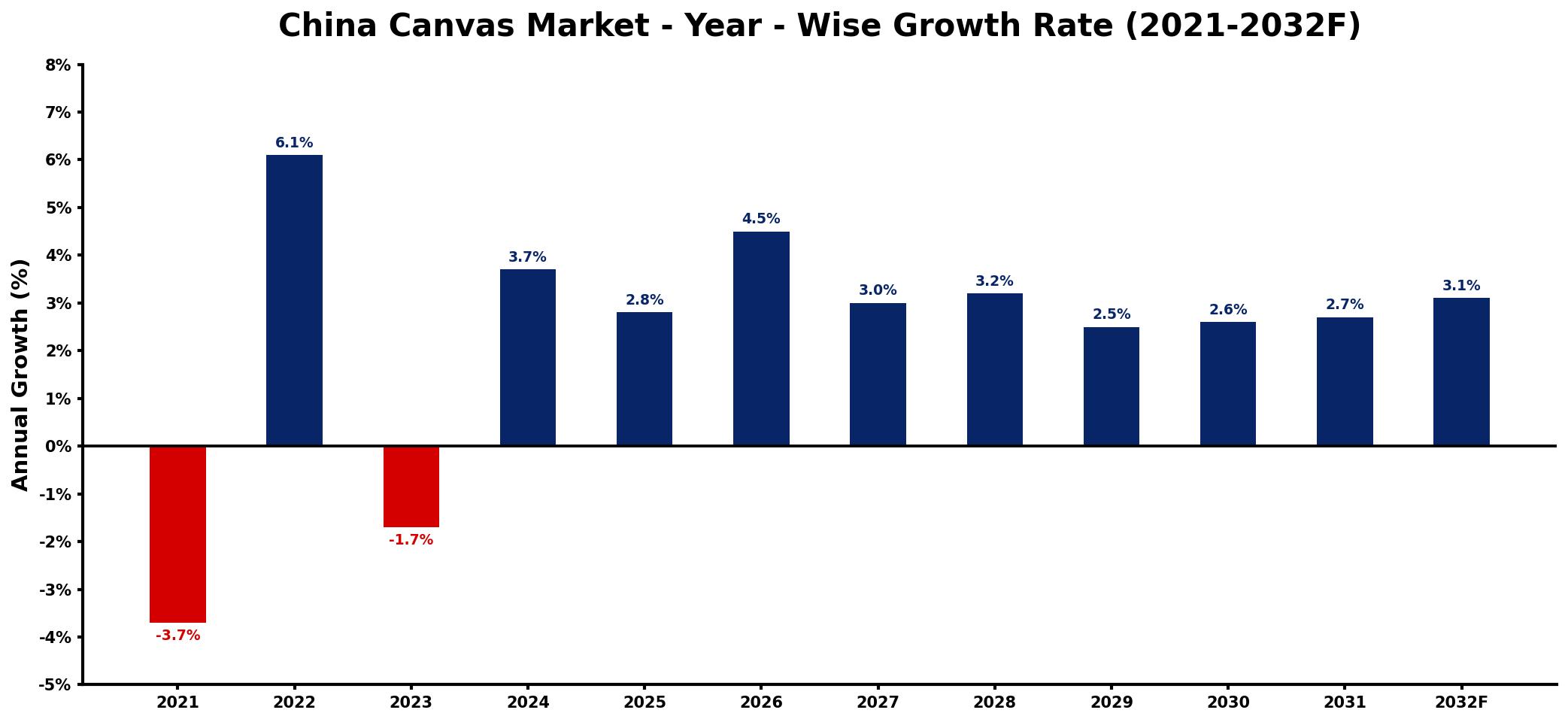
The table below presents the year‑wise growth rates along with the key drivers influencing the market
| Year | Growth Rate | Major Drivers |
| 2021 | -3.7% | decreased consumer spending on art |
| 2022 | 6.1% | growing interest in artistic hobbies |
| 2023 | -1.7% | reduced investments in arts sector |
| 2024 | 3.7% | increased demand for eco-friendly materials |
| 2025 | 2.8% | expansion of digital art platforms |
| 2026 | 4.5% | rising popularity of home decor |
| 2027 | 3.0% | growth in educational art programs |
| 2028 | 3.2% | increased collaborations with influencers |
| 2029 | 2.5% | increased production capacity utilization |
| 2030 | 2.6% | growing trends in DIY projects |
| 2031 | 2.7% | increased focus on sustainability initiatives |
| 2032 | 3.1% | rising end-use demand growth |
Note: Market size estimations and growth projections presented in this report are based on 6Wresearch's proprietary forecasting methodology, utilizing the latest available industry data, government publications, and primary research inputs.
China Canvas Market Synopsis
One of the most powerful forces currently shaping the China Canvas Market is the rising popularity of sustainable and eco-friendly materials. As consumers become more environmentally conscious, the demand for canvas products that utilize natural fibers has surged. This trend is particularly evident in sectors such as fashion, where brands increasingly prioritize sustainability in their sourcing and production practices.
Additionally, the growth of outdoor recreational activities, such as camping and hiking, has significantly contributed to the canvas market's expansion. Consumers are increasingly investing in durable and multifunctional products, driving demand for high-quality canvas items like tents and outdoor gear. Together, these dynamics create a robust landscape for growth in the China Canvas Market.
China Canvas Market Key Takeaways
- The market is primarily driven by the textile and fashion industries, emphasizing sustainability.
- Increased outdoor recreational activities are prompting higher demand for durable canvas products.
- Innovations in fabric technology are enhancing product offerings, attracting diverse consumers.
- Environmental regulations are shaping production practices, encouraging the use of eco-friendly materials.
- Competitive pricing pressures from synthetic alternatives necessitate strategic positioning in the market.
Evaluation of Restraints in China Canvas Market
The China Canvas Market encounters several constraints that could hinder its growth. One primary challenge is the volatility of raw material costs, which can fluctuate due to supply chain disruptions or changes in agricultural output. These fluctuations directly impact the pricing of canvas products. Furthermore, stringent environmental regulations require manufacturers to comply with increasingly demanding standards regarding chemical use and waste management. This compliance can elevate production costs and complicate operations, creating barriers for small and medium-sized enterprises within the market. Lastly, the presence of synthetic alternatives presents an ongoing competitive challenge, as many consumers opt for potentially cheaper options, influencing overall demand.
China Canvas Market Trends
Current trends indicate a strong shift toward the use of sustainable materials in canvas production. Innovations in fabric technology are not only improving the durability of canvas products but also enhancing their aesthetic appeal, making them more attractive to fashion-conscious consumers. Moreover, the DIY and crafting movements are gaining traction, spurring interest in canvas for personal projects and custom creations. This trend is particularly potent among younger demographics, who seek unique, personalized items that reflect their identities and values. Overall, these trends are reshaping the landscape of the China Canvas Market, aligning with broader global shifts toward sustainability and creativity.
China Canvas Market Opportunities
The landscape of the China Canvas Market is ripe with opportunities for growth and investment. One notable area is the expansion of eco-friendly product lines, which can cater to the growing consumer demand for sustainable options. Brands that effectively communicate their commitment to sustainability could capture significant market share. Furthermore, the growth of the outdoor recreational sector presents opportunities for innovation in product design and functionality. With more consumers engaging in outdoor activities, there is room for high-performance canvas products that combine durability with aesthetic appeal. Additionally, targeting the burgeoning DIY market with versatile and customizable canvas options can further bolster growth.
Government Initiatives in the China Canvas Market
Government policies play a crucial role in shaping the China Canvas Market. Regulations regarding manufacturing standards and environmental impact are continuously evolving, aimed at ensuring the quality and safety of canvas products. The government has also introduced initiatives that promote sustainable practices within the textile industry, encouraging manufacturers to adopt eco-friendly materials and processes. These policies not only help safeguard the environment but also position the industry favorably in the eyes of increasingly eco-conscious consumers. Public funding for research and development in sustainable materials is likely to further enhance innovation in the canvas sector.
Future Insights of the China Canvas Market
Looking ahead to 2026-2032, the China Canvas Market is expected to evolve significantly, driven by technological advancements and changing consumer preferences. The continued emphasis on sustainability will likely reshape product development and marketing strategies, positioning eco-friendly canvas items at the forefront. Furthermore, as outdoor activities remain a popular pastime among the Chinese population, the demand for durable and functional canvas products will likely sustain the market's growth. Additionally, the integration of digital platforms for retail and direct-to-consumer sales may revolutionize how canvas products are marketed and distributed, making it essential for stakeholders to stay ahead of these trends.
China Canvas Market Latest Developments (2025 - 2026)
In recent months, the China Canvas Market has witnessed notable shifts, particularly in consumer preferences toward sustainability. Many manufacturers are actively reformulating their production processes to align with environmental standards, utilizing more organic materials. Concurrently, there has been a surge in collaborations between fashion brands and eco-conscious suppliers, emphasizing the significance of sustainable sourcing in product lines. Additionally, various DIY workshops and community initiatives have emerged, further promoting the creative use of canvas in both craft and fashion sectors, thereby stimulating interest and demand for innovative canvas applications.
China Canvas Market - Key Attractiveness of the Report
- 10 Years of Market Numbers
- Historical Data Starting from 2022 to 2025
- Base Year: 2025
- Forecast Data until 2032
- Key Performance Indicators Impacting the Market
- Major Upcoming Developments and Projects
Key Highlights of the Report:
- China Canvas Market Outlook
- Market Size of China Canvas Market, 2025
- Forecast of China Canvas Market, 2032
- Historical Data and Forecast of China Canvas Revenues & Volume for the Period 2022-2032F
- China Canvas Market Trend Evolution
- China Canvas Market Drivers and Challenges
- China Canvas Price Trends
- China Canvas Porter's Five Forces
- China Canvas Industry Life Cycle
- Historical Data and Forecast of China Canvas Market Revenues & Volume By Types for the Period 2022-2032F
- Historical Data and Forecast of China Canvas Market Revenues & Volume By Plane Canvas for the Period 2022-2032F
- Historical Data and Forecast of China Canvas Market Revenues & Volume By Duck Canvas for the Period 2022-2032F
- Historical Data and Forecast of China Canvas Market Revenues & Volume By Application for the Period 2022-2032F
- Historical Data and Forecast of China Canvas Market Revenues & Volume By Tent for the Period 2022-2032F
- Historical Data and Forecast of China Canvas Market Revenues & Volume By Luggage Fabric for the Period 2022-2032F
- Historical Data and Forecast of China Canvas Market Revenues & Volume By Automotive Fabric for the Period 2022-2032F
- Historical Data and Forecast of China Canvas Market Revenues & Volume By Apparel for the Period 2022-2032F
- Historical Data and Forecast of China Canvas Market Revenues & Volume By Others for the Period 2022-2032F
- China Canvas Import Export Trade Statistics
- Market Opportunity Assessment By Types
- Market Opportunity Assessment By Application
- China Canvas Top Companies Market Share
- China Canvas Competitive Benchmarking By Technical and Operational Parameters
- China Canvas Company Profiles
- China Canvas Key Strategic Recommendations






































