China Cutting Equipment Market Top 5 Importing Countries and Market Competition (HHI) Analysis
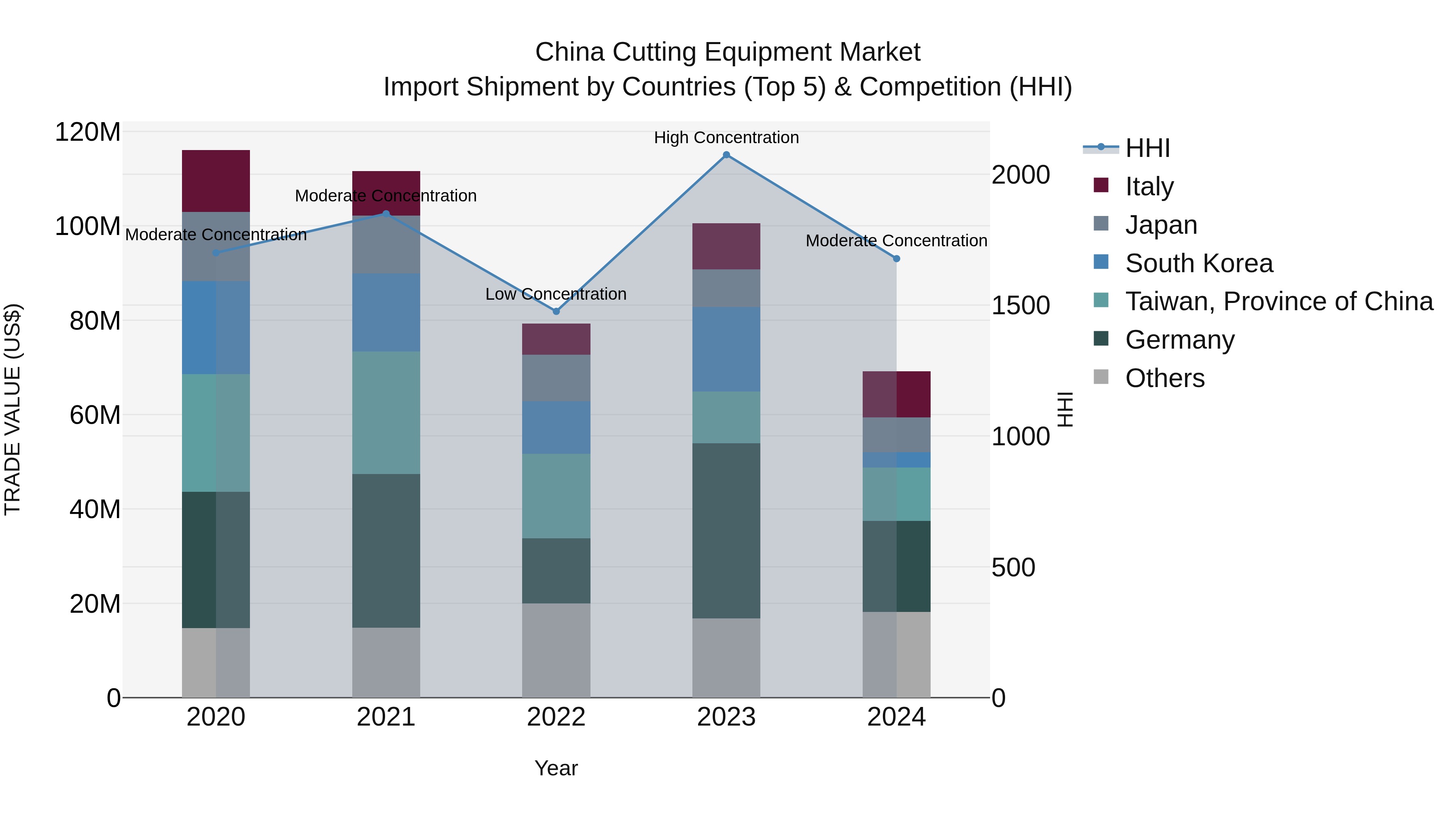
China cutting equipment import shipments in 2024 saw a shift in the concentration of top exporting countries, with Germany, Austria, Taiwan, Italy, and Japan leading the way. The Herfindahl-Hirschman Index (HHI) displayed a decrease in concentration levels from high to moderate in 2024. However, the industry experienced a decline with a Compound Annual Growth Rate (CAGR) of -12.13% from 2020 to 2024, and a significant growth rate decrease of -31.19% from 2023 to 2024. These fluctuations indicate a changing landscape in the cutting equipment market in China.
China Cutting Equipment Market Overview
The Cutting Equipment market in China is witnessing significant growth, fueled by advancements in manufacturing technologies and the increasing demand for precision and efficiency in production processes. Cutting equipment, including laser cutters, water jet cutters, and plasma cutters, is essential in various industries such as automotive, aerospace, and metalworking. The market is driven by the need for high-quality and cost-effective cutting solutions that can handle complex materials and designs. Technological innovations, such as automation and smart cutting systems, are enhancing the capabilities of cutting equipment, providing businesses with more efficient and versatile tools for their manufacturing needs.
Drivers of the market
The Cutting Equipment market in China is experiencing growth due to the rising demand across various industries such as automotive, aerospace, and manufacturing. Technological advancements in cutting equipment, including precision cutting and automation, are enhancing productivity and efficiency. Additionally, the increasing focus on quality and precision in manufacturing processes drives the demand for advanced cutting technologies.
Challenges of the market
The China Cutting Equipment market faces several challenges, including the need for continuous technological upgrades to meet industry standards. Cutting equipment must adapt to new materials and production techniques, which can require substantial investment in research and development. Additionally, the market is characterized by intense competition, which can lead to price wars and reduced profit margins. Quality control is another challenge, as manufacturers must ensure that cutting equipment meets stringent safety and performance standards. Moreover, there is a growing demand for automation and smart cutting solutions, which can be costly and require specialized expertise.
Government Policy of the market
China`s cutting equipment market is influenced by policies promoting industrial modernization and technological advancement. The "Made in China 2025" initiative encourages the development and adoption of advanced manufacturing technologies, including cutting equipment. Government incentives and subsidies for high-tech manufacturing contribute to the growth of this market by supporting innovation and enhancing production capabilities.
Key Highlights of the Report:
- China Cutting Equipment Market Outlook
- Market Size of China Cutting Equipment Market, 2024
- Forecast of China Cutting Equipment Market, 2031
- Historical Data and Forecast of China Cutting Equipment Revenues & Volume for the Period 2021-2031
- China Cutting Equipment Market Trend Evolution
- China Cutting Equipment Market Drivers and Challenges
- China Cutting Equipment Price Trends
- China Cutting Equipment Porter's Five Forces
- China Cutting Equipment Industry Life Cycle
- Historical Data and Forecast of China Cutting Equipment Market Revenues & Volume By Equipment Type for the Period 2021-2031
- Historical Data and Forecast of China Cutting Equipment Market Revenues & Volume By Manual for the Period 2021-2031
- Historical Data and Forecast of China Cutting Equipment Market Revenues & Volume By Mechanized for the Period 2021-2031
- Historical Data and Forecast of China Cutting Equipment Market Revenues & Volume By Cutting Technology for the Period 2021-2031
- Historical Data and Forecast of China Cutting Equipment Market Revenues & Volume By Plasma cutting for the Period 2021-2031
- Historical Data and Forecast of China Cutting Equipment Market Revenues & Volume By Oxy-fuel cutting for the Period 2021-2031
- Historical Data and Forecast of China Cutting Equipment Market Revenues & Volume By Laser cutting for the Period 2021-2031
- Historical Data and Forecast of China Cutting Equipment Market Revenues & Volume By Waterjet cutting for the Period 2021-2031
- Historical Data and Forecast of China Cutting Equipment Market Revenues & Volume By Carbon arc cutting for the Period 2021-2031
- Historical Data and Forecast of China Cutting Equipment Market Revenues & Volume By End Use Industry for the Period 2021-2031
- Historical Data and Forecast of China Cutting Equipment Market Revenues & Volume By Construction for the Period 2021-2031
- Historical Data and Forecast of China Cutting Equipment Market Revenues & Volume By Heavy metal fabrication for the Period 2021-2031
- Historical Data and Forecast of China Cutting Equipment Market Revenues & Volume By Shipbuilding & offshore for the Period 2021-2031
- Historical Data and Forecast of China Cutting Equipment Market Revenues & Volume By Automotive for the Period 2021-2031
- Historical Data and Forecast of China Cutting Equipment Market Revenues & Volume By Others for the Period 2021-2031
- Historical Data and Forecast of China Cutting Equipment Market Revenues & Volume By Type for the Period 2021-2031
- Historical Data and Forecast of China Cutting Equipment Market Revenues & Volume By Equipment for the Period 2021-2031
- Historical Data and Forecast of China Cutting Equipment Market Revenues & Volume By Consumables/Accessories for the Period 2021-2031
- China Cutting Equipment Import Export Trade Statistics
- Market Opportunity Assessment By Equipment Type
- Market Opportunity Assessment By Cutting Technology
- Market Opportunity Assessment By End Use Industry
- Market Opportunity Assessment By Type
- China Cutting Equipment Top Companies Market Share
- China Cutting Equipment Competitive Benchmarking By Technical and Operational Parameters
- China Cutting Equipment Company Profiles
- China Cutting Equipment Key Strategic Recommendations






































