China Electrical Equipment Market Summary
The china electrical equipment market was estimated at USD 226 Million in 2025 and is projected to reach USD 262 Million by 2032, growing at a CAGR of 4.2% from 2026 to 2032.
China Electrical Equipment Market Year-wise Growth Rate and Key Drivers
This graph highlights how the China Electrical Equipment Market has steadily grown over the past five years, supported by major growth factors.
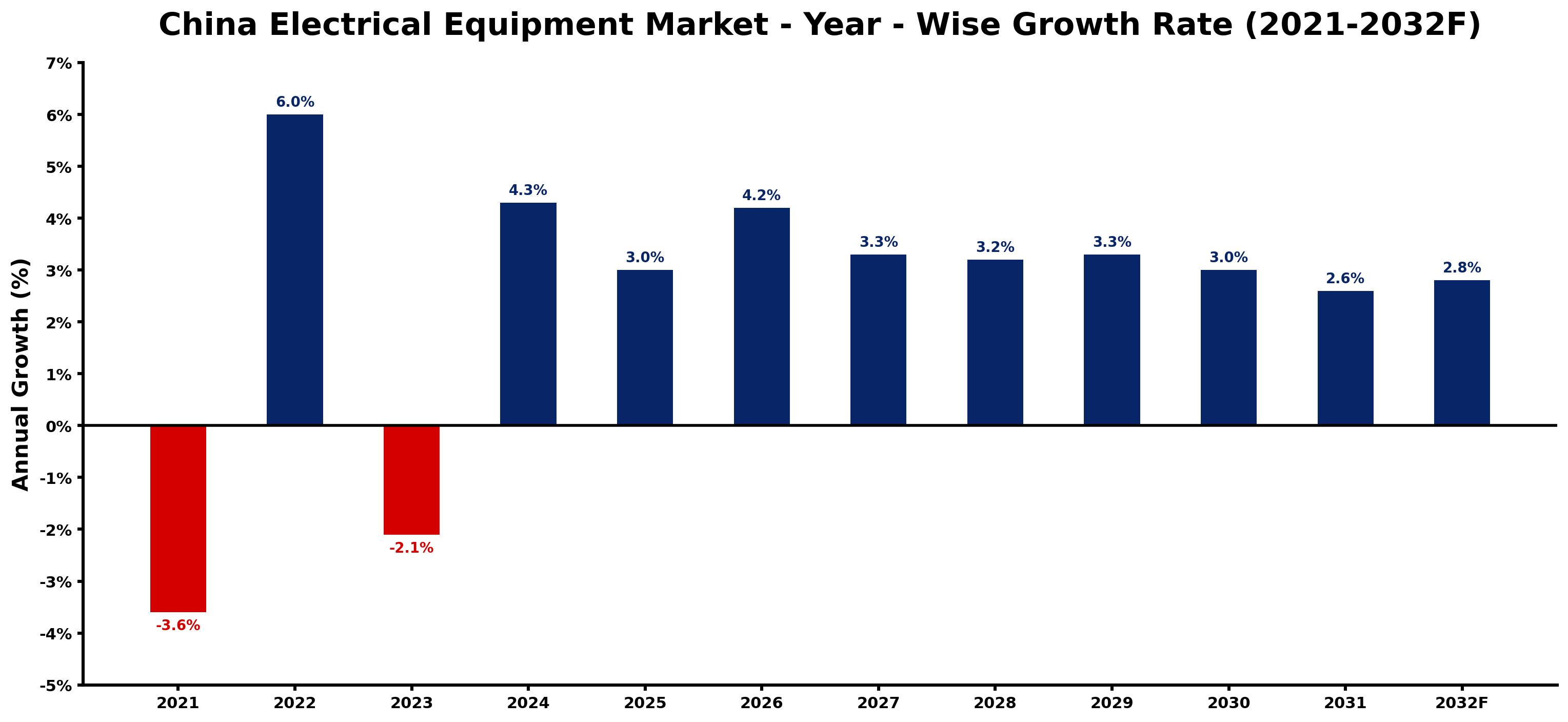
The table below presents the year wise growth rates along with the key drivers influencing the market
| Year | Growth Rate | Major Drivers |
| 2021 | -3.6% | Heightened geopolitical tensions led to reduced investment and uncertainty in the electrical equipment sector. |
| 2022 | 6.0% | Rural electrification projects receive funding, expanding market access nationwide. |
| 2023 | -2.1% | Supply chain disruptions led to increased production costs, hampering the industry's competitiveness in local markets. |
| 2024 | 4.3% | Urbanization accelerates demand for advanced electrical infrastructure solutions. |
| 2025 | 3.0% | Increased investments in renewable energy projects reshape electrical equipment needs. |
| 2026 | 4.2% | Emerging technologies foster innovation in battery storage and management systems. |
| 2027 | 3.3% | International partnerships facilitate knowledge transfer and technology sharing in industry. |
| 2028 | 3.2% | Sustainability practices become essential for businesses, driving eco-friendly product development. |
| 2029 | 3.3% | Enhanced industrial automation demands sophisticated electrical control systems and equipment. |
| 2030 | 3.0% | Consumer electronics market growth propels demand for high-performance electrical components. |
| 2031 | 2.6% | Evolving manufacturing standards necessitate upgrades in electrical equipment capabilities. |
| 2032 | 2.8% | Smart city initiatives create new opportunities for intelligent energy distribution solutions. |
Note - Market size estimations and growth projections presented in this report are based on 6Wresearch's advanced forecasting approach, validated with industry datasets as of June 2026.
China Electrical Equipment Market Synopsis
The China Electrical Equipment Market is projected to reach 4.2% and witness significant growth during the forecast period (2026-2032). This growth is fueled by several pivotal factors including urbanization, industrialization, and substantial investments in infrastructure development across the nation. The market encompasses various segments such as power generation equipment, transmission and distribution equipment, electric motors, and electrical appliances. As the country continues to evolve, the demand for innovative and energy-efficient products is escalating, driven largely by governmental initiatives and consumer preferences.
China Electrical Equipment Market Growth Drivers
A multitude of drivers are propelling the growth of the China Electrical Equipment Market. Firstly, the rapid urbanization occurring throughout China is leading to increased demand for electricity and, consequently, electrical equipment. This trend is prominent in expanding cities and industrial parks, where infrastructure development is a priority.
- Infrastructure investments dominate the landscape, with new projects necessitating enhanced electrical systems to support population growth and industrial needs.
- Government incentives aimed at promoting renewable energy sources, such as solar and wind, are leading to a surge in demand for related electrical equipment.
- The increasing adoption of smart technologies, including IoT-enabled devices and automation, is revolutionizing traditional electrical systems, paving the way for modern equipment solutions.
- A growing focus on energy efficiency is driving innovation among manufacturers to create eco-friendly products that meet regulatory standards and consumer expectations.
- The rise in electric vehicle ownership is contributing to the demand for charging infrastructure and supporting electrical equipment, further expanding market opportunities.
China Electrical Equipment Market Trends and Opportunities
Trends within the China Electrical Equipment Market illustrate evolving consumer preferences and technological advancements. The major trend is the escalating demand for smart, energy-efficient electrical products, which is increasingly prioritized due to sustainability and environmental concerns.
- The shift towards electric vehicles is creating a pronounced need for enhanced charging stations and related electrical components.
- Digital transformation is altering traditional practices, with a focus on smart grids that facilitate the integration of renewable energy sources.
- Automation and control systems are becoming essential in industrial applications, enhancing operational efficiency and reducing costs.
- There is a notable increase in competition within the market, prompting continuous innovation and development of new products to gain a competitive edge.
- Investment opportunities abound in the realm of renewable energy, particularly with solar power technologies attracting significant interest from stakeholders.
China Electrical Equipment Market Challenges and Restraints
Despite the promising growth trajectory, the China Electrical Equipment Market faces several significant challenges. Intense competition from a multitude of domestic and international manufacturers creates a crowded marketplace that can stifle new entrants and innovation.
- Rapid technological advancements necessitate constant investment in research and development, which can be a barrier for smaller firms lacking resources.
- Stringent government regulations related to environmental and safety standards can complicate compliance, particularly for manufacturers operating in multiple regions.
- Fluctuations in raw material prices have the potential to impact production costs and pricing strategies, influencing overall market dynamics.
- Supply chain disruptions pose significant risks, especially in a global economy shaped by unpredictability and external factors.
- A growing emphasis on sustainability requires manufacturers to innovate continually, which can strain resources and operational capabilities.
China Electrical Equipment Market Government Investment and Initiatives
The Chinese government plays a crucial role in shaping the electrical equipment market through various policies and initiatives designed to foster innovation and sustainability. Comprehensive strategies have been implemented to promote energy efficiency and environmental protection, resulting in stricter regulations concerning energy consumption and emissions.
- The government provides incentives for research and development, supporting enterprises that develop innovative technologies within the electrical equipment sector.
- Policies are directed towards encouraging domestic production over imports, enhancing local manufacturers' competitiveness through preferential treatment in government procurement contracts.
- Public investments in renewable energy infrastructure aim to align with national goals of reducing carbon emissions while enhancing grid reliability.
- Support for smart grid technology development is evident, facilitating the integration of renewable sources and improving overall electrical system efficiency.
- Collaborations between public and private sectors are designed to address safety standards and enhance the technological landscape of electrical equipment.
China Electrical Equipment Market Latest Developments (May 2025 - June 2026)
Recent developments within the China Electrical Equipment Market indicate a clear trajectory towards modernization and sustainability. The adoption of renewable energy technologies continues to accelerate, with significant strides being made in solar energy deployments and electric vehicle infrastructure.
- New regulatory frameworks are being established to support the rapid expansion of smart grid technologies, enabling better integration of diverse energy sources.
- Investment in electric vehicle charging infrastructure is being prioritized, indicating a strong commitment to supporting the growing EV market.
- Technological advances in energy storage solutions are receiving increased attention, which is critical for enhancing the reliability of renewable energy systems.
- Companies are increasingly investing in automation technologies that boost efficiency and promote sustainability within the manufacturing process.
- Market competition is intensifying, leading to innovative partnerships and collaborations aimed at developing cutting-edge electrical equipment.
China Electrical Equipment Market - Key Attractiveness of the Report
- 10 Years of Market Numbers
- Historical Data Starting from 2022 to 2025
- Base Year: 2025
- Forecast Data until 2032
- Key Performance Indicators Impacting the Market
- Major Upcoming Developments and Projects
Key Highlights of the Report:
- China Electrical Equipment Market Outlook
- Market Size of China Electrical Equipment Market, 2025
- Forecast of China Electrical Equipment Market, 2032F
- Historical Data and Forecast of China Electrical Equipment Revenues & Volume for the Period 2022-2032F
- China Electrical Equipment Market Trend Evolution
- China Electrical Equipment Market Drivers and Challenges
- China Electrical Equipment Price Trends
- China Electrical Equipment Porter's Five Forces
- China Electrical Equipment Industry Life Cycle
- Historical Data and Forecast of China Electrical Equipment Market Revenues & Volume By Types for the Period 2022-2032F
- Historical Data and Forecast of China Electrical Equipment Market Revenues & Volume By Electronic and electrical wires and cables for the Period 2022-2032F
- Historical Data and Forecast of China Electrical Equipment Market Revenues & Volume By Batteries and accumulators for the Period 2022-2032F
- Historical Data and Forecast of China Electrical Equipment Market Revenues & Volume By Wiring devices for the Period 2022-2032F
- Historical Data and Forecast of China Electrical Equipment Market Revenues & Volume By Electric lighting equipment for the Period 2022-2032F
- Historical Data and Forecast of China Electrical Equipment Market Revenues & Volume By Others for the Period 2022-2032F
- Historical Data and Forecast of China Electrical Equipment Market Revenues & Volume By Applications for the Period 2022-2032F
- Historical Data and Forecast of China Electrical Equipment Market Revenues & Volume By Residential end-users for the Period 2022-2032F
- Historical Data and Forecast of China Electrical Equipment Market Revenues & Volume By Non-residential end-users for the Period 2022-2032F
- China Electrical Equipment Import Export Trade Statistics
- Market Opportunity Assessment By Types
- Market Opportunity Assessment By Applications
- China Electrical Equipment Top Companies Market Share
- China Electrical Equipment Competitive Benchmarking By Technical and Operational Parameters
- China Electrical Equipment Company Profiles
- China Electrical Equipment Key Strategic Recommendations






































