China Energy Efficient Lighting Market Size, Share & Growth Rate
The China Energy Efficient Lighting Market was estimated at USD 228 Million in 2025 and is projected to reach USD 263 Million by 2032, growing at a CAGR of 2.1% from 2026 to 2032. This growth trajectory is primarily fueled by government initiatives aimed at reducing energy consumption and carbon emissions. The increasing adoption of energy-efficient technologies, particularly LED lighting and smart lighting systems, aligns with China's sustainability goals and is further propelling the market forward.
China Energy Efficient Lighting Market Year-wise Growth Rate and Key Drivers
This graph highlights how the China Energy Efficient Lighting Market has steadily grown over the years, supported by major growth factors.
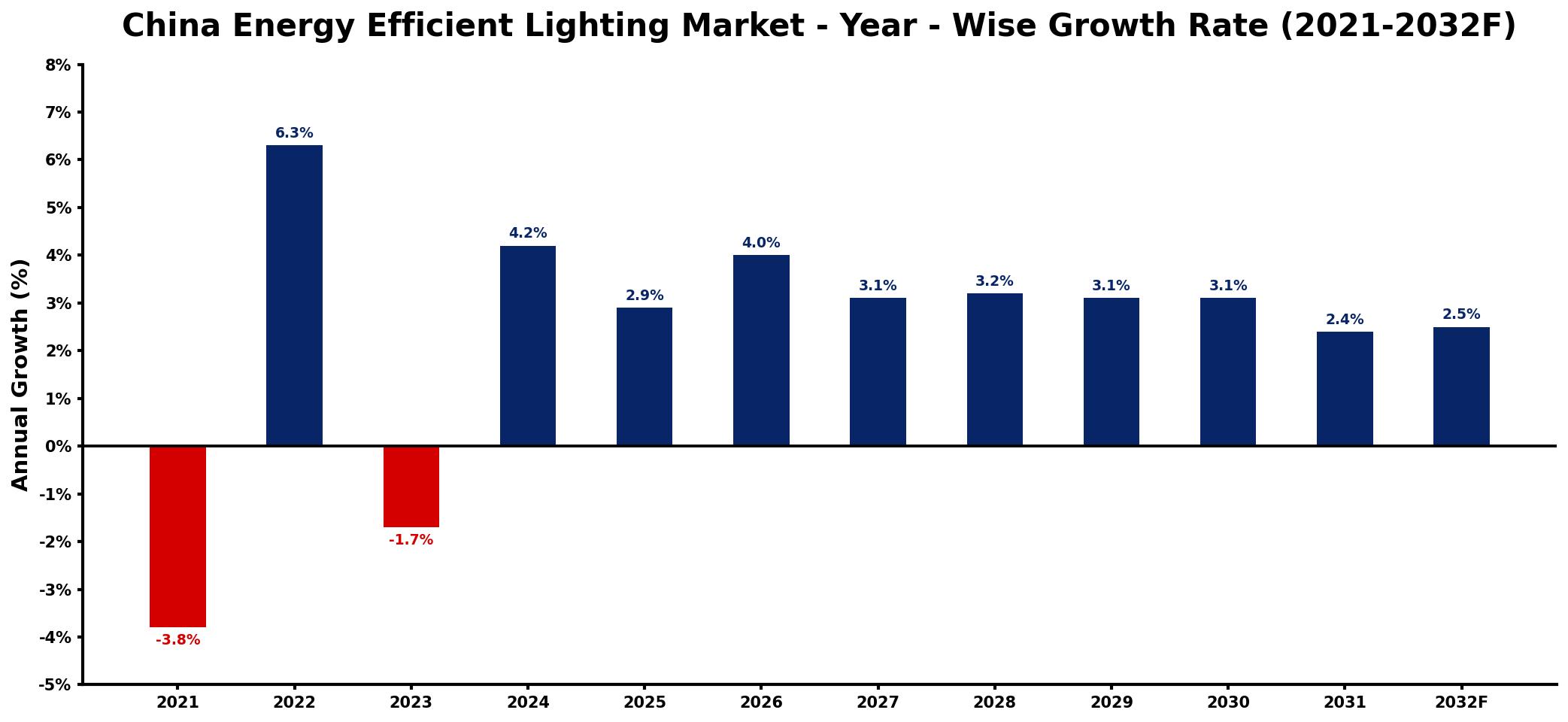
The table below presents the year‑wise growth rates along with the key drivers influencing the market
| Year | Growth Rate | Major Drivers |
| 2021 | -3.8% | decrease in construction activities |
| 2022 | 6.3% | growing demand for sustainability |
| 2023 | -1.7% | reduction in consumer spending |
| 2024 | 4.2% | rise in urban development projects |
| 2025 | 2.9% | increased investments in technology |
| 2026 | 4.0% | expansion of renewable initiatives |
| 2027 | 3.1% | growing interest in smart homes |
| 2028 | 3.2% | enhanced government incentives programs |
| 2029 | 3.1% | development of green building standards |
| 2030 | 3.1% | improved raw material availability |
| 2031 | 2.4% | increased focus on retrofitting |
| 2032 | 2.5% | rising awareness of environmental impact |
Note: Market size estimations and growth projections presented in this report are based on 6Wresearch's proprietary forecasting methodology, utilizing the latest available industry data, government publications, and primary research inputs.
China Energy Efficient Lighting Market Synopsis
In recent years, the China Energy Efficient Lighting Market has seen a surge in adoption driven by consumer awareness and regulatory support. However, as the market evolves, the focus is shifting towards integrating advanced technologies that optimize energy usage and enhance user experience. This transition is indicative of a larger trend towards sustainability and innovation.
As the market matures, key players are leveraging research and development to introduce cutting-edge solutions. The demand for smart lighting that can be customized to user preferences is rising, which is expected to create new market dynamics. This evolution is not only beneficial for consumers but also aligns with broader environmental initiatives.
China Energy Efficient Lighting Market Key Takeaways
- The market is set to grow steadily, driven by sustainability initiatives and technological advancements.
- LED lighting remains the dominant solution due to its energy efficiency and long lifespan.
- Smart lighting technologies are increasingly being adopted for enhanced energy savings.
- Government policies play a pivotal role in shaping market dynamics and fostering innovation.
- Investment opportunities abound, particularly in manufacturing and distribution sectors.
Evaluation of Restraints in China Energy Efficient Lighting Market
The China Energy Efficient Lighting Market faces various constraints that can impede its growth. Intense competition among manufacturers has led to price wars, which can compress profit margins and deter smaller players from entering the market. Furthermore, product quality and performance standards often fluctuate, causing consumer hesitance. There is also a pressing need for greater consumer education on the benefits of energy-efficient products, as many still opt for traditional lighting solutions. Additionally, regulatory inconsistencies surrounding energy efficiency standards can create challenges for manufacturers, making it crucial to navigate this landscape with strategic foresight.
China Energy Efficient Lighting Market Trends
Current trends indicate a marked increase in the adoption of LED solutions, fueled by their affordability and efficiency. The rise of smart lighting technologies is transforming the landscape, with IoT-enabled systems offering users unprecedented control over their lighting environment. Moreover, as urbanization continues to accelerate, the demand for energy-efficient lighting solutions in infrastructure projects is gaining momentum. The market is also witnessing a growing emphasis on sustainability, as consumers increasingly seek products that align with their environmental values.
China Energy Efficient Lighting Market Opportunities
The investment landscape within the China Energy Efficient Lighting Market is ripe with opportunities. As government regulations increasingly support energy-efficient technologies, sectors such as commercial, residential, and industrial lighting are poised for growth. Companies focusing on the innovation of LED products and smart lighting systems stand to benefit significantly. Moreover, with the integration of IoT technology, there is a burgeoning market for smart home solutions that promise greater customization and efficiency.
Government Initiatives in the China Energy Efficient Lighting Market
The Chinese government has enacted several initiatives to drive the energy-efficient lighting sector. The Energy Conservation Law sets ambitious energy-saving targets, while subsidy programs encourage the adoption of technologies like LED lighting. The "Top Runner Program" is aimed at enhancing the energy efficiency of lighting products, establishing performance standards that manufacturers must adhere to. Moreover, efforts to phase out inefficient incandescent bulbs reflect a commitment to promote sustainable lighting solutions across the country.
Future Insights of the China Energy Efficient Lighting Market
Looking ahead to the period of 2026-2032, the China Energy Efficient Lighting Market is expected to witness continued growth, underpinned by a heightened awareness of environmental sustainability. The ongoing integration of advanced technologies into lighting solutions will play a crucial role in this expansion. Urbanization, alongside infrastructure development projects, will create new demand for energy-efficient lighting products. Additionally, as consumers increasingly prioritize smart solutions that offer convenience and energy savings, the market is set to experience transformative changes in user preferences and engagement.
China Energy Efficient Lighting Market Latest Developments (2025 - 2026)
Recent months have seen a flurry of activity within the China Energy Efficient Lighting Market, with numerous companies announcing advancements in LED technology and smart lighting systems. Industry stakeholders are increasingly collaborating to align their offerings with the latest government regulations aimed at energy efficiency. Moreover, the rise in urban development projects has stimulated investment and innovation, prompting a wave of new product launches tailored to meet evolving consumer expectations. This dynamic landscape is indicative of a sector gearing up for significant shifts towards more sophisticated and sustainable solutions.
China Energy Efficient Lighting Market - Key Attractiveness of the Report
- 10 Years of Market Numbers
- Historical Data Starting from 2022 to 2025
- Base Year: 2025
- Forecast Data until 2032
- Key Performance Indicators Impacting the Market
- Major Upcoming Developments and Projects
Key Highlights of the Report:
- China Energy Efficient Lighting Market Outlook
- Market Size of China Energy Efficient Lighting Market, 2025
- Forecast of China Energy Efficient Lighting Market, 2032
- Historical Data and Forecast of China Energy Efficient Lighting Revenues & Volume for the Period 2022-2032F
- China Energy Efficient Lighting Market Trend Evolution
- China Energy Efficient Lighting Market Drivers and Challenges
- China Energy Efficient Lighting Price Trends
- China Energy Efficient Lighting Porter's Five Forces
- China Energy Efficient Lighting Industry Life Cycle
- Historical Data and Forecast of China Energy Efficient Lighting Market Revenues & Volume By Product Type for the Period 2022-2032F
- Historical Data and Forecast of China Energy Efficient Lighting Market Revenues & Volume By Incandescent Lamp for the Period 2022-2032F
- Historical Data and Forecast of China Energy Efficient Lighting Market Revenues & Volume By Light Emitting Diode for the Period 2022-2032F
- Historical Data and Forecast of China Energy Efficient Lighting Market Revenues & Volume By Arc Lamp for the Period 2022-2032F
- Historical Data and Forecast of China Energy Efficient Lighting Market Revenues & Volume By Gas Discharge Lamps for the Period 2022-2032F
- Historical Data and Forecast of China Energy Efficient Lighting Market Revenues & Volume By Application for the Period 2022-2032F
- Historical Data and Forecast of China Energy Efficient Lighting Market Revenues & Volume By Commercial for the Period 2022-2032F
- Historical Data and Forecast of China Energy Efficient Lighting Market Revenues & Volume By Residential for the Period 2022-2032F
- Historical Data and Forecast of China Energy Efficient Lighting Market Revenues & Volume By Government for the Period 2022-2032F
- Historical Data and Forecast of China Energy Efficient Lighting Market Revenues & Volume By Correlated Color Temperature for the Period 2022-2032F
- Historical Data and Forecast of China Energy Efficient Lighting Market Revenues & Volume By 2700K-3000K for the Period 2022-2032F
- Historical Data and Forecast of China Energy Efficient Lighting Market Revenues & Volume By 3500K??4000K for the Period 2022-2032F
- Historical Data and Forecast of China Energy Efficient Lighting Market Revenues & Volume By 4000K-5000K for the Period 2022-2032F
- Historical Data and Forecast of China Energy Efficient Lighting Market Revenues & Volume By 5000K-6500K for the Period 2022-2032F
- Historical Data and Forecast of China Energy Efficient Lighting Market Revenues & Volume By More Than 6500K for the Period 2022-2032F
- China Energy Efficient Lighting Import Export Trade Statistics
- Market Opportunity Assessment By Product Type
- Market Opportunity Assessment By Application
- Market Opportunity Assessment By Correlated Color Temperature
- China Energy Efficient Lighting Top Companies Market Share
- China Energy Efficient Lighting Competitive Benchmarking By Technical and Operational Parameters
- China Energy Efficient Lighting Company Profiles
- China Energy Efficient Lighting Key Strategic Recommendations






































