China Energy Security Market Size & Growth Rate (2026-2032)
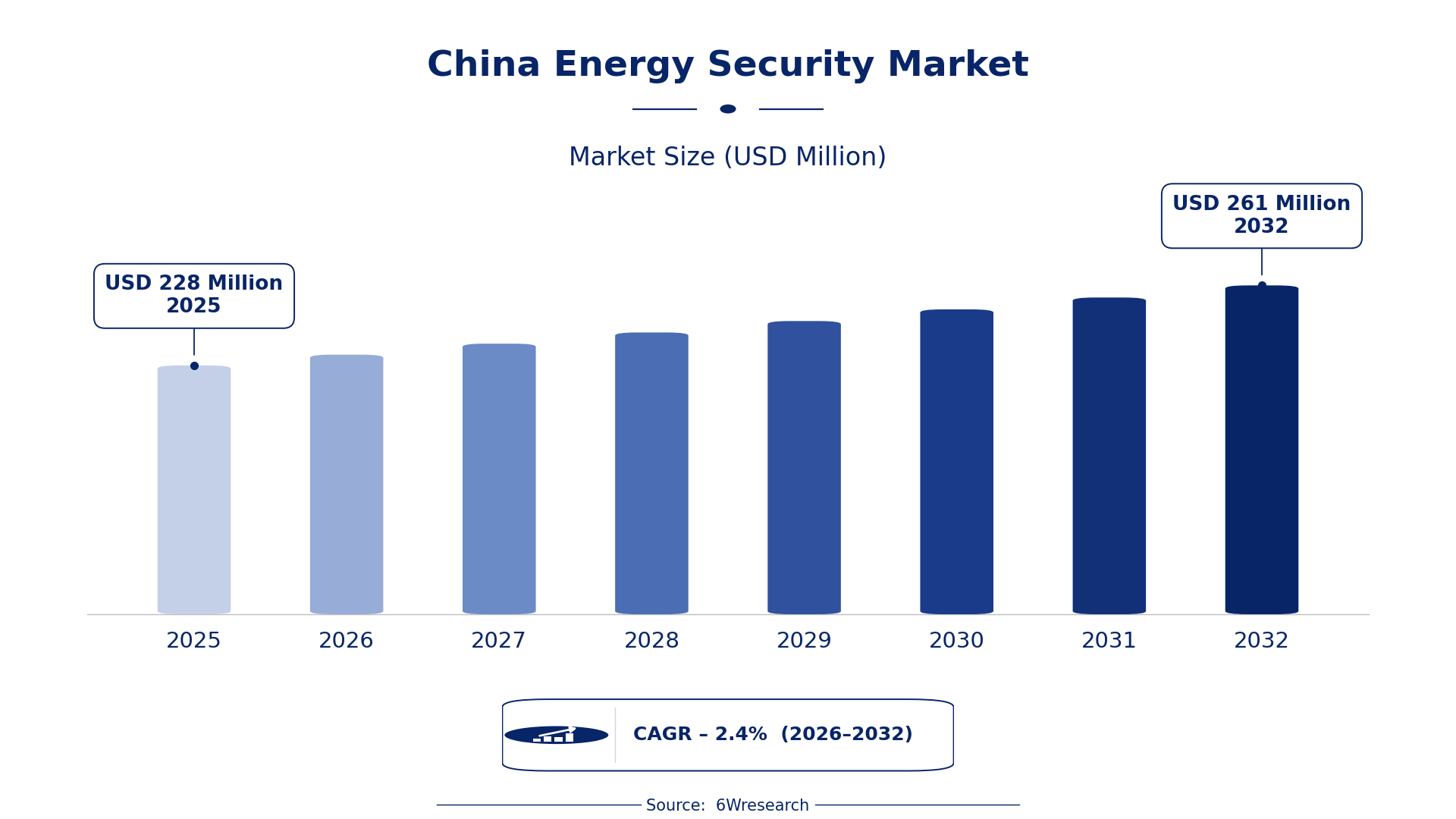
The China Energy Security Market was estimated at USD 228 Million in 2025 and is projected to reach USD 261 Million by 2032, growing at a CAGR of 2.4% from 2026 to 2032.
China Energy Security Market Synopsis
China's energy security market is navigating through a critical phase marked by its ambitious energy consumption targets. The country is aggressively working towards enhancing its energy independence by diversifying its energy supply and focusing on domestic production to alleviate reliance on imports.
This market is not only shaped by its heavy investments in renewable energy—particularly wind and solar—but also by governmental policies that promote energy efficiency and technological advancements. The combination of these factors is steering China toward a sustainable energy future while addressing pressing environmental concerns.
China Energy Security Market Year-wise Growth Rate and Key Drivers
This graph illustrates the annual growth rates of the China Energy Security Market from 2021 to 2032, highlighting a steady upward trajectory and projected expansion over the forecast period.
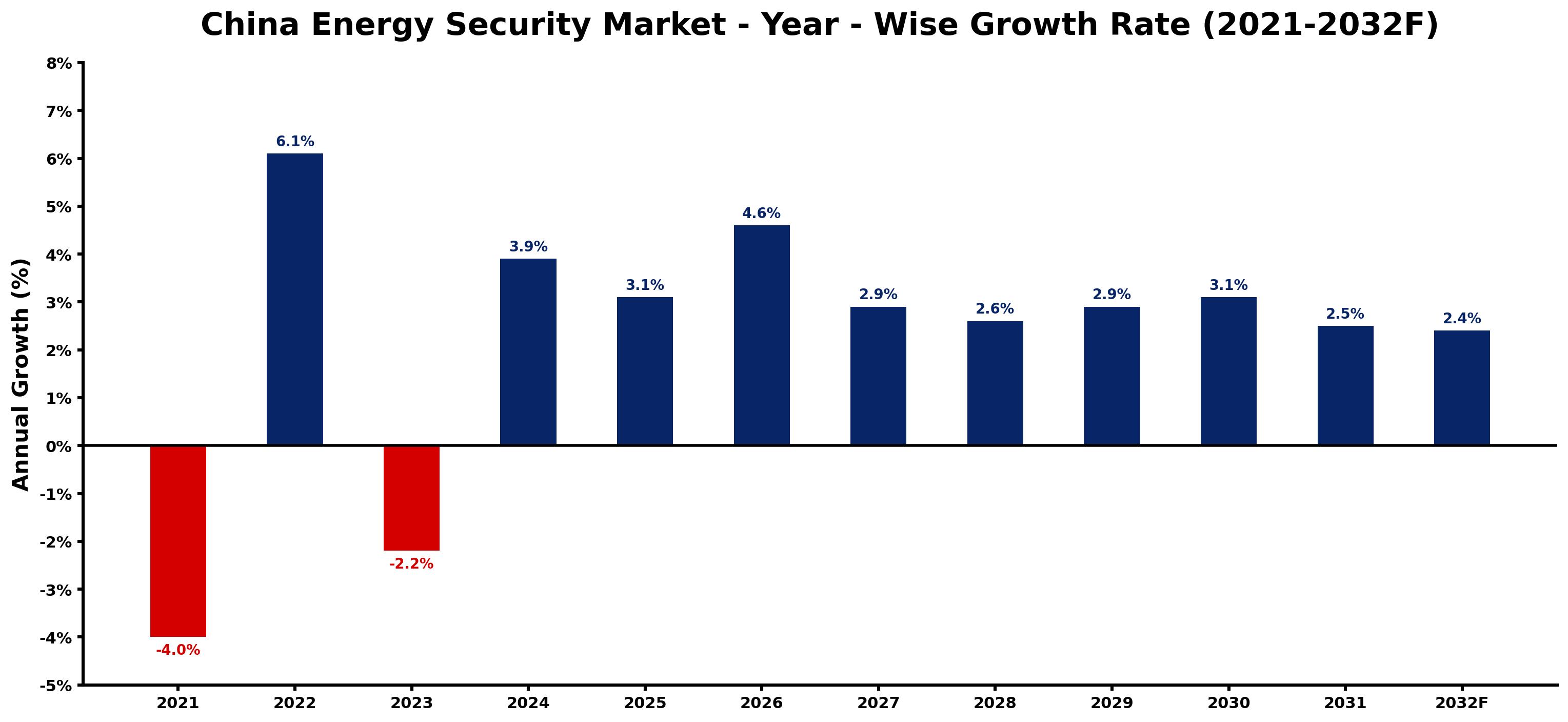
The table below presents the year‑wise growth rates along with the key drivers influencing the market
| Year | Growth Rate | Major Drivers |
| 2021 | -4.0% | Delayed approval of renewable energy projects by NDRC |
| 2022 | 6.1% | Strengthening of energy security policies by NEA |
| 2023 | -2.2% | Increased coal dependency amid global energy crisis |
| 2024 | 3.9% | Increased investment in domestic renewable energy projects |
| 2025 | 3.1% | Focus on carbon neutrality commitments driving innovation |
| 2026 | 4.6% | Collaboration with Belt and Road Initiative in energy |
| 2027 | 2.9% | Enhanced cybersecurity regulations for energy infrastructure |
| 2028 | 2.6% | Tax incentives for renewable energy technology adoption |
| 2029 | 2.9% | Investment in grid modernization to reduce energy loss |
| 2030 | 3.1% | Launch of national energy efficiency improvement programs |
| 2031 | 2.5% | Implementation of strict energy management standards nationwide |
| 2032 | 2.4% | Government focus on diversifying energy sources for stability |
Note: Market size estimations and growth projections presented in this report are based on 6Wresearch's proprietary forecasting methodology, utilizing the latest available industry data, government publications, and primary research inputs.
China Energy Security Market Key Takeaways
Below are some of the specific key takeaways from the market, including:
- The market is transitioning from a heavy reliance on coal to a more balanced energy mix.
- Investment in renewable energy sources like solar and wind is significantly increasing.
- Government policies focus on reducing carbon emissions and enhancing energy efficiency.
- Challenges include high pollution levels and infrastructural pressures due to rapid urbanization.
- Investment opportunities are emerging in energy storage and electric vehicle infrastructure.
Evaluation of Restraints in China Energy Security Market
A core restraint in the China Energy Security Market is its historical reliance on coal for energy generation. This dependence has led to severe environmental consequences, complicating the shift toward cleaner energy. Compounded by rapid economic growth and urbanization, energy demands are skyrocketing, straining existing resources and infrastructure.
on top of that, the market's lack of diversity in energy sources, especially with regards to oil and gas imports, poses significant risks. Geopolitical tensions further amplify these concerns, making it imperative for China to strengthen its domestic energy capabilities while pursuing international partnerships.
China Energy Security Market Trends
A noticeable trend in this market is the increasing investment in renewable energy technologies. The government's strong emphasis on wind and solar energy not only aims to cut down reliance on fossil fuels but also aligns with global climate change initiatives. The expansion of domestic oil and gas production capabilities through advanced exploration technologies is another critical trend.
on top of that, electric vehicles are gaining traction, supported by incentives that encourage their adoption. With these initiatives, the sector is witnessing a shift toward a more diversified and sustainable energy model that mitigates environmental impacts while ensuring energy security.
China Energy Security Market Opportunities
The current investment climate in the China Energy Security Market is ripe with opportunities. Growth in renewable energy sectors presents a lucrative avenue for investors, particularly in solar and wind energy projects. The nuclear energy segment is also gaining attention as it offers a way to meet soaring energy demands with lower emissions.
Advancements in energy storage technologies and the development of smart grid systems can further enhance energy efficiency. The growth of electric vehicle infrastructure, including charging stations and battery production, stands out as a promising investment area as China aims for greener transportation solutions.
Government Initiatives in the China Energy Security Market
The Chinese government is actively shaping the energy security market through a series of targeted initiatives. This regulatory framework focuses on promoting domestic energy resources and increasing the share of renewables in the energy mix. With a strategic emphasis on technology and infrastructure investments, these policies aim to ensure a sustainable energy future for the nation.
- A regulatory framework introduced in 2025 mandating emissions reductions across major industries.
- A national renewable energy development initiative that began in early 2025 and remains underway, enhancing solar and wind capacity.
- A planned public-private partnership expected to launch by mid-2026 to bolster electric vehicle infrastructure.
- Ongoing investments in energy efficiency programs aimed at retrofitting existing power plants to reduce coal dependency.
- A comprehensive strategy initiated in late 2024 to explore alternative energy partnerships with neighboring countries.
Future Insights of the China Energy Security Market
Looking ahead to 2026-2032, the China Energy Security Market is expected to see sustained growth driven by a commitment to diversifying energy sources and advancing technology. The focus on renewables will continue to intensify, potentially reshaping the energy mix. As domestic production capacity expands and technologies improve, energy efficiency will also see considerable gains, securing a more sustainable energy framework for the future.
China Energy Security Market Latest Developments
In the past year, the China Energy Security Market has witnessed significant activity, underscoring its shift towards sustainability and efficiency. The landscape is shifting rapidly, with technological advancements and policy changes spearheading the charge towards a greener energy future.
- A major renewable energy project was launched in Q1 2025, aimed at boosting wind and solar capacity in coastal regions.
- An initiative that began in mid-2025 and remains underway focuses on improving energy storage systems to enhance grid reliability.
- A public-private investment framework aimed at electric vehicle infrastructure is expected to begin rolling out in late 2025.
- A pilot program initiated in early 2025 is exploring geothermal energy solutions in underutilized areas of China.
- A recent partnership between the government and technology firms has been announced, focused on advancing smart grid applications by 2026.
China Energy Security Market - Key Attractiveness of the Report
- 10 Years of Market Numbers
- Historical Data Starting from 2022 to 2025
- Base Year: 2025
- Forecast Data until 2032
- Key Performance Indicators Impacting the Market
- Major Upcoming Developments and Projects
Key Highlights of the Report:
- China Energy Security Market Outlook
- Market Size of China Energy Security Market, 2025
- Forecast of China Energy Security Market, 2032
- Historical Data and Forecast of China Energy Security Revenues & Volume for the Period 2022-2032F
- China Energy Security Market Trend Evolution
- China Energy Security Market Drivers and Challenges
- China Energy Security Price Trends
- China Energy Security Porter's Five Forces
- China Energy Security Industry Life Cycle
- Historical Data and Forecast of China Energy Security Market Revenues & Volume By Power Plants for the Period 2022-2032F
- Historical Data and Forecast of China Energy Security Market Revenues & Volume By Nuclear for the Period 2022-2032F
- Historical Data and Forecast of China Energy Security Market Revenues & Volume By Thermal for the Period 2022-2032F
- Historical Data and Forecast of China Energy Security Market Revenues & Volume By Hydro for the Period 2022-2032F
- Historical Data and Forecast of China Energy Security Market Revenues & Volume By Oil for the Period 2022-2032F
- Historical Data and Forecast of China Energy Security Market Revenues & Volume By Gas for the Period 2022-2032F
- Historical Data and Forecast of China Energy Security Market Revenues & Volume By Renewable Energy for the Period 2022-2032F
- Historical Data and Forecast of China Energy Security Market Revenues & Volume By Technologies for the Period 2022-2032F
- Historical Data and Forecast of China Energy Security Market Revenues & Volume By Physical for the Period 2022-2032F
- Historical Data and Forecast of China Energy Security Market Revenues & Volume By Network Security for the Period 2022-2032F
- China Energy Security Import Export Trade Statistics
- Market Opportunity Assessment By Power Plants
- Market Opportunity Assessment By Technologies
- China Energy Security Top Companies Market Share
- China Energy Security Competitive Benchmarking By Technical and Operational Parameters
- China Energy Security Company Profiles
- China Energy Security Key Strategic Recommendations






































