China Epdm Rubber Market Top 5 Importing Countries and Market Competition (HHI) Analysis
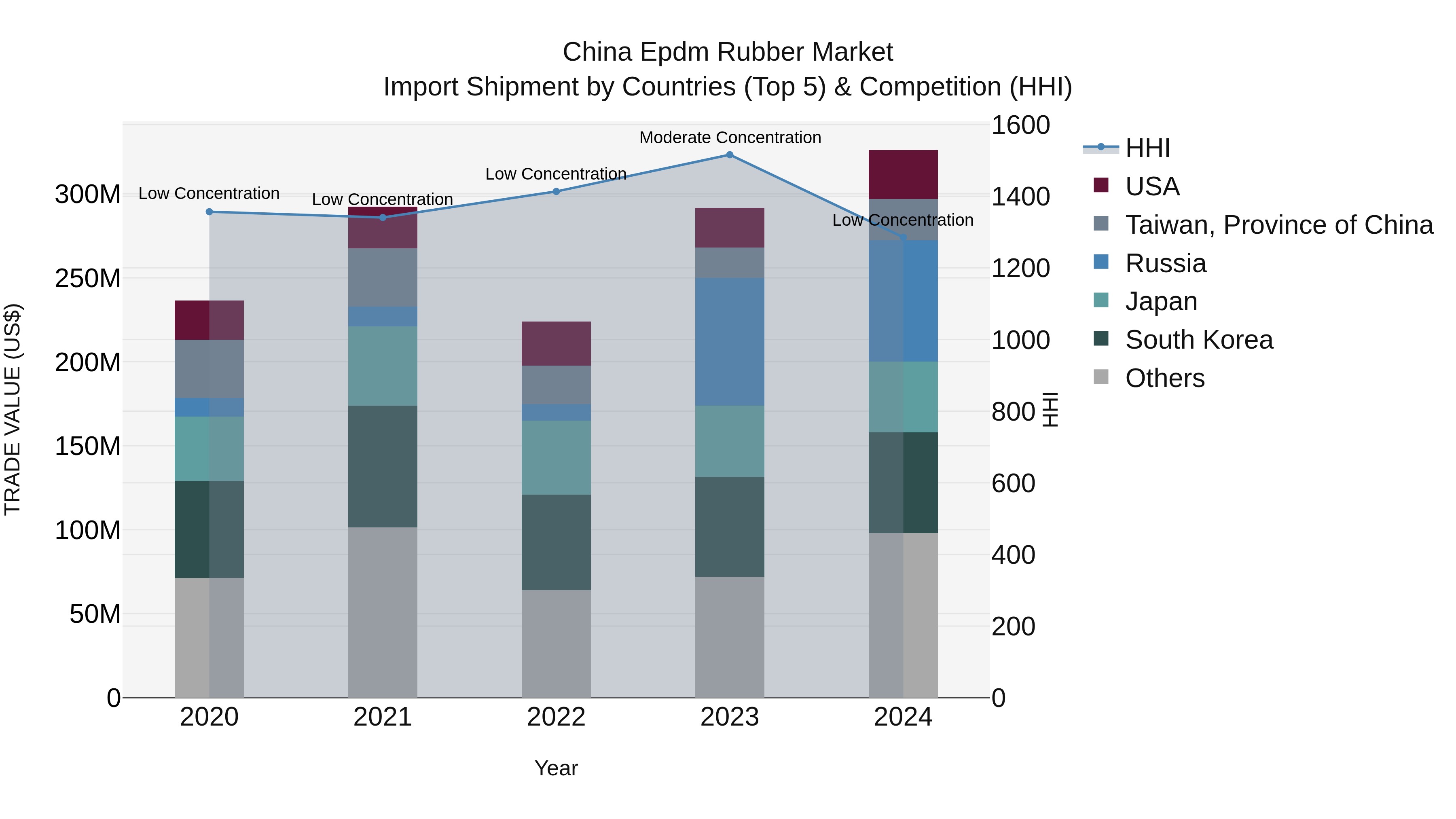
China import shipments of EPDM rubber in 2024 saw a notable increase in diversity, with top exporting countries including Russia, South Korea, Japan, USA, and Taiwan, Province of China. The market exhibited a shift from moderate to low concentration, indicating a more balanced distribution among suppliers. With a strong compound annual growth rate of 8.37% from 2020 to 2024 and a growth rate of 11.76% in 2024 alone, the EPDM rubber market in China continues to show promising expansion and opportunities for both domestic and international suppliers.
China EPDM Rubber Market Synopsis
The China EPDM rubber market is witnessing steady growth driven by the expanding automotive, construction, and electrical industries. EPDM rubber is favored for its excellent weather resistance, heat resistance, and electrical insulation properties, making it a popular choice for various applications such as automotive seals, weather-stripping, roofing membranes, and wire insulations. The increasing demand for EPDM rubber in end-use industries, coupled with the growing emphasis on energy efficiency and sustainability, is expected to further boost market growth. Key players in the China EPDM rubber market include Sinopec, ExxonMobil, LANXESS, and Mitsui Chemicals. However, challenges such as fluctuating raw material prices and environmental regulations may impact market dynamics in the coming years. Overall, the China EPDM rubber market is poised for significant growth opportunities driven by expanding industrial sectors and technological advancements.
China EPDM Rubber Market Trends
The China EPDM rubber market is experiencing growth due to increasing demand from industries such as automotive, construction, and electronics. The shift towards eco-friendly and sustainable products is driving the demand for EPDM rubber, which is known for its durability and resistance to weathering and chemicals. With the government`s focus on infrastructure development and the automotive sector`s expansion, there are ample opportunities for EPDM rubber manufacturers to capitalize on. Additionally, the growing trend of electric vehicles in China presents a new avenue for EPDM rubber usage in battery components and sealing applications. Overall, the China EPDM rubber market is poised for steady growth, with opportunities for innovation and partnerships to meet the evolving demands of various industries.
China EPDM Rubber Market Challenges
In the China EPDM rubber market, one of the key challenges faced is the increasing competition from lower-cost suppliers in other regions. This has put pressure on Chinese manufacturers to maintain competitive pricing while ensuring product quality and reliability. Additionally, fluctuations in raw material prices, such as ethylene and propylene, can impact production costs and ultimately affect pricing strategies in the market. Furthermore, regulatory changes and environmental concerns regarding the production processes of EPDM rubber in China also present challenges for manufacturers in complying with stricter standards while remaining cost-effective. Overall, navigating these challenges requires companies in the China EPDM rubber market to continuously innovate, optimize operational efficiencies, and adapt to evolving market dynamics to maintain a competitive edge.
China EPDM Rubber Market Investment Opportunities
The China EPDM rubber market is being primarily driven by the increasing demand from the automotive industry for use in manufacturing weatherstripping, hoses, and seals due to its excellent weather resistance and durability. Additionally, the construction industry`s rapid growth in the country is contributing to the market expansion as EPDM rubber is used in roofing membranes, gaskets, and insulation materials. The rising focus on renewable energy sources like solar power is also boosting the demand for EPDM rubber for solar panel installations. Furthermore, the government`s initiatives to promote sustainable development and environmentally friendly practices are encouraging the adoption of EPDM rubber in various applications, driving the market growth in China.
China EPDM Rubber Market Government Polices
The Chinese government has implemented various policies impacting the EPDM rubber market, such as promoting energy conservation, environmental protection, and industrial upgrading to support sustainable development. In recent years, there has been a focus on tightening environmental regulations and enforcing stricter quality standards for EPDM rubber production to reduce pollution and improve product quality. Additionally, initiatives to strengthen intellectual property rights protection and enhance innovation capabilities in the industry have been introduced to drive technological advancements and competitiveness. The government`s emphasis on fostering a more efficient and environmentally friendly EPDM rubber sector through policy measures is expected to shape the market landscape and drive sustainable growth in the future.
China EPDM Rubber Market Future Outlook
The future outlook for the China EPDM rubber market appears promising, driven by factors such as increasing demand from industries like automotive, construction, and electrical, along with the growth in end-use applications like automotive hoses, gaskets, and roofing materials. The market is expected to witness steady growth due to infrastructural developments and the demand for durable and weather-resistant materials. Additionally, the focus on sustainable and eco-friendly products is likely to propel the adoption of EPDM rubber in various applications. With the Chinese government`s initiatives to promote domestic manufacturing and innovation, coupled with the expanding automotive and construction sectors in the region, the China EPDM rubber market is anticipated to experience sustained growth in the coming years.
Key Highlights of the Report:
- China EPDM Rubber Market Outlook
- Market Size of China EPDM Rubber Market, 2024
- Forecast of China EPDM Rubber Market, 2031
- Historical Data and Forecast of China EPDM Rubber Revenues & Volume for the Period 2021- 2031
- China EPDM Rubber Market Trend Evolution
- China EPDM Rubber Market Drivers and Challenges
- China EPDM Rubber Price Trends
- China EPDM Rubber Porter's Five Forces
- China EPDM Rubber Industry Life Cycle
- Historical Data and Forecast of China EPDM Rubber Market Revenues & Volume By Type for the Period 2021- 2031
- Historical Data and Forecast of China EPDM Rubber Market Revenues & Volume By Solution Polymerization for the Period 2021- 2031
- Historical Data and Forecast of China EPDM Rubber Market Revenues & Volume By Suspension Polymerization for the Period 2021- 2031
- Historical Data and Forecast of China EPDM Rubber Market Revenues & Volume By Product for the Period 2021- 2031
- Historical Data and Forecast of China EPDM Rubber Market Revenues & Volume By Compressor Grommet for the Period 2021- 2031
- Historical Data and Forecast of China EPDM Rubber Market Revenues & Volume By Electrical Insulation & Stinger Covers for the Period 2021- 2031
- Historical Data and Forecast of China EPDM Rubber Market Revenues & Volume By Belts for the Period 2021- 2031
- Historical Data and Forecast of China EPDM Rubber Market Revenues & Volume By seals for the Period 2021- 2031
- Historical Data and Forecast of China EPDM Rubber Market Revenues & Volume By Others for the Period 2021- 2031
- Historical Data and Forecast of China EPDM Rubber Market Revenues & Volume By Industry Vertical for the Period 2021- 2031
- Historical Data and Forecast of China EPDM Rubber Market Revenues & Volume By Automotive for the Period 2021- 2031
- Historical Data and Forecast of China EPDM Rubber Market Revenues & Volume By Building & Construction for the Period 2021- 2031
- Historical Data and Forecast of China EPDM Rubber Market Revenues & Volume By Chemical for the Period 2021- 2031
- Historical Data and Forecast of China EPDM Rubber Market Revenues & Volume By Others for the Period 2021- 2031
- China EPDM Rubber Import Export Trade Statistics
- Market Opportunity Assessment By Type
- Market Opportunity Assessment By Product
- Market Opportunity Assessment By Industry Vertical
- China EPDM Rubber Top Companies Market Share
- China EPDM Rubber Competitive Benchmarking By Technical and Operational Parameters
- China EPDM Rubber Company Profiles
- China EPDM Rubber Key Strategic Recommendations






































