China Food & Grocery Retail Market Size, Share & Growth Rate
The China Food & Grocery Retail Market was estimated at USD 152 Million in 2025 and is projected to reach USD 202 Million by 2032, growing at a CAGR of 4.1% from 2026 to 2032. This upward trajectory can be attributed to the dual forces of urbanization and increasing disposable incomes, which are reshaping consumer buying patterns. As e-commerce continues to expand its footprint, more consumers are opting for the convenience of online grocery shopping, further solidifying this market's robust growth.
China Food & Grocery Retail Market Year-wise Growth Rate and Key Drivers
This graph highlights how the China Food & Grocery Retail Market has steadily grown over the years, supported by major growth factors.
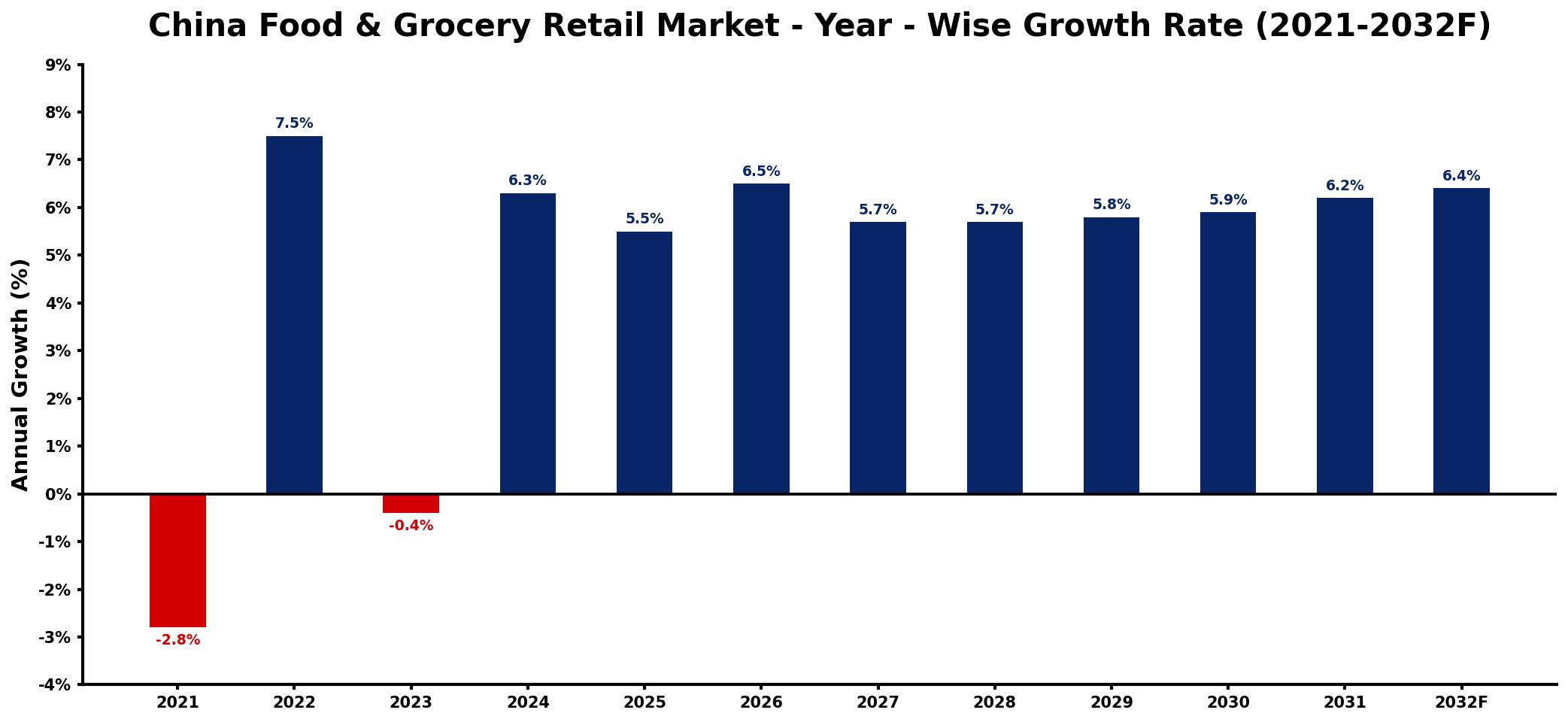
The table below presents the year‑wise growth rates along with the key drivers influencing the market
| Year | Growth Rate | Major Drivers |
| 2021 | -2.8% | decrease in consumer spending habits |
| 2022 | 7.5% | rise in online shopping convenience |
| 2023 | -0.4% | fall in disposable income levels |
| 2024 | 6.3% | growth in health consciousness trends |
| 2025 | 5.5% | increase in sustainable sourcing practices |
| 2026 | 6.5% | expansion of delivery service options |
| 2027 | 5.7% | development of local sourcing initiatives |
| 2028 | 5.7% | enhancement of customer loyalty programs |
| 2029 | 5.8% | broadening of product variety availability |
| 2030 | 5.9% | strengthening of community engagement efforts |
| 2031 | 6.2% | innovation in packaging technologies |
| 2032 | 6.4% | improvement in supply chain efficiency |
Note: Market size estimations and growth projections presented in this report are based on 6Wresearch's proprietary forecasting methodology, utilizing the latest available industry data, government publications, and primary research inputs.
China Food & Grocery Retail Market Synopsis
The recent momentum in the China Food & Grocery Retail Market reflects a vibrant shift towards online and omnichannel shopping experiences, fueled by a digitally-savvy consumer base eager for convenience. However, as we look to the future, the market is expected to evolve further, influenced by health trends and sustainability concerns that will dictate product offerings and shopping experiences.
While traditional supermarkets and hypermarkets continue to play significant roles, the landscape is increasingly dominated by e-commerce platforms, revolutionizing how consumers approach grocery shopping. This dynamic is indicative of a broader shift, where convenience and quality are paramount in consumer decisions, paving the way for innovative strategies among retailers.
- The market is poised for steady growth, reflecting rising disposable incomes and urbanization.
- E-commerce has transformed consumer preferences, driving demand for online grocery shopping.
- Health and wellness trends are increasingly influencing purchasing decisions.
- Intense competition persists among domestic and international players.
- Government policies are shaping market dynamics, promoting sustainability and food safety.
Despite its growth potential, the China Food & Grocery Retail Market faces notable restraints. The competitive landscape is fierce, with both local and international players vying for market share, leading to price wars and pressure on profit margins. Rapidly evolving consumer behaviors necessitate constant adaptation, leaving retailers scrambling to align their strategies with changing preferences. Additionally, challenges related to supply chain management, food safety, and compliance with increasingly stringent regulatory frameworks present further hurdles that businesses must navigate to succeed.
Current trends within the China Food & Grocery Retail Market highlight a significant pivot towards online and omnichannel retailing, as consumers increasingly favor the convenience of home delivery and click-and-collect options. The rise of e-commerce giants has facilitated this transformation, enabling rapid and efficient logistics solutions. Moreover, there is a palpable shift towards premium and imported food products, reflecting a growing appetite among consumers for diverse and high-quality culinary experiences. Sustainability has also emerged as a critical focus, with many retailers striving to offer organic and environmentally friendly options to appeal to health-conscious shoppers.
As the China Food & Grocery Retail Market matures, various investment opportunities are becoming evident. The burgeoning demand for high-quality and imported food items presents significant potential for retailers that can adapt their offerings accordingly. The ongoing shift toward online grocery shopping invites investment in e-commerce platforms and digital logistics solutions, which can enhance operational efficiencies. Furthermore, urban expansion is catalyzing the growth of convenience store chains, presenting lucrative avenues for strategic investments.
The Chinese government has enacted several policies aimed at regulating the food and grocery retail sector, emphasizing food safety and consumer protection. Initiatives like the Food Safety Law establish stringent standards for food production and distribution, ensuring that public health remains a priority. Additionally, the government is advancing sustainable development through strategies such as the Rural Revitalization Strategy, which seeks to enhance agricultural efficiency and improve supply chain integrity. Furthermore, policies encouraging foreign investment are shaping a more open and competitive environment for retailers.
Looking ahead to the 2026-2032 period, the outlook for the China Food & Grocery Retail Market is markedly optimistic. Factors such as urbanization, rising incomes, and a heightened demand for convenience will continue to drive market growth. E-commerce is anticipated to evolve, offering increasingly sophisticated shopping experiences tailored to consumer preferences. Moreover, the focus on food quality and safety will spur innovation, compelling retailers to invest in state-of-the-art technologies and sustainable practices. Overall, the market is set for transformation, with myriad opportunities for both local and international players.
In recent months, the China Food & Grocery Retail Market has witnessed a surge in investments in logistics technologies to enhance supply chain efficiencies. Many retailers are also exploring partnerships with technology firms to integrate AI-driven solutions for personalized shopping experiences. There is also a noticeable trend towards expanding offerings in organic and health-focused products, aligning with evolving consumer preferences. Furthermore, e-commerce platforms continue to innovate in delivery models, aiming to minimize wait times and enhance customer satisfaction.
- 10 Years of Market Numbers
- Historical Data Starting from 2022 to 2025
- Base Year: 2025
- Forecast Data until 2032
- Key Performance Indicators Impacting the Market
- Major Upcoming Developments and Projects
Key Highlights of the Report:
- China Food & Grocery Retail Market Outlook
- Market Size of China Food & Grocery Retail Market, 2025
- Forecast of China Food & Grocery Retail Market, 2032
- Historical Data and Forecast of China Food & Grocery Retail Revenues & Volume for the Period 2022-2032F
- China Food & Grocery Retail Market Trend Evolution
- China Food & Grocery Retail Market Drivers and Challenges
- China Food & Grocery Retail Price Trends
- China Food & Grocery Retail Porter's Five Forces
- China Food & Grocery Retail Industry Life Cycle
- Historical Data and Forecast of China Food & Grocery Retail Market Revenues & Volume By Product for the Period 2022-2032F
- Historical Data and Forecast of China Food & Grocery Retail Market Revenues & Volume By Fresh Food for the Period 2022-2032F
- Historical Data and Forecast of China Food & Grocery Retail Market Revenues & Volume By Frozen Food for the Period 2022-2032F
- Historical Data and Forecast of China Food & Grocery Retail Market Revenues & Volume By Food Cupboard for the Period 2022-2032F
- Historical Data and Forecast of China Food & Grocery Retail Market Revenues & Volume By Beverages for the Period 2022-2032F
- Historical Data and Forecast of China Food & Grocery Retail Market Revenues & Volume By Cleaning & Household for the Period 2022-2032F
- Historical Data and Forecast of China Food & Grocery Retail Market Revenues & Volume By Others for the Period 2022-2032F
- Historical Data and Forecast of China Food & Grocery Retail Market Revenues & Volume By Distribution Channel for the Period 2022-2032F
- Historical Data and Forecast of China Food & Grocery Retail Market Revenues & Volume By Supermarkets & Hypermarkets for the Period 2022-2032F
- Historical Data and Forecast of China Food & Grocery Retail Market Revenues & Volume By Convenience Stores for the Period 2022-2032F
- Historical Data and Forecast of China Food & Grocery Retail Market Revenues & Volume By Departmental Stores & Clubs for the Period 2022-2032F
- Historical Data and Forecast of China Food & Grocery Retail Market Revenues & Volume By Online for the Period 2022-2032F
- China Food & Grocery Retail Import Export Trade Statistics
- Market Opportunity Assessment By Product
- Market Opportunity Assessment By Distribution Channel
- China Food & Grocery Retail Top Companies Market Share
- China Food & Grocery Retail Competitive Benchmarking By Technical and Operational Parameters
- China Food & Grocery Retail Company Profiles
- China Food & Grocery Retail Key Strategic Recommendations






































