China Food Retail Market Summary
The china food retail market was estimated at USD 423 Million in 2025 and is projected to reach USD 565 Million by 2032, growing at a CAGR of 6.5% from 2026 to 2032.
China Food Retail Market Year-wise Growth Rate and Key Drivers
This graph highlights how the China Food Retail Market has steadily grown over the past five years, supported by major growth factors.
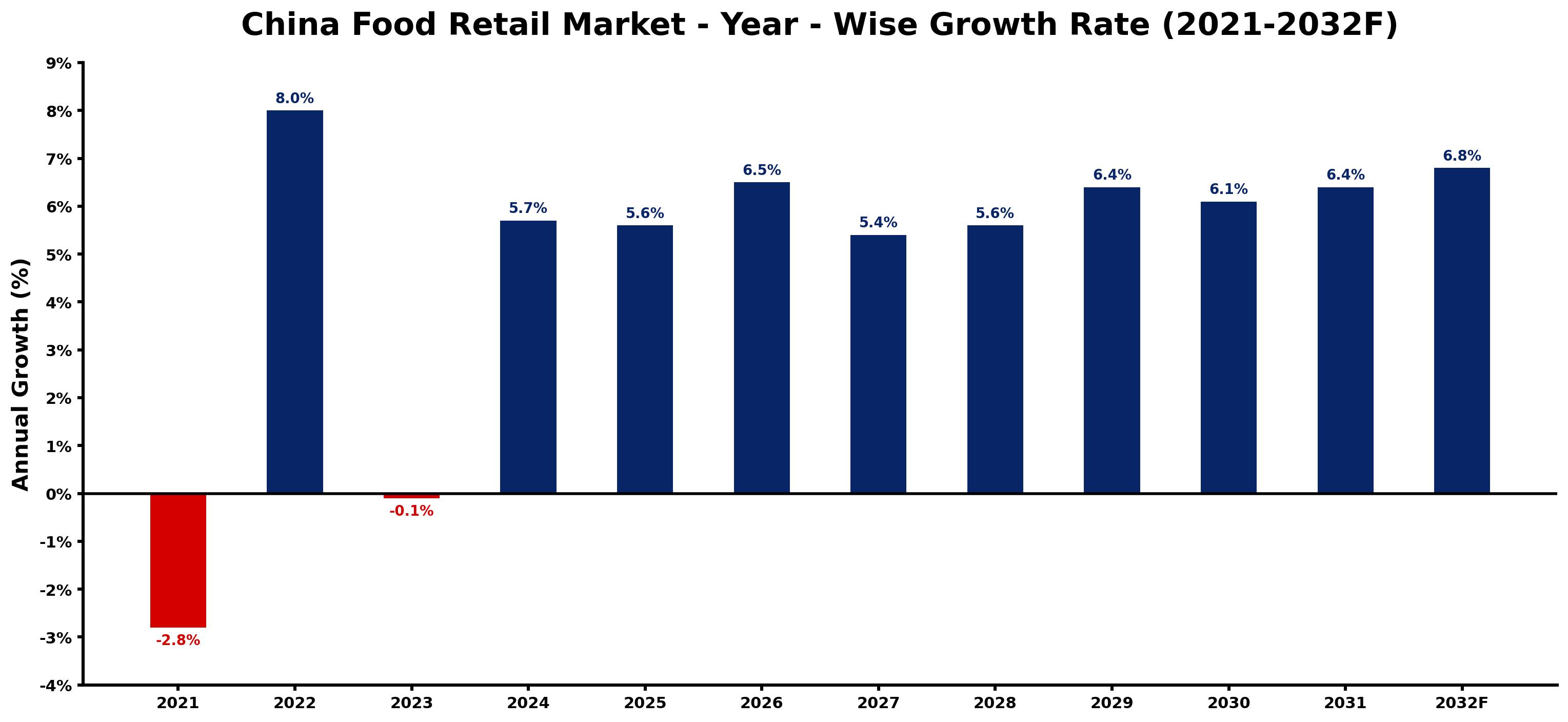
The table below presents the year wise growth rates along with the key drivers influencing the market
| Year | Growth Rate | Major Drivers |
| 2021 | -2.8% | Pandemicrelated supply chain disruptions limited product availability, leading to diminished consumer access and reduced sales. |
| 2022 | 8.0% | Consumers increasingly preferred online grocery shopping, reshaping traditional retail landscapes. |
| 2023 | -0.1% | Lingering supply chain disruptions led to product shortages, diminishing consumer access and overall market vitality. |
| 2024 | 5.7% | Rapid urbanization demanded larger supermarkets and hypermarkets in growing cities. |
| 2025 | 5.6% | Health-conscious trends prompted an uptick in organic and natural food offerings. |
| 2026 | 6.5% | Technology integration streamlined operations, improving supply chain efficiencies significantly. |
| 2027 | 5.4% | Competitive pricing strategies emerged as retailers sought to attract budget-conscious shoppers. |
| 2028 | 5.6% | Sustainability commitments led to eco-friendly packaging becoming a market expectation. |
| 2029 | 6.4% | Digital payment systems flourished, creating seamless shopping experiences for consumers. |
| 2030 | 6.1% | Cross-border e-commerce expanded food options, catering to diverse consumer preferences. |
| 2031 | 6.4% | Consumer awareness of food safety intensified, influencing purchasing decisions profoundly. |
| 2032 | 6.8% | Innovative loyalty programs emerged, significantly enhancing customer retention across retail chains. |
Note - Market size estimations and growth projections presented in this report are based on 6Wresearch's advanced forecasting approach, validated with industry datasets as of June 2026.
China Food Retail Market Synopsis
The China Food Retail Market is projected to reach 6.5% and witness significant growth during the forecast period (2026-2032). This sector stands as one of the largest and most vibrant globally, spurred by an expanding population, increasing disposable incomes, and a notable shift in consumer preferences towards convenience and quality. The market landscape is defined by a diverse range of retail formats, including traditional grocery stores, supermarkets, hypermarkets, convenience stores, and a rapidly growing online shopping segment.
China Food Retail Market Trends and Opportunities
The China Food Retail Market is currently shaped by various trends that signify transformative opportunities for stakeholders. A key development is the escalating demand for online grocery shopping and food delivery services. This trend is primarily driven by the convenience they provide to consumers, who increasingly favor digital platforms over conventional shopping options. Furthermore, a growing interest in healthy and organic food products is evident, as consumers become more health-conscious, opting for higher quality and nutritious options.
The market is also experiencing a notable inclination towards imported and foreign food brands, especially among urban dwellers seeking unique culinary experiences. Another significant trend is the emergence of small-format stores and convenience outlets, which cater to the fast-paced lifestyles prevalent in urban centers. These shifts indicate that the China Food Retail Market is evolving to meet the dynamic needs of its consumers for variety, quality, and convenience.
China Food Retail Market Challenges and Restraints
Despite its robust growth potential, the China Food Retail Market grapples with a variety of challenges. Heightened competition from both domestic and international players necessitates continuous innovation and strategic differentiation. Consumer preferences are increasingly shifting toward healthier, high-quality food options, compelling retailers to adapt their offerings accordingly. Furthermore, compliance with stringent food safety regulations adds another layer of complexity that retailers must navigate.
Additionally, the rapid rise of e-commerce presents a significant challenge to traditional brick-and-mortar establishments. Retailers are under pressure to innovate and leverage technology to capture market share. Supply chain complexities also play a critical role, particularly regarding the need to maintain consistent quality and freshness in a globalized market. Successfully addressing these challenges requires agility, investment in technology, and a relentless focus on product quality and safety.
China Food Retail Market Investment Opportunities
The landscape within the China Food Retail Market is ripe with investment opportunities, driven by a burgeoning consumer base and an increasing appetite for high-quality food products. Significant potential lies in developing innovative e-commerce platforms that cater to the growing trend of online grocery shopping, as more consumers embrace digital avenues for their retail needs.
Investing in premium and imported food products presents another lucrative area, as Chinese consumers are willing to pay a premium for healthier and higher-quality options. Additionally, exploring investments in sustainable practices and innovative food technologies aligns with the growing consumer trend towards environmental awareness and sustainability. Overall, the evolving preferences of Chinese consumers create a spectrum of opportunities for investors to harness within this diverse and dynamic market.
China Food Retail Market Government Investment and Initiatives
The Chinese government plays a pivotal role in shaping the food retail market through various policies and initiatives aimed at ensuring food safety and promoting healthy eating practices. Regulatory frameworks focus on food safety laws, labeling requirements, and quality standards designed to protect consumers and maintain market integrity. In recent years, the government has actively encouraged the development of e-commerce platforms and online food delivery services, providing favorable policies and incentives to enhance competitiveness.
Additionally, initiatives to bolster domestic agricultural production through subsidies and investment programs further illustrate the government's commitment to enhancing the food supply chain. The integration of these measures is indicative of a focused effort to ensure that the food retail sector remains robust, safe, and capable of meeting the evolving demands of consumers.
China Food Retail Market Latest Developments (May 2025 - June 2026)
In the period from May 2025 to June 2026, the China Food Retail Market saw several noteworthy developments that signal a transformative direction for the industry. The growth of online grocery shopping accelerated, with more brands and retailers investing in enhanced digital platforms to attract tech-savvy consumers. The rising demand for food delivery services also spurred innovation in logistics and supply chain management.
Amid increasing health awareness, retailers began to expand their range of organic and health-conscious food options, catering to a consumer base that is more discerning about nutritional offerings. Furthermore, a continued preference for premium imported food products highlighted a shift in consumer tastes towards quality and unique flavors.
Overall, the developments within this timeframe reflect a broader trend of retailers having to adapt swiftly to changing consumer behaviors, while also improving their technological capabilities to compete effectively in an increasingly digital landscape.
China Food Retail Market - Key Attractiveness of the Report
- 10 Years of Market Numbers
- Historical Data Starting from 2022 to 2025
- Base Year: 2025
- Forecast Data until 2032
- Key Performance Indicators Impacting the Market
- Major Upcoming Developments and Projects
Key Highlights of the Report:
- China Food Retail Market Outlook
- Market Size of China Food Retail Market, 2025
- Forecast of China Food Retail Market, 2032F
- Historical Data and Forecast of China Food Retail Revenues & Volume for the Period 2022-2032F
- China Food Retail Market Trend Evolution
- China Food Retail Market Drivers and Challenges
- China Food Retail Price Trends
- China Food Retail Porter's Five Forces
- China Food Retail Industry Life Cycle
- Historical Data and Forecast of China Food Retail Market Revenues & Volume By Product Types for the Period 2022-2032F
- Historical Data and Forecast of China Food Retail Market Revenues & Volume By Unpackaged Food for the Period 2022-2032F
- Historical Data and Forecast of China Food Retail Market Revenues & Volume By Packaged Food for the Period 2022-2032F
- Historical Data and Forecast of China Food Retail Market Revenues & Volume By Drinks for the Period 2022-2032F
- Historical Data and Forecast of China Food Retail Market Revenues & Volume By Household Products for the Period 2022-2032F
- Historical Data and Forecast of China Food Retail Market Revenues & Volume By Packaging Types for the Period 2022-2032F
- Historical Data and Forecast of China Food Retail Market Revenues & Volume By Boxes for the Period 2022-2032F
- Historical Data and Forecast of China Food Retail Market Revenues & Volume By Cans for the Period 2022-2032F
- Historical Data and Forecast of China Food Retail Market Revenues & Volume By Cellophane Wrapping for the Period 2022-2032F
- Historical Data and Forecast of China Food Retail Market Revenues & Volume By Cylindrical Cardboard for the Period 2022-2032F
- China Food Retail Import Export Trade Statistics
- Market Opportunity Assessment By Product Types
- Market Opportunity Assessment By Packaging Types
- China Food Retail Top Companies Market Share
- China Food Retail Competitive Benchmarking By Technical and Operational Parameters
- China Food Retail Company Profiles
- China Food Retail Key Strategic Recommendations






































