China Furniture Market Top 5 Importing Countries and Market Competition (HHI) Analysis
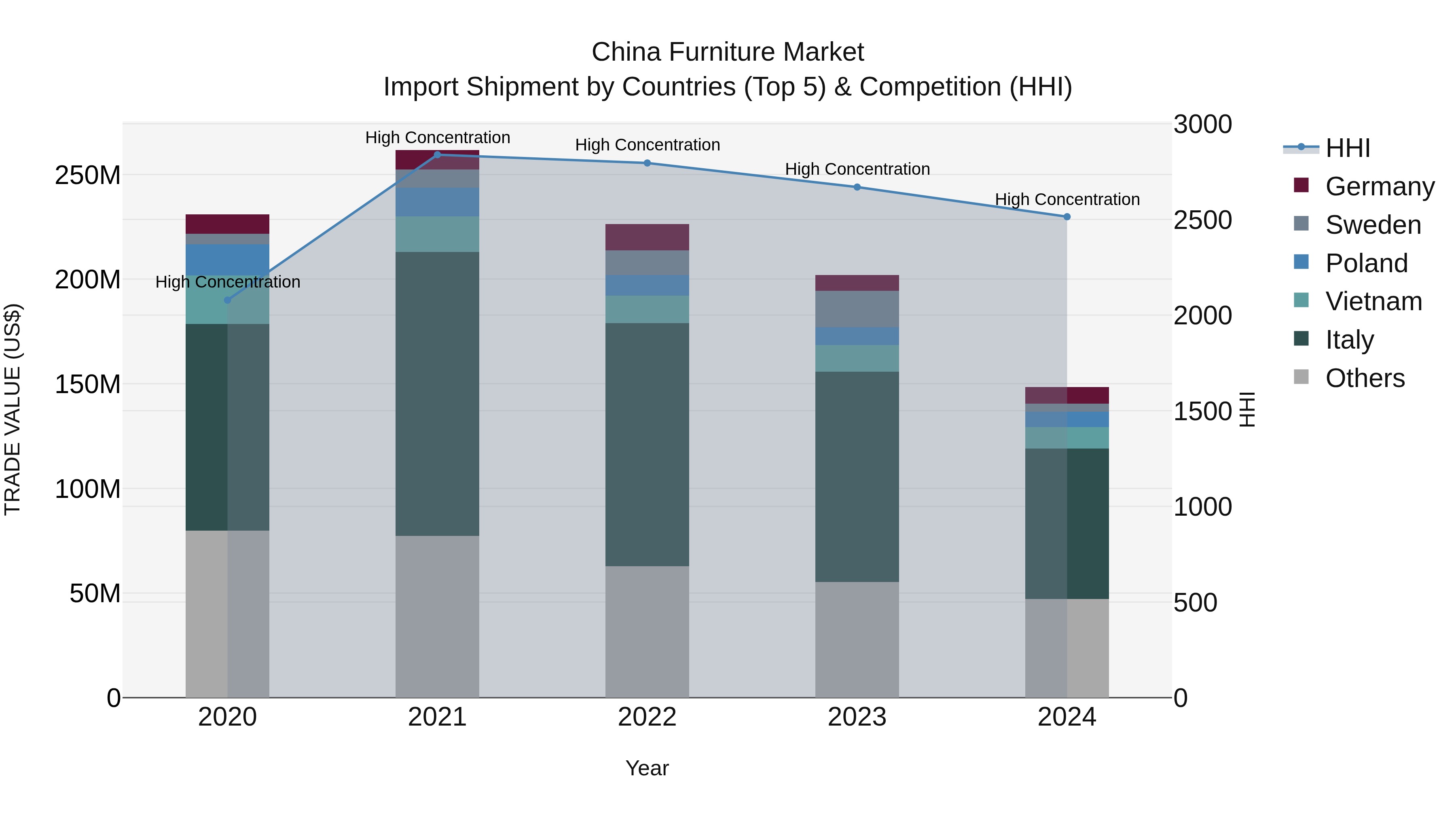
Despite the challenging market conditions, China continued to see a high concentration of furniture imports in 2024, with top exporters being Italy, Vietnam, Germany, Poland, and Japan. The negative CAGR of -10.48% from 2020 to 2024 reflects the impact of various factors on the industry. Moreover, the sharp decline in growth rate from 2023 to 2024 at -26.56% indicates ongoing challenges faced by the sector. It will be crucial for stakeholders to closely monitor market trends and adapt strategies to navigate the evolving landscape of furniture imports in China.
China Furniture Market Highlights
| Report Name | China Furniture Market |
| Forecast period | 2025-2031 |
| CAGR | 6.86% |
| Growing Sector | Residential |
Topics Covered in the China Furniture Market Report
The China Furniture Market report thoroughly covers the market by material types and applications. The report provides an unbiased and detailed analysis of ongoing market trends, opportunities/high-growth areas, and market drivers to help stakeholders align their strategies with current and future market dynamics. It also explores emerging technologies, organized vs. unorganized sector dynamics, and government-backed initiatives supporting the furniture industry in China.
China Furniture Market Synopsis
Heightened residential construction, and rising urbanization, has been driving the rapid growth of China furniture market. Growth in disposable income among the middle class is also a key driver of market expansion. Demand for multifunctional, ergonomic, and environmentally friendly furniture products is growing among users. In addition, distribution channels are shaped by app-based marketplaces and online retail platforms. This makes the furniture more accessible to urban and semi-urban populations. Market is further boosted by investments in modular designs, smart furniture solutions, and premium wooden furniture.
The China Furniture Market is projected to grow at a CAGR of 6.86% during 2025–2031. Major factors that drive the China furniture market include growth of the commercial sector and rising homeownership. The intense demand for customized and modular furniture solutions also fuels market growth. Market revenue is improved by the growth of the e-commerce ecosystem. Increasing awareness of sustainable materials, and entry of international furniture brands play a key role in market expansion. Government-backed programs encouraging urban housing development and green building certifications also drive the market in an upward trajectory.
China Furniture Market Challenges
Despite the potential for growth, the China furniture market encounters numerous obstacles. Major challenges include increasing labor costs, and uncertain prices of raw material. Stringent environmental standards regulating manufacturing also obstructs market expansion. Lack of access to financing, technology, and distribution networks is a critical challenge for small-scale producers, which affects competitiveness. Consumer worries associated with product durability and warranty services also impact market share. Imported furniture competition can hinder the enhancement of market revenue. In addition, urban space limitations need advanced design solutions, adding pressure on producers to constantly advance within the industry.
China Furniture Market Trends
The China furniture market is experiencing transformational trends. Key trends influencing the market include the growing adoption of sustainable and eco-friendly materials. Other recent trends are smart home-integrated products, and modular and multifunctional furniture designs. There is a rising popularity of app-based platforms and online retail. App-based platforms provide personalization choices and AI-based recommendation engines. The use of innovative production technologies such as CNC machining and automated assembly is increasing, which enhances manufacturing efficiency and product quality while tailoring according to demands for design, convenience, and sustainability among urban consumers.
Investment Opportunities in the China Furniture Market
The Chine furniture market offers numerous opportunities for growth. Promising investment prospects can be found in emerging modular and space-saving furniture. Some other opportunities for investment lie in premium wooden furniture, and commercial office solutions. App-based sales channels, e-commerce integration, and customized design services can be primary emphasis of market players. Partnerships with real estate developers, interior designers, and co-working space workers open new pathways for expansion. Investments in green manufacturing practices, sustainable materials can be beneficial for investors. Smart furniture technologies offer profitable prospects for both local and foreign investors seeking develop the China furniture market dynamics.
Leading players in the China Furniture Market:
Leading companies dominating the China furniture market include Herman Miller, Ashley Furniture, IKEA, and HNI Corporation. These players hold notable market share through e-commerce, retail, and customized solutions. Both local and international firms lead in the market. Prominent local companies include KUKA Home, Oppein Home Group, Sunon Group, and Markor Home Furnishings, specializing in residential, office, and modular furniture.
Government Regulations in the China Furniture Market
China furniture market is regulated by national standards related to quality, safety, and environmental compliance. Initiatives such as the Green Building Action Plan encourage the use of eco-friendly materials and energy-efficient manufacturing processes. Agencies monitor product certifications, fire safety standards, and emissions in factories. Government programs promoting urban housing, affordable residential projects, and support for SMEs in furniture manufacturing also facilitate industry growth. Regulatory policies increasingly favor sustainable practices, recycling, and resource-efficient production methods.
Future Insights of the China Furniture Market
The future of China furniture market seems romising. With shifting consumer preferences, increasing urbanization, the market is expected to grow rapidly. Technological innovations in manufacturing will also play a key role in fueling market expansion. The market will continue to experience the growing demand for ergonomic, modular, and sustainable furniture. Rise in e-commerce, smart home integration, and customization services will influence trends in the future. Market revenue will be driven by urban and semi-urban consumers seeking functional yet stylish furniture, alongside government-supported initiatives promoting green manufacturing and digital adoption within the industry.
Market Segmentation Analysis
The report offers a comprehensive study of the following market segments and their leading categories:
Wood to Dominate the Market – By Material Types
According to Adammya, Senior Research Analyst at 6Wresearch, Wood-based furniture dominates the market due to its durability, aesthetic appeal, and wide applications in residential and commercial settings. Rising demand for solid wood, engineered wood, and eco-certified wooden furniture drives revenue growth.
Residential to Dominate the Market – By Applications
The residential segment leads the China furniture market as increasing homeownership, urban apartment construction, and remodeling projects fuel demand. Popular categories include bedroom sets, living room furniture, dining tables, and storage solutions.
Key Attractiveness of the Report
- 10 Years of Market Numbers
- Historical Data: Starting from 2021 to 2024
- Base Year: 2024
- Forecast Data until 2031
- Key Performance Indicators Impacting the Market
- Major Upcoming Developments and Projects
Key Highlights of the Report:
- China Furniture Market Outlook
- Market Size of China Furniture Market, 2024
- Forecast of China Furniture Market, 2031
- Historical Data and Forecast of China Furniture Revenues & Volume for the Period 2021 - 2031
- China Furniture Market Trend Evolution
- China Furniture Market Drivers and Challenges
- China Furniture Price Trends
- China Furniture Porter's Five Forces
- China Furniture Industry Life Cycle
- Historical Data and Forecast of China Furniture Market Revenues & Volume By Material Types for the Period 2021 - 2031
- Historical Data and Forecast of China Furniture Market Revenues & Volume By Plastic for the Period 2021 - 2031
- Historical Data and Forecast of China Furniture Market Revenues & Volume By Wood for the Period 2021 - 2031
- Historical Data and Forecast of China Furniture Market Revenues & Volume By Metal for the Period 2021 - 2031
- Historical Data and Forecast of China Furniture Market Revenues & Volume By Other for the Period 2021 - 2031
- Historical Data and Forecast of China Furniture Market Revenues & Volume By Applications for the Period 2021 - 2031
- Historical Data and Forecast of China Furniture Market Revenues & Volume By Residential for the Period 2021 - 2031
- Historical Data and Forecast of China Furniture Market Revenues & Volume By Commercial for the Period 2021 - 2031
- China Furniture Import Export Trade Statistics
- Market Opportunity Assessment By Material Types
- Market Opportunity Assessment By Applications
- China Furniture Top Companies Market Share
- China Furniture Competitive Benchmarking By Technical and Operational Parameters
- China Furniture Company Profiles
- China Furniture Key Strategic Recommendations
Market Segmentations
The Market report covers a detailed analysis of the following market segments:
By Material Types
- Plastic
- Wood
- Metal
- Other
By Applications
- Residential
- Commercial






































