China Gallium Market Size Growth Rate
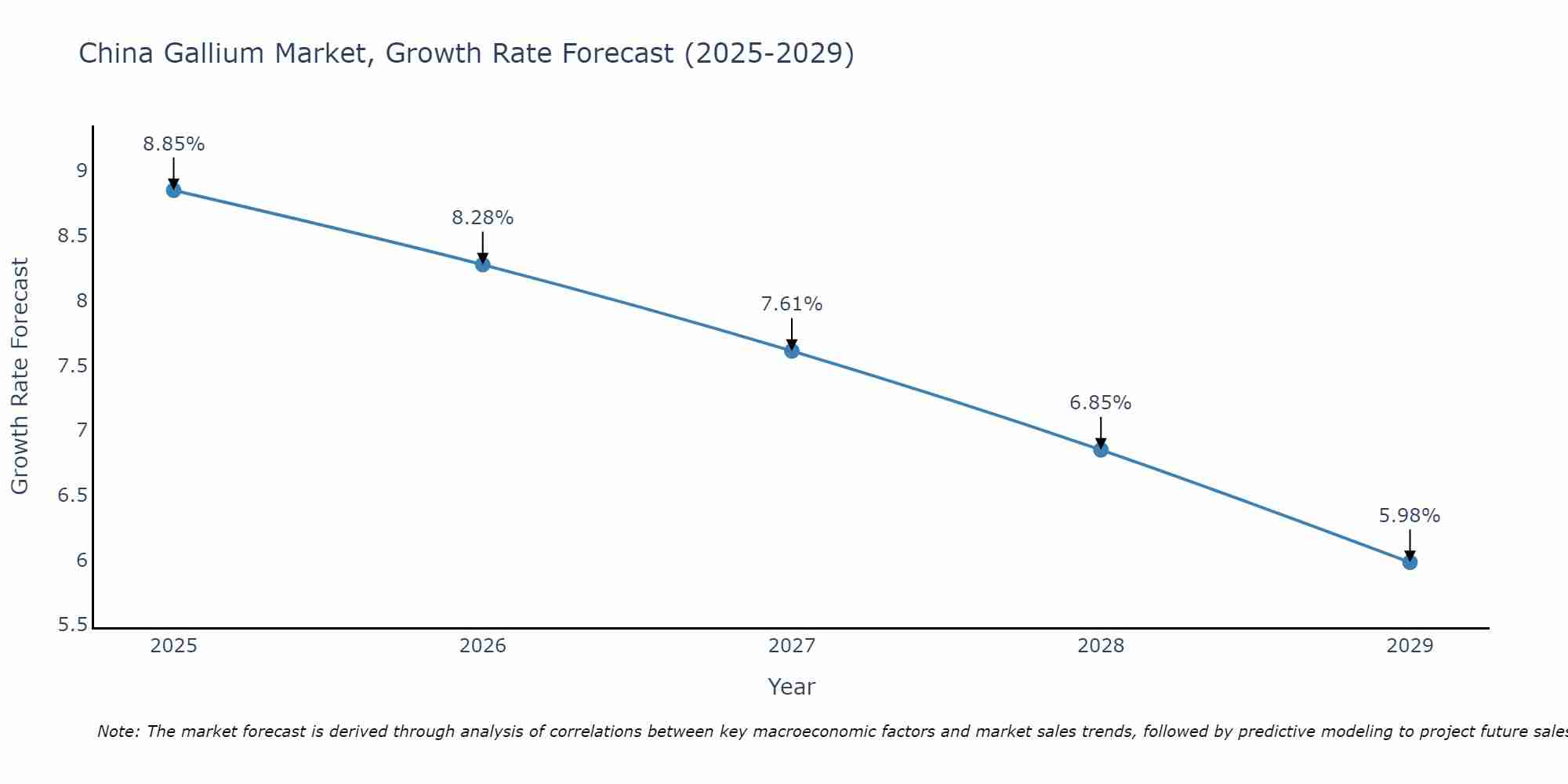
The China Gallium Market could see a tapering of growth rates over 2025 to 2029. Beginning strongly at 8.85% in 2025, growth softens to 5.98% in 2029.
China Gallium Market Overview
The China Gallium market is witnessing steady growth driven by increasing demand from the electronics and semiconductor industries. Gallium is a key component in the production of light-emitting diodes (LEDs) and photovoltaic cells, both of which are experiencing robust demand in China. The country`s focus on promoting clean energy and sustainability is further boosting the market for gallium in solar panel applications. Additionally, the expanding 5G infrastructure in China is driving demand for gallium-based semiconductors for high-frequency communications technology. However, the market faces challenges related to supply chain disruptions and fluctuating prices due to global economic uncertainties. Overall, the China Gallium market is poised for growth in the coming years, supported by technological advancements and increasing investments in the electronics and renewable energy sectors.
China Gallium Market Trends
The China Gallium market is experiencing steady growth due to the increasing demand for semiconductors and electronics in various industries such as consumer electronics, automotive, and telecommunications. The market is also benefiting from the growth of the LED industry, where gallium is a key component in the production of LED lights. Additionally, with the rise of renewable energy sources like solar power, there is a growing need for gallium in the production of solar panels. However, the market is facing challenges such as fluctuating raw material prices and supply chain disruptions. To stay competitive, market players are focusing on expanding their production capacities, investing in research and development for new applications, and forming strategic partnerships to secure a stable supply of gallium.
China Gallium Market Challenges
One of the main challenges faced in the China Gallium market is the fluctuation in global demand and supply dynamics, leading to price volatility. China is a major producer and consumer of gallium, but its market is heavily influenced by factors such as trade tensions, technological advancements, and changes in end-user industries. Additionally, environmental regulations and sustainability concerns are becoming increasingly important, impacting the production processes and supply chain of gallium. The market also faces competition from alternative materials and technologies, further complicating the demand outlook. Overall, navigating these challenges requires market players to stay informed about global trends, adapt to changing market conditions, and invest in innovation to maintain a competitive edge in the China Gallium market.
China Gallium Market Investment Opportunities
The China Gallium market presents several promising investment opportunities due to the increasing demand for gallium in the electronics and energy sectors. With China being a dominant player in the global semiconductor industry, the demand for gallium-based products such as LEDs, solar panels, and semiconductors is expected to rise. Investing in companies involved in gallium production, refining, or application development could prove lucrative. Additionally, as China aims to transition to a more sustainable energy mix, there is potential for growth in the gallium arsenide solar cell market. Monitoring technological advancements and government policies in China related to gallium usage will be crucial for identifying the most promising investment opportunities in this market.
China Gallium Market Government Policy
The Chinese government has implemented various policies to support the development of the gallium market in the country. This includes providing tax incentives and subsidies to companies involved in gallium production and research, as well as promoting domestic consumption of gallium products. Additionally, the government has set quality standards and regulations to ensure the safe and sustainable production of gallium. Furthermore, China has been actively investing in research and development initiatives to enhance the technological capabilities of the gallium industry and promote innovation. Overall, the government`s policies aim to stimulate growth in the gallium market, strengthen domestic supply chains, and establish China as a key player in the global gallium industry.
China Gallium Market Future Outlook
The future outlook for the China Gallium market appears promising, driven by the growing demand for gallium in various high-tech industries such as electronics, semiconductors, and solar panels. With China being a key player in the global electronics manufacturing sector and the rapid technological advancements in the country, the demand for gallium is expected to continue rising. Additionally, the increasing focus on renewable energy sources like solar power is likely to boost the demand for gallium in the production of photovoltaic cells. However, challenges such as fluctuating prices of raw materials and regulatory restrictions on gallium exports may impact the market growth. Overall, the China Gallium market is anticipated to witness steady growth in the coming years, supported by technological innovations and increasing applications in key industries.
Key Highlights of the Report:
- China Gallium Market Outlook
- Market Size of China Gallium Market, 2021
- Forecast of China Gallium Market, 2031
- Historical Data and Forecast of China Gallium Revenues & Volume for the Period 2018 - 2031
- China Gallium Market Trend Evolution
- China Gallium Market Drivers and Challenges
- China Gallium Price Trends
- China Gallium Porter's Five Forces
- China Gallium Industry Life Cycle
- Historical Data and Forecast of China Gallium Market Revenues & Volume By Applications for the Period 2018 - 2031
- Historical Data and Forecast of China Gallium Market Revenues & Volume By LED for the Period 2018 - 2031
- Historical Data and Forecast of China Gallium Market Revenues & Volume By Laser Diodes for the Period 2018 - 2031
- Historical Data and Forecast of China Gallium Market Revenues & Volume By Integrated Circuits for the Period 2018 - 2031
- Historical Data and Forecast of China Gallium Market Revenues & Volume By Solar Cells for the Period 2018 - 2031
- China Gallium Import Export Trade Statistics
- Market Opportunity Assessment By Applications
- China Gallium Top Companies Market Share
- China Gallium Competitive Benchmarking By Technical and Operational Parameters
- China Gallium Company Profiles
- China Gallium Key Strategic Recommendations






































