China Glycerol Market Top 5 Importing Countries and Market Competition (HHI) Analysis
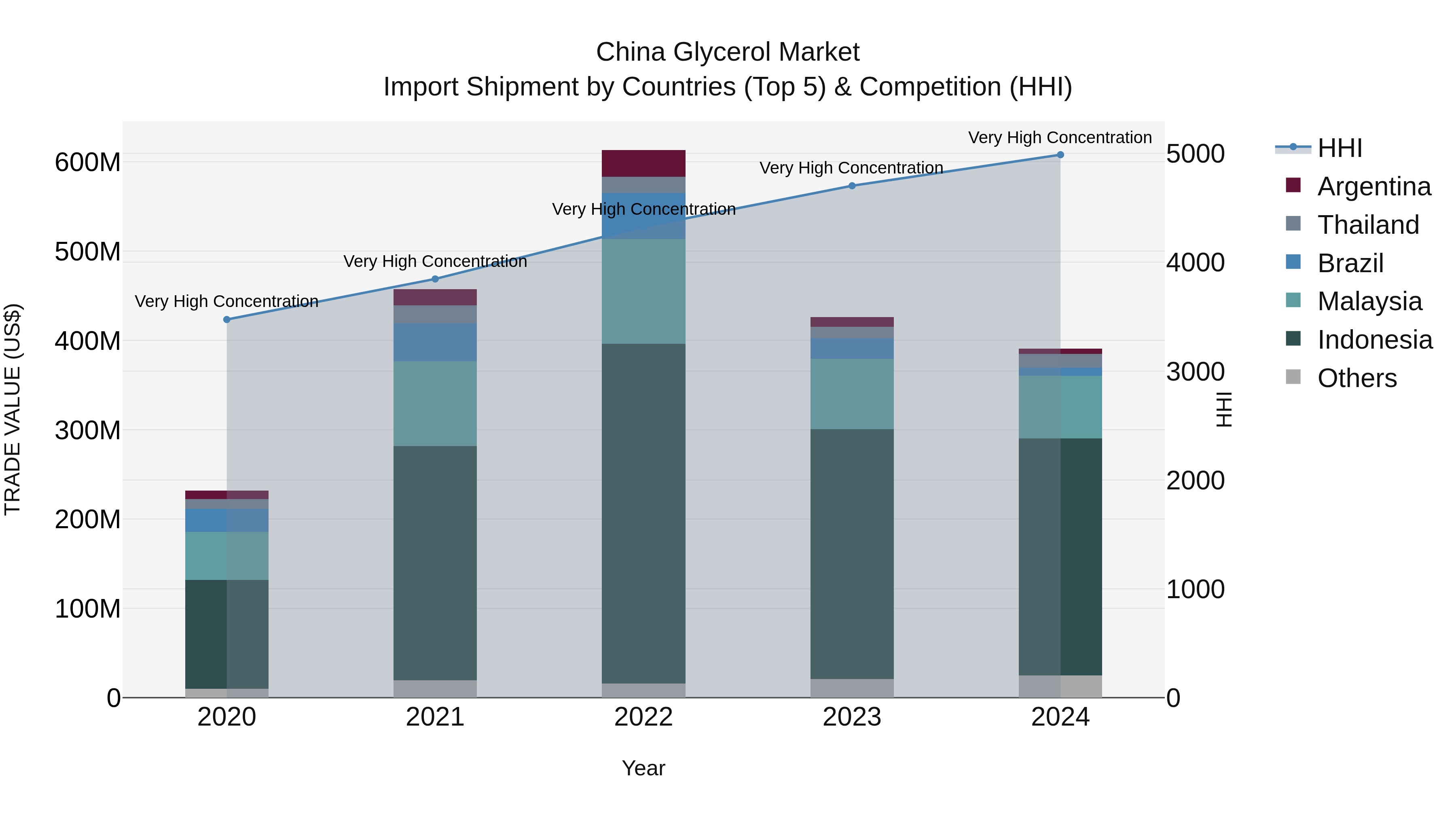
China glycerol import market in 2024 continued to be dominated by top exporting countries such as Indonesia, Malaysia, Germany, Thailand, and Brazil. The high Herfindahl-Hirschman Index (HHI) suggests a concentrated market, indicating limited competition. Despite a strong compound annual growth rate (CAGR) of 13.94% from 2020 to 2024, the growth rate saw a slight decline in 2024 with a -8.33% change from the previous year. This data highlights the importance of monitoring market dynamics and competitive landscape in the glycerol import industry in China.
China Glycerol Market Overview
The Glycerol Market in China is experiencing growth as the demand for glycerol increases in industries such as pharmaceuticals, cosmetics, and food production. Glycerol, a versatile compound with applications as a moisturizer, sweetener, and solvent, is used in a range of products including skincare, medications, and food items. The market expansion is supported by the growing awareness of glycerol`s benefits in personal care and healthcare products, the increasing use of glycerol in food and industrial applications, and advancements in production technologies that enhance product quality and efficiency.
Drivers of the market
China`s glycerol market is driven by the increasing demand for glycerol in various industries, including pharmaceuticals, personal care, and food and beverages. Glycerol is used as a humectant, solvent, and emulsifier in a wide range of products, including cosmetics, soaps, and pharmaceuticals. The growth of these industries, coupled with rising consumer awareness of natural and sustainable ingredients, supports market expansion. Additionally, advancements in production technology and the development of new applications for glycerol further drive market growth.
Challenges of the market
The China glycerol market faces several challenges, primarily driven by fluctuating raw material prices and environmental regulations. Glycerol, a byproduct of biodiesel production, is impacted by the volatility in the biodiesel sector, which can affect its supply and pricing. Additionally, stringent environmental regulations in China require manufacturers to adopt cleaner production technologies, which can increase operational costs. The market is also witnessing intense competition among domestic and international players, leading to price pressure and the need for constant innovation to maintain market share.
Government Policy of the market
The Glycerol market in China is influenced by government policies that aim to enhance chemical production and promote sustainable practices. The government`s focus on improving production efficiency and supporting the development of high-quality glycerol products drives the demand in this market. Policies that encourage the adoption of glycerol in various applications, including pharmaceuticals, personal care, and food processing, also contribute to market growth. Additionally, initiatives aimed at fostering innovation in chemical technology and supporting the growth of the chemical and food sectors further support the expansion of the glycerol market.
Key Highlights of the Report:
- China Glycerol Market Outlook
- Market Size of China Glycerol Market, 2024
- Forecast of China Glycerol Market, 2031
- Historical Data and Forecast of China Glycerol Revenues & Volume for the Period 2018 - 2031
- China Glycerol Market Trend Evolution
- China Glycerol Market Drivers and Challenges
- China Glycerol Price Trends
- China Glycerol Porter's Five Forces
- China Glycerol Industry Life Cycle
- Historical Data and Forecast of China Glycerol Market Revenues & Volume By Source for the Period 2018 - 2031
- Historical Data and Forecast of China Glycerol Market Revenues & Volume By Biodiesel for the Period 2018 - 2031
- Historical Data and Forecast of China Glycerol Market Revenues & Volume By Fatty Alcohols for the Period 2018 - 2031
- Historical Data and Forecast of China Glycerol Market Revenues & Volume By Fatty Acids for the Period 2018 - 2031
- Historical Data and Forecast of China Glycerol Market Revenues & Volume By Soap for the Period 2018 - 2031
- Historical Data and Forecast of China Glycerol Market Revenues & Volume By Type for the Period 2018 - 2031
- Historical Data and Forecast of China Glycerol Market Revenues & Volume By Crude for the Period 2018 - 2031
- Historical Data and Forecast of China Glycerol Market Revenues & Volume By Refined for the Period 2018 - 2031
- Historical Data and Forecast of China Glycerol Market Revenues & Volume By End-use for the Period 2018 - 2031
- Historical Data and Forecast of China Glycerol Market Revenues & Volume By Food & Beverage for the Period 2018 - 2031
- Historical Data and Forecast of China Glycerol Market Revenues & Volume By Pharmaceutical for the Period 2018 - 2031
- Historical Data and Forecast of China Glycerol Market Revenues & Volume By Nutraceutical for the Period 2018 - 2031
- Historical Data and Forecast of China Glycerol Market Revenues & Volume By Personal Care & Cosmetics for the Period 2018 - 2031
- Historical Data and Forecast of China Glycerol Market Revenues & Volume By Industrial for the Period 2018 - 2031
- Historical Data and Forecast of China Glycerol Market Revenues & Volume By Others for the Period 2018 - 2031
- China Glycerol Import Export Trade Statistics
- Market Opportunity Assessment By Source
- Market Opportunity Assessment By Type
- Market Opportunity Assessment By End-use
- China Glycerol Top Companies Market Share
- China Glycerol Competitive Benchmarking By Technical and Operational Parameters
- China Glycerol Company Profiles
- China Glycerol Key Strategic Recommendations






































