China Government Cloud Market Size & Growth Rate (2026-2032)
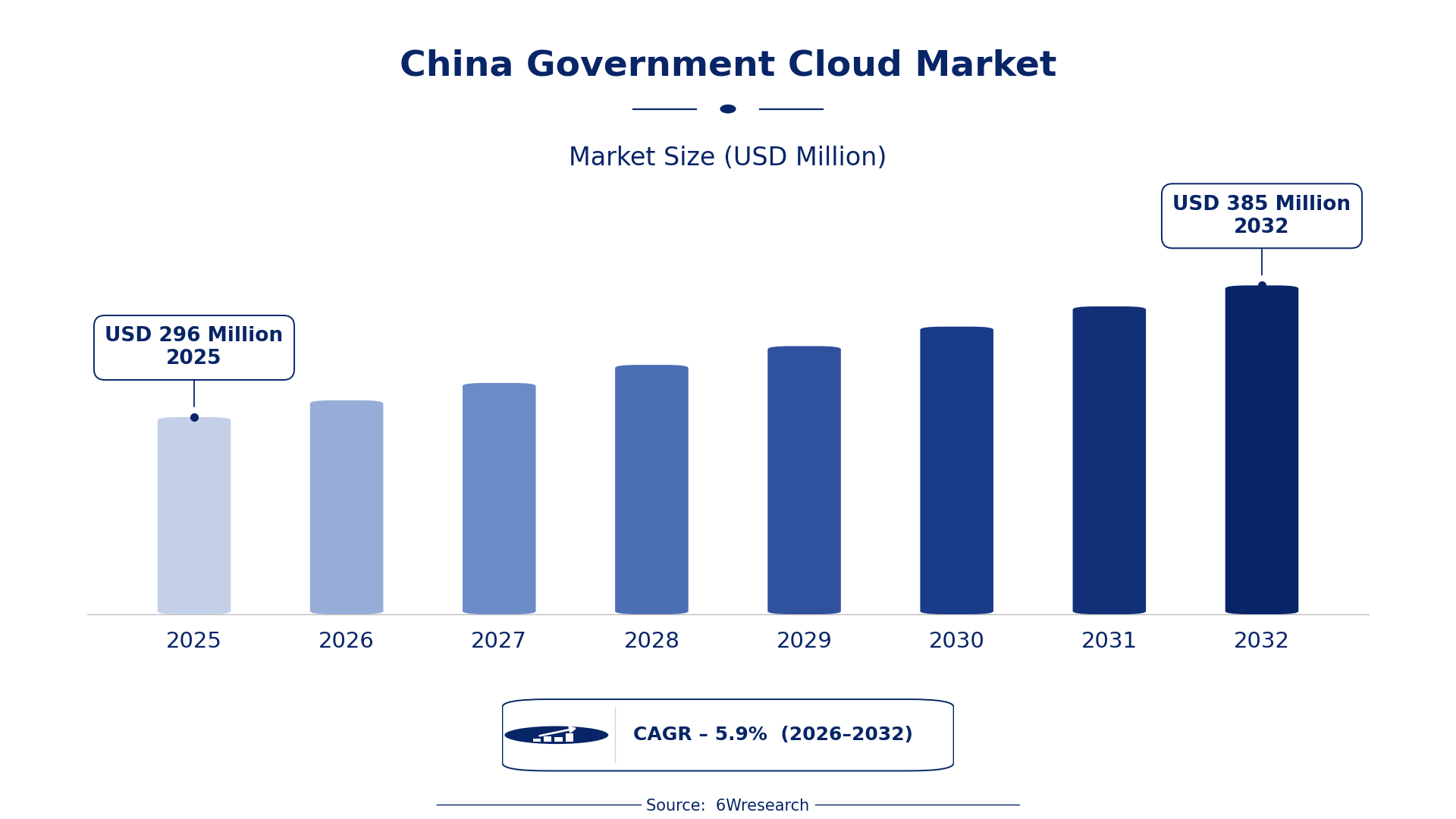
The China Government Cloud Market was estimated at USD 296 Million in 2025 and is projected to reach USD 385 Million by 2032, growing at a CAGR of 5.9% from 2026 to 2032.
China Government Cloud Market Synopsis
The China Government Cloud Market is on a trajectory of substantial growth, fueled by a robust government initiative aimed at digital transformation. As agencies transition to cloud technologies, the momentum observed in recent years is expected to accelerate, driven by the urgent need for data security and operational efficiency.
Looking ahead, the market will likely see intensified competition among domestic and international cloud service providers. With the government’s commitment to enhancing data sovereignty and compliance, the focus will shift to developing tailored solutions that meet the specific needs of various public sector entities.
China Government Cloud Market Year-wise Growth Rate and Key Drivers
This graph illustrates the annual growth rates of the China Government Cloud Market from 2021 to 2032, highlighting a steady upward trajectory and projected expansion over the forecast period.
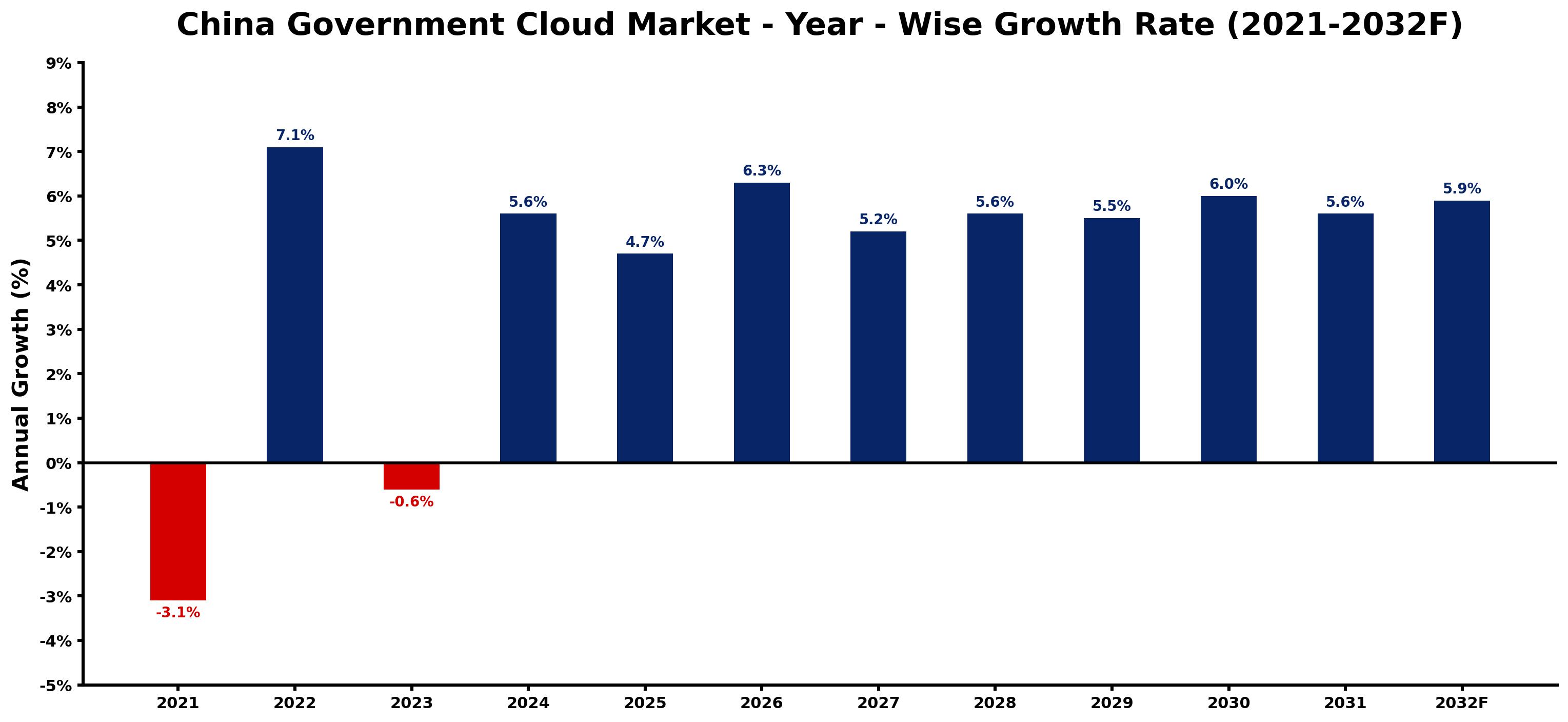
The table below presents the year‑wise growth rates along with the key drivers influencing the market
| Year | Growth Rate | Major Drivers |
| 2021 | -3.1% | Government's focus on domestic cloud providers stifling competition |
| 2022 | 7.1% | National Data Management Regulations fostering cloud adoption. |
| 2023 | -0.6% | Delays in Cloud Service Standards implementation by MIIT |
| 2024 | 5.6% | Government initiatives for digital transformation in public sectors. |
| 2025 | 4.7% | Increased spending on e-governance systems by municipalities. |
| 2026 | 6.3% | Focus on cybersecurity compliance driving cloud solutions demand. |
| 2027 | 5.2% | Growth in artificial intelligence applications in governmental processes. |
| 2028 | 5.6% | National Cloud Computing Innovation and Development Plan supports growth. |
| 2029 | 5.5% | Rise in demand for data sovereignty in government operations. |
| 2030 | 6.0% | Investment in smart city projects requiring robust cloud infrastructure. |
| 2031 | 5.6% | Boost from inter-agency collaboration on data sharing platforms. |
| 2032 | 5.9% | Strengthening of public services for enhanced government transparency. |
Note: Market size estimations and growth projections presented in this report are based on 6Wresearch's proprietary forecasting methodology, utilizing the latest available industry data, government publications, and primary research inputs.
China Government Cloud Market Key Takeaways
Below are some of the specific key takeaways from the market, including:
- The government's digital transformation agenda drives increasing cloud adoption across various agencies.
- Security and compliance are paramount, influencing the demand for specialized cloud solutions.
- Partnerships between cloud providers and government entities are becoming common to create tailored services.
- Hybrid cloud models are gaining traction as agencies seek flexibility and efficiency.
- The market is expected to grow steadily as public agencies modernize their IT infrastructures.
Evaluation of Restraints in China Government Cloud Market
Despite positive growth signals, several factors are constraining the China Government Cloud Market. Data security concerns stemming from stringent government regulations create apprehension among potential adopters. The competitive landscape is another hurdle, with numerous players vying for contracts in a market where familiarity with governmental processes is crucial. Additionally, the complexity of procurement procedures often results in delays, hampering the swift integration of cloud technologies into public sector operations. Addressing these restraints is essential for cloud service providers aiming to penetrate this market effectively.
China Government Cloud Market Trends
Several trends are shaping the China Government Cloud Market. The demand for cloud-based solutions that enhance operational efficiency is at an all-time high, driven by the government’s push for digital services. on top of that, increasing emphasis on data privacy regulations is steering providers towards more secure cloud offerings. The shift towards hybrid cloud solutions is notable, as agencies seek to balance the advantages of public and private clouds while addressing legacy system integration challenges. This trend is reflective of a broader movement towards customized cloud services that align with governmental objectives.
China Government Cloud Market Opportunities
The China Government Cloud Market presents a myriad of growth opportunities for savvy providers. There is a clear demand for customized cloud services that cater to the specific needs of different government functions, particularly in areas like data encryption and compliance solutions. Collaborating with local cloud providers to navigate the complex regulatory environment can yield significant advantages. Additionally, as the government invests heavily in cloud infrastructure, vendors have the chance to capitalize on innovative solutions that enhance public service delivery.
Government Initiatives in the China Government Cloud Market
Government policy is a significant force shaping the China Government Cloud Market. The Chinese government has been proactive in promoting cloud adoption among public agencies, with a focus on data security and regulatory compliance. Recent initiatives emphasize the importance of integrating cloud technology into public services to enhance efficiency and effectiveness.
- A national digital infrastructure upgrade programme launched in 2023 aims to enhance cloud capabilities within government agencies.
- The Government Cloud Strategic Development Plan is currently underway, emphasizing secure cloud solutions for public sector entities.
- New regulations regarding data classification and cross-border data transfers are being developed, anticipated to roll out by 2026.
- A public-private partnership initiative focused on developing cloud services for smart city projects is scheduled to begin in 2025.
- Ongoing collaborations with domestic cloud providers are expected to foster innovation and compliance solutions tailored to governmental needs.
Future Insights of the China Government Cloud Market
The outlook for the China Government Cloud Market from 2026 to 2032 is encouraging. With increasing investments in cloud infrastructure and services, the market is set for steady expansion. The push for 'Government Cloud 2.0' will likely accelerate cloud adoption, particularly as agencies prioritize data sovereignty and cybersecurity measures. As public sector entities modernize their IT frameworks, the demand for secure, compliant cloud solutions will continue to rise, presenting ample opportunities for innovative service providers.
China Government Cloud Market Latest Developments
In the past year, the China Government Cloud Market has seen a surge in activity, reflecting the government's commitment to digital transformation. Various initiatives have emerged, enhancing the infrastructure and capabilities of cloud services within the public sector.
- A major technology vendor launched an advanced data encryption service aimed at government agencies in early 2025, enhancing data security measures.
- An initiative that began in mid-2025 is currently underway, focusing on integrating cloud solutions with existing legacy systems in various ministries.
- A rollout expected to begin in late 2026 will introduce a new regulatory framework mandating increased transparency in cloud service procurement.
- A partnership formed in Q3 2025 between regional operators and government entities aims to expand cloud access across underserved areas.
- A planned digital infrastructure project expected to launch in early 2026 will enhance the capabilities of cloud services available to local governments.
China Government Cloud Market - Key Attractiveness of the Report
- 10 Years of Market Numbers
- Historical Data Starting from 2022 to 2025
- Base Year: 2025
- Forecast Data until 2032
- Key Performance Indicators Impacting the Market
- Major Upcoming Developments and Projects
Key Highlights of the Report:
- China Government Cloud Market Outlook
- Market Size of China Government Cloud Market, 2025
- Forecast of China Government Cloud Market, 2032
- Historical Data and Forecast of China Government Cloud Revenues & Volume for the Period 2022-2032F
- China Government Cloud Market Trend Evolution
- China Government Cloud Market Drivers and Challenges
- China Government Cloud Price Trends
- China Government Cloud Porter's Five Forces
- China Government Cloud Industry Life Cycle
- Historical Data and Forecast of China Government Cloud Market Revenues & Volume By Solutions for the Period 2022-2032F
- Historical Data and Forecast of China Government Cloud Market Revenues & Volume By Cloud Storage for the Period 2022-2032F
- Historical Data and Forecast of China Government Cloud Market Revenues & Volume By Disaster Recovery for the Period 2022-2032F
- Historical Data and Forecast of China Government Cloud Market Revenues & Volume By Identity and Access Management (IAM) for the Period 2022-2032F
- Historical Data and Forecast of China Government Cloud Market Revenues & Volume By Risk and compliance management for the Period 2022-2032F
- Historical Data and Forecast of China Government Cloud Market Revenues & Volume By Others (reporting and analytics, and security and vulnerability) for the Period 2022-2032F
- Historical Data and Forecast of China Government Cloud Market Revenues & Volume By Services for the Period 2022-2032F
- Historical Data and Forecast of China Government Cloud Market Revenues & Volume By Training, consulting, and education for the Period 2022-2032F
- Historical Data and Forecast of China Government Cloud Market Revenues & Volume By Support and Maintenance for the Period 2022-2032F
- Historical Data and Forecast of China Government Cloud Market Revenues & Volume By Integration and Migration for the Period 2022-2032F
- Historical Data and Forecast of China Government Cloud Market Revenues & Volume By Service Model for the Period 2022-2032F
- Historical Data and Forecast of China Government Cloud Market Revenues & Volume By Infrastructure as a Service (IaaS) for the Period 2022-2032F
- Historical Data and Forecast of China Government Cloud Market Revenues & Volume By Platform as a Service (PaaS) for the Period 2022-2032F
- Historical Data and Forecast of China Government Cloud Market Revenues & Volume By Software as a Service (SaaS) for the Period 2022-2032F
- Historical Data and Forecast of China Government Cloud Market Revenues & Volume By Deployment Model for the Period 2022-2032F
- Historical Data and Forecast of China Government Cloud Market Revenues & Volume By Public Cloud for the Period 2022-2032F
- Historical Data and Forecast of China Government Cloud Market Revenues & Volume By Private Cloud for the Period 2022-2032F
- Historical Data and Forecast of China Government Cloud Market Revenues & Volume By Hybrid Cloud for the Period 2022-2032F
- China Government Cloud Import Export Trade Statistics
- Market Opportunity Assessment By Solutions
- Market Opportunity Assessment By Services
- Market Opportunity Assessment By Service Model
- Market Opportunity Assessment By Deployment Model
- China Government Cloud Top Companies Market Share
- China Government Cloud Competitive Benchmarking By Technical and Operational Parameters
- China Government Cloud Company Profiles
- China Government Cloud Key Strategic Recommendations






































